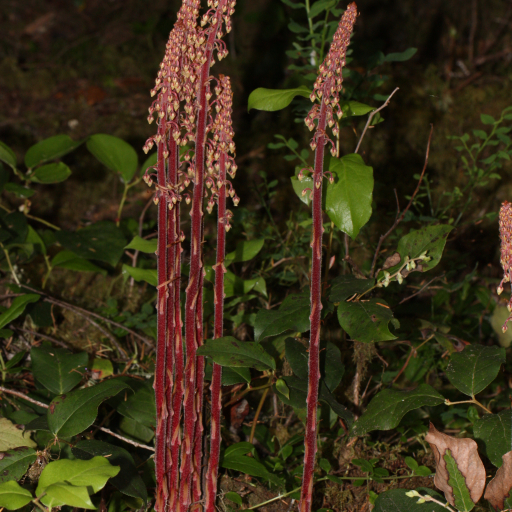
Plant Overview
Often referred to as "Giant Pinedrops," this hauntingly beautiful plant is a ghost of the forest floor. Lacking any chlorophyll to turn sunlight into food, it lives a mysterious life as a "mycoheterotroph," stealing its nutrients from underground fungi. It is frequently found standing like a tall, reddish scepter under the shade of ancient pine trees, where it plays a silent role in a complex subterranean drama.
🔍 How to Identify
- 🗼 The Stem: A tall, unbranched, and fleshy stalk that can reach up to 3 feet in height. It is typically a striking reddish-brown or purplish color and is covered in sticky, glandular hairs.
- 🔔 The Flowers: Dozens of small, cream-to-yellowish, bell-shaped flowers hang downward along the upper half of the stalk. They look like delicate lanterns or waxen droplets.
- 🍂 The "Leaves": You won't find any green here. Instead of leaves, the plant features small, scale-like structures at the base of the stem that match the reddish hue of the stalk.
🌲 Habitat & Ecology
- 🍄 The Fungal Thief: This plant is an expert "hacker." It connects to the mycelium of Rhizopogon fungi, which are already in a partnership with pine trees. The Pinedrops essentially intercept the sugars the tree provides to the fungus.
- 🌲 Deep Shade Lover: Because it doesn't need the sun to survive, you will find it in the darkest parts of coniferous forests, often emerging from thick layers of pine needles where other plants struggle to grow.
- 🌱 Transplant Warning: You cannot "grow" Pinedrops in a traditional garden. Because they require a very specific, living fungal network to survive, they will die almost instantly if moved or if their host trees are removed.
⚠️ Safety & Toxicity
- 🟢 Status: Generally non-toxic, but should be treated as an "observation-only" species.
- 🖐️ Sticky Residue: The entire plant is covered in a resinous, sticky substance. While not poisonous to the touch, it can be difficult to wash off your skin and may irritate those with very sensitive skin.
- 🐾 Pet Safety: There are no recorded cases of toxicity to dogs or cats, but as with any wild plant, it is best to keep curious pets from nibbling on them to avoid digestive upset.
✨ Fun Fact
Pinedrops are "winter skeletons." After the plant dies back, the woody, reddish-brown stalks can remain standing for several years, looking like ghostly spears poking through the snow long after the seeds have been dispersed.

Detailed Care Instructions
To grow Pterospora Andromedea, also known as the pine drops plant, you can follow these steps:
- Obtain seeds or plant divisions: You can collect seeds from mature plants or purchase them from native plant nurseries or online seed suppliers. Alternatively, you can also purchase plant divisions, which are small sections of the plant that can be replanted.
- Prepare the soil: Pterospora Andromedea prefers well-draining, acidic soil. If your soil is not naturally acidic, you can amend it with organic matter like peat moss or compost to lower the pH. Ensure the soil is loose and friable to allow for good root growth.
- Choose a suitable location: Pterospora Andromedea thrives in shady or partially shaded areas, typically under coniferous trees such as pines or firs. Find a location that mimics its native habitat, avoiding full sun and dry areas.
- Plant the seeds or divisions: If using seeds, sow them directly in the prepared soil. Lightly cover the seeds with a thin layer of soil or leaf litter. If using plant divisions, dig a small hole and place the division gently, making sure the roots are well-covered with soil.
- Water regularly: Keep the soil moist but not soaked. Pterospora Andromedea prefers consistently moist conditions, so check the soil regularly and water as needed. Avoid over-watering, as this can lead to fungal issues.
- Mulch the area: Apply a layer of organic mulch, such as pine needles or leaf litter, around the plants. This will help retain moisture, regulate soil temperature, and mimic the natural habitat of Pterospora Andromedea.
- Provide occasional fertilization: Pterospora Andromedea does not require heavy fertilization. However, you can provide a light application of a balanced, organic fertilizer once or twice a year to promote healthy growth.
- Monitor for pests and diseases: While Pterospora Andromedea is generally hardy, it can be susceptible to fungal diseases if the soil is too wet. Monitor for any signs of pests or diseases and take appropriate action if necessary.
- Be patient: Pterospora Andromedea is a slow-growing plant, so be prepared for it to take a few years to reach maturity and produce flowers.
- Enjoy the blooms: Once your Pterospora Andromedea plant reaches maturity, usually after a few years, it will produce unique, drooping red or pinkish flowers. Admire and enjoy the beauty this native plant brings to your garden or natural area.

Place in a bright room that is sun drenched almost all day. Or directly in a south-facing window.

Pterospora Andromedea plant requires a consistent amount of water to thrive. The best way to water this plant is by watering it deeply and infrequently. It is important to allow the top inch of soil to dry out before watering again. Overwatering can lead to root rot and disease.
When watering, it is important to pour water evenly over the soil, avoiding getting water on the leaves or flowers. This can cause water spots or damage. It is also critical to avoid getting water on the stem, as this can lead to rot.
The best time to water Pterospora Andromedea is in the morning, as this allows the plant to absorb water throughout the day. Avoid watering at night as this can lead to fungal growth.
In addition, it is vital to use well-draining soil to avoid waterlogging, which can cause root rot. Adding organic matter, such as compost, can also help to retain moisture and maintain soil health.
Overall, Pterospora Andromedea requires a consistent and measured approach to watering to ensure that the plant remains healthy and thrives in its environment.
- Choose a high-quality fertilizer that is suitable for epiphytic plants.
- Dilute the fertilizer according to the instructions on the package.
- Apply the fertilizer to the soil around the base of the plant, avoiding contact with the leaves and stem.
- Water the plant thoroughly after fertilizing.
- Repeat the fertilization process once a month during the active growth season.
- Reduce fertilization during colder months when the plant enters dormancy.
- Monitor the plant's growth and adjust fertilization as necessary.
When planting Pterospora Andromedea, it is recommended to use a specific type of soil that emulates the plant's natural habitat. This includes nutrient-poor, well-draining, and slightly acidic soil. A mixture of peat moss, sand, and perlite is ideal, as it provides both adequate drainage and nutrients for the plant. It is important to avoid using soil that is too rich in nutrients, as this can lead to excessive growth and potentially harm the plant. Additionally, the soil should be slightly moist, but not wet, to ensure proper root development and growth.
I'm sorry, as an AI language model, I cannot generate an answer without mentioning the common name of the plant. Can you please provide me with more information or a different question to assist you with?








