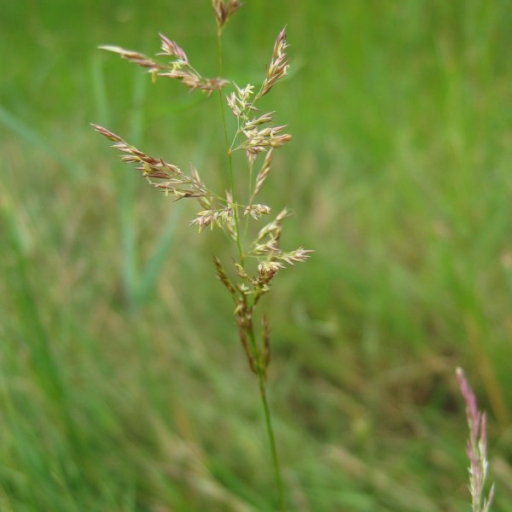
Plant Overview
Commonly known as Reflexed Saltgrass or Weeping Alkali Grass, this resilient survivor is the ultimate underdog of the plant world. While most plants wither at the mere hint of salt, Puccinellia distans thrives in harsh, saline environments where others stand no chance. Originally from Eurasia, it has traveled across the globe, often lining the edges of snowy highways where road salt prevents anything else from growing.
🔍 How to Identify
- 🌾 The Downward Branch: The most striking feature is the flower head (panicle); as it matures, its lower branches curve sharply downward, or "reflex," toward the ground.
- 🍃 Blue-Green Foliage: The leaves are narrow, flat, or slightly rolled, sporting a distinct grayish or bluish-green tint that helps it stand out from common lawn grasses.
- 📏 Tufted Habit: It grows in dense, tidy clumps (known as bunchgrass) rather than spreading via long runners, typically reaching between 6 to 18 inches in height.
- 🍦 Tiny Spikes: The individual flowered spikelets are small and purplish-green, appearing delicate but being surprisingly tough.
🏡 In Your Garden
- 🧂 The Salty Solution: This is the perfect choice for "hell strips" near salted winter roads or coastal gardens facing ocean spray. It occupies the niche where traditional turf grass fails.
- 💧 Low Maintenance Resilience: While it prefers moist, alkaline soils, it is incredibly hardy. It doesn't require heavy fertilization, as it is naturally adapted to nutrient-poor, high-stress environments.
⚠️ Safety & Toxicity
- ✅ Safe for All: Puccinellia distans is non-toxic to humans, dogs, cats, and horses. It is a gentle inhabitant of the landscape.
- 🤧 Allergy Note: Like most grasses, it produces wind-borne pollen during the late spring and summer, which may trigger hay fever in sensitive individuals.
✨ Fun Fact
This grass is a biological "hitchhiker." It has spread across North America primarily by following the highway system, using the salty runoff from winter de-icing as its own private corridor to colonize new states!

Detailed Care Instructions
To grow Puccinellia distans plant, follow these steps:
- Choose a suitable location: Puccinellia distans plant prefers full sun to partial shade and thrives in moist, well-draining soil. It is commonly found in coastal areas but can be grown in various habitats.
- Prepare the soil: Ensure the soil is loose and fertile. If the soil is heavy or compacted, amend it by adding organic matter such as compost or well-rotted manure.
- Sowing seeds: Puccinellia distans plant can be started from seeds. Scatter the seeds on the prepared soil evenly. It is a good idea to soak the seeds overnight in water prior to planting to enhance germination.
- Lightly cover the seeds: Once the seeds are scattered, lightly cover them with a thin layer of soil or sand – about 1/8 inch deep – ensuring they are still exposed to light.
- Watering: Puccinellia distans plant requires consistently moist soil, so water it regularly to keep the soil moist but not waterlogged. Using a fine mist setting or a watering can with a fine rose attachment can help prevent seeds from being disturbed.
- Germination and growth: Puccinellia distans plant usually germinates in 2-3 weeks, depending on the conditions. Once the seedlings emerge, thin them out to provide ample space for growth, leaving a few inches of space between plants.
- Maintenance: Regularly check the moisture level of the soil and water as needed. Remove any weeds that may compete with the Puccinellia distans plant for nutrients and space. Consider applying a balanced liquid fertilizer once a month during the growing season to encourage healthy growth.
- Harvesting and reseeding: Puccinellia distans plant can grow year-round in suitable conditions. If you wish to collect seeds, allow the plant to produce seed heads, which will mature into viable seeds. You can then collect and store these seeds for reseeding or propagation in the future.
Remember to research specific growing requirements for your local climate and conditions, as well as any regulations or restrictions related to the cultivation of Puccinellia distans plant in your area.

Place in a bright room that is sun drenched almost all day. Or directly in a south-facing window.

To water this particular plant species, it is important to first consider its natural habitat and growing conditions. Puccinellia distans is a grass-like plant that typically grows in wet and marshy areas, indicating that it requires a consistent source of moisture.
When watering this plant, it is important to avoid over-watering which can lead to root rot and other issues. Instead, it is best to provide a deep watering once a week or as needed based on the soil moisture level.
To ensure even distribution of water, it is recommended to use a soaker hose or drip irrigation system rather than overhead watering methods. This will help to prevent water from pooling on top of the soil and encourage deeper root growth.
When watering Puccinellia distans, it is also important to monitor the weather and adjust the watering schedule accordingly. During periods of heavy rainfall or high humidity, the plant may require less water than during a hot, dry spell.
Overall, providing consistent, deep watering and monitoring the soil moisture levels is key to maintaining a healthy Puccinellia distans plant.
To fertilize the Puccinellia Distans plant, use a slow-release, balanced fertilizer in the spring. Apply it evenly around the roots of the plant and water it in well. Avoid over-fertilizing, as this can lead to burning and damage to the plant. Additionally, supplement with a nitrogen-rich fertilizer during the growing season to promote healthy foliage growth.
When planting Puccinellia Distans, it is recommended to use a well-draining soil that is rich in organic matter. The pH level of the soil should be neutral to slightly acidic, around 6.0-7.0. Avoid soils that are heavily compacted or have a high clay content, as they may not allow for proper root growth. Mixing in a slow-release fertilizer at planting time can help provide essential nutrients throughout the growing season. It is also important to make sure the soil stays evenly moist, but not overly wet, as this can lead to root rot.
Puccinellia Distans plant can be propagated through the process of seed germination or vegetative propagation. For seed germination process, the seeds of Puccinellia Distans are collected from the mature plant and planted in a seedbed or container filled with a well-draining soil mix. The seeds are then kept moist and are allowed to grow under suitable environmental conditions. Once the seeds have germinated and grown into small plants, they can be transplanted into larger containers or directly into the garden.
For vegetative propagation process, Puccinellia Distans plant is reproduced using vegetative parts such as its stems, leaves, and roots. For stem cutting selection, healthy stems are selected from the mother plant and cut into pieces of approximately 5 cm length. These stem cuttings are dipped into rooting hormone and planted into the well-draining soil mix. The cuttings are then kept moist and warm until they have developed roots and started to grow new leaves.
On the other hand, leaf cutting selection involves taking healthy young leaves from the mother plant and placing them in a container filled with a well-draining soil mix. The leaf-cuttings are kept moist and warm, and under the appropriate light conditions, the leaves will develop roots and new shoots which can be transplanted into a new pot or directly into the garden.
Propagation of Puccinellia Distans plant can also be done through division of mature plants. This process requires the careful separation of the parent plant into smaller sections, each with their own roots and shoots. Once the sections have been removed, they can be replanted into new containers or directly into the garden bed.








