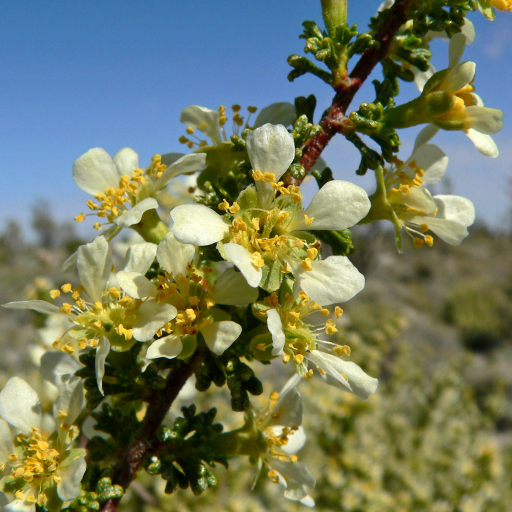
Plant Overview
Often called the Mojave Bitterbrush, this rugged evergreen shrub is a master of survival in the arid landscapes of the American Southwest. It serves as a vital bridge for wildlife, providing high-protein forage during harsh winters when other plants have withered away. Its name comes from the tiny, sticky glands that dot its stems and leaves, giving it a unique resinous texture and a resilient character.
🔍 How to Identify
- 🍃 Lobed Leaves: Look for small, leathery, wedge-shaped leaves that are usually divided into three distinct lobes at the tip. They are a deep olive green and often have tucked-under edges to conserve moisture.
- 🌼 Rose-like Blooms: In late spring, the shrub is covered in small, pale yellow to creamy white flowers. Each flower has five petals, revealing its botanical connection to the rose family.
- 🪵 Gnarled Form: It grows as an intricately branched, woody shrub. With age, the stems can become beautifully twisted and dark, reaching anywhere from 3 to 10 feet in height.
🏡 In Your Garden
- 🏜️ Drainage is Key: This plant is a "desert specialist." It thrives in sandy, rocky, or gravelly soil and will quickly succumb to root rot if forced to sit in heavy, wet clay or over-mulched beds.
- 🧬 Soil Builder: It possesses a remarkable ability to "fix" nitrogen through a symbiotic relationship with soil bacteria. This means it actually improves the quality of the soil it grows in, making it a great "pioneer" plant for restoration projects.
- ⚓ The Taproot Factor: Like many desert survivors, it develops a deep taproot very quickly. Because of this, it hates being moved; it is best to plant it from a small nursery container directly into its "forever home" to avoid transplant shock.
⚠️ Safety & Toxicity
- ✅ Status: Generally non-toxic and safe for humans and pets.
- 👅 Bitter Defense: While not poisonous, the leaves contain bitter tannins. This "bitter" trait is a natural defense mechanism—it tastes unpleasant to most, though it remains a favorite "survival food" for wild deer and bighorn sheep.
- 🧤 Skin Texture: The resinous glands can feel slightly sticky or tacky to the touch, but they do not typically cause skin irritation.
✨ Fun Fact
Despite its scraggly desert appearance, the Desert Bitterbrush is a member of the Rosaceae (Rose) family. If you look closely at its blossoms, you are essentially looking at a tiny, drought-hardy wild rose that has traded soft petals for desert armor!

Detailed Care Instructions
To grow Purshia glandulosa, also known as desert bitterbrush or desert peach, follow these steps:
- Select an appropriate location: Desert bitterbrush requires well-drained soil and plenty of sunlight. Choose a spot in your garden that receives full sun for at least six hours a day.
- Prepare the soil: This plant prefers sandy or loamy soil. Improve the drainage of heavy clay soils by adding organic matter like compost or sand. Avoid excessive fertilization as desert bitterbrush prefers low-nutrient soils.
- Start from seeds or seedlings: You can either purchase seeds or seedlings from local nurseries or collect seeds from mature plants. If starting from seeds, plant them in early spring or fall. Soak the seeds in warm water for 24 hours before planting. Sow them at a depth of 1/4 inch in the prepared soil.
- Watering: Desert bitterbrush is quite drought-tolerant but needs regular watering during the establishment phase. After that, it can rely on natural rainfall. Water deeply, once a week, to encourage root development and ensure the water penetrates the soil deeply. Reduce watering during the winter months.
- Mulching: Apply a layer of organic mulch around the plant to help retain moisture and suppress weed growth. Keep the mulch away from the base of the plant to prevent rot.
- Pruning: Desert bitterbrush requires minimal pruning. Remove any dead or damaged branches to maintain a healthy appearance. You can also shape the plant, if desired, by selectively trimming branches.
- Pest and disease control: Desert bitterbrush is generally resistant to pests and diseases. However, keep an eye out for any signs of damage or infestations. If necessary, use insecticidal soaps or horticultural oils to treat pests.
- Wildlife benefits: Purshia glandulosa is an important plant for wildlife. It provides food and habitat for insects, birds, and mammals. Consider its ecological value while creating or maintaining the habitat.
Remember, desert bitterbrush is a native plant in certain regions. Ensure it is permitted to grow in your specific area and adhere to any local regulations or guidelines regarding plant species.

To provide adequate moisture to the plant without causing waterlogging that could lead to root rot or other fungal diseases, water the Purshia Glandulosa plant regularly during the growing season. Assess the soil moisture level by inserting a finger into the soil up to the first knuckle. If the soil feels dry, water the plant thoroughly.
Water the plant slowly, allowing the soil to absorb the water without runoff. Avoid splashing water on the foliage to prevent scorching or spreading diseases. Use a watering can, a hose fitted with a gentle spray nozzle, or a drip irrigation system to water the plant.
Reduce watering during the dormant season to prevent the soil from getting too wet, which could damage the roots. During this time, the plant is less active, and its water uptake slows down.
Monitor the plant for signs of overwatering, such as yellowing or drooping foliage, or fungal growth. Reduce watering frequency or improve drainage if these symptoms occur. Overall, aim to maintain even soil moisture, neither too dry nor too wet, to keep the Purshia Glandulosa plant healthy and thriving.
To fertilize Purshia Glandulosa, use a slow-release granular fertilizer with a balanced N-P-K ratio, such as 10-10-10 or 15-15-15. Apply the fertilizer in the early spring before new growth emerges, and again in the late summer or early fall. Follow the package instructions for the appropriate amount to use based on the size of the plant. Avoid over-fertilizing, as this can lead to excessive growth and poor plant health. Water thoroughly after fertilizing to help distribute the nutrients throughout the soil.
Purshia glandulosa prefers a well-drained soil with a neutral to slightly alkaline pH, typically between 6 to 8.5. The soil should be rich in organic matter and porous to allow for good root development and proper drainage. A sandy loam with good drainage is ideal for this plant. It can tolerate a range of soil textures, but heavy clay soils should be avoided. Additionally, soil fertility should be moderate to low, as high fertilizer inputs can negatively affect Purshia glandulosa's growth and health. Overall, the soil should provide adequate water and nutrient availability while promoting good root growth and plant vigor.
Purshia glandulosa can be propagated through cutting or seed propagation.
- Cutting propagation:
- Select a healthy stem without signs of disease or damage.
- Cut a 4-6 inch long stem from the mother plant using a sharp and sterile knife.
- Strip off the leaves from the bottom 2/3 of the stem.
- Dip the cut end of the stem in rooting hormone to encourage root growth.
- Plant the cutting in a well-draining potting mix that is moistened beforehand and keep it in a warm and bright spot out of direct sunlight.
- Mist the cutting regularly to keep it humid and do not let the soil dry out.
- After 4-6 weeks, check for roots by gently tugging on the stem. If there is resistance, roots have formed and the new plant can be transplanted.
- Seed propagation:
- Collect seed pods from a mature plant in the fall when they have turned brown or gray and begin to split open.
- Remove the seeds from the pods and soak them overnight in a container of water that is at room temperature.
- Plant the seeds in a well-draining potting mix that is moistened beforehand.
- Cover the seeds lightly with soil, just enough to cover them.
- Keep the soil warm (around 70-75°F) and moist by covering the container with plastic wrap or a clear lid.
- After 2-4 weeks, the seeds should germinate and seedlings will emerge. Thin out the weaker seedlings to give the stronger ones room to grow.
- Once the seedlings have developed their second set of true leaves, they can be transplanted into individual pots or into the ground.








