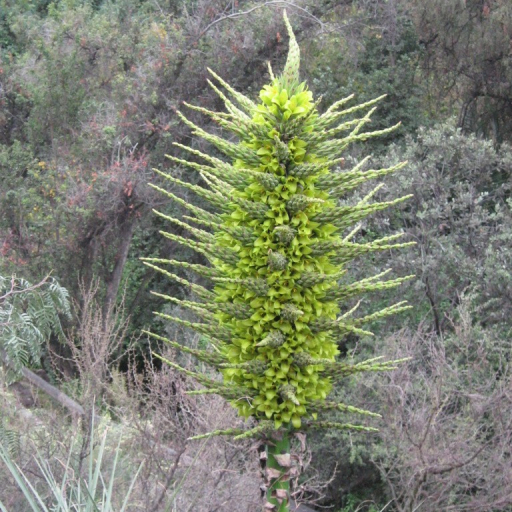
Plant Overview
Known as the "Sheep-Eating Plant," Puya chilensis is a titan of the botanical world. Native to the arid hillsides of central Chile, this terrestrial bromeliad looks like something from the prehistoric era, forming massive, silvery rosettes that can take over a decade to produce their first bloom. It is famous—and feared—for its formidable physical defenses and its strange, legendary diet.
🔍 How to Identify
- 🍃 Sword-like Foliage: The plant grows in dense, sprawling rosettes of narrow, silvery-green leaves that can reach over three feet in length.
- ⚔️ Hooked Spines: The leaf margins are lined with incredibly sharp, yellow, inward-curving teeth. These hooks are designed to grab and hold onto anything that brushes against them.
- 🗼 Towering Inflorescence: When it finally blooms, it sends up a massive, woody flower spike that can reach 10 feet (3 meters) in height, topped with clusters of waxy flowers.
- 🦜 Neon Blooms: The flowers are a stunning, otherworldly shade of chartreuse or bright lime-yellow, filled with thick, sweet nectar.
🏡 In Your Garden
- 🏜️ Strategic Placement: Because of its size and dangerous spines, this plant should never be placed near a walkway or path. It is an "architectural" plant, best used as a focal point in a large rock garden or a xeriscape where it has plenty of room to expand.
- ☀️ Drainage is Key: Coming from the Chilean matorral, it thrives in poor, rocky soil and full sun. It is extremely drought-tolerant but is sensitive to "wet feet"; ensure your soil drains rapidly to prevent root rot during rainy seasons.
⚠️ Safety & Toxicity
- ⚔️ Physical Danger: This is one of the most physically hazardous plants for a home garden. The spines are sharp enough to puncture skin and "lock" onto clothing or fur.
- 🐾 The "Sheep-Eater" Myth: Its nickname comes from reports of sheep and birds getting their wool or feathers caught in the hooks. Unable to escape, the animals perish, and as they decompose, they provide a nutrient-rich "fertilizer" for the plant’s roots. Keep pets and small children far away from this plant.
✨ Fun Fact
The massive flower spikes have unique, horizontal "perches" built into them. These are sturdy, leafless branches designed specifically for heavy birds to land on so they can reach the nectar-filled flowers more easily!

Detailed Care Instructions
| Hardiness Zones | 9A - 11 |
To grow Puya Chilensis plant, you can follow the steps below:
- Obtain seeds or a young plant: You can either purchase Puya Chilensis seeds online or find a young plant at a local nursery specializing in rare or exotic plants.
- Prepare the planting area: Puya Chilensis prefers well-draining soil, so make sure to provide a suitable planting area. If your soil is heavy or clay-like, improve drainage by adding sand or perlite.
- Plant the seeds or young plant: If starting from seeds, sow them in a container filled with a well-draining potting mix. Keep the soil slightly moist and place the container in a warm and brightly lit area. Once the seedlings are a few inches tall, transplant them into individual pots or directly into the ground.
- Provide the right growing conditions: Puya Chilensis prefers full sun but can tolerate partial shade. Ensure it gets at least 6 hours of direct sunlight per day. Also, provide protection from strong winds as the plant has tall spiky leaves that can get damaged easily.
- Watering: Allow the soil to dry out slightly between waterings, but do not let it completely dry out. Puya Chilensis is drought-tolerant, but it appreciates occasional watering during dry periods. Avoid overwatering, as it can cause root rot.
- Fertilize: Once the plant is well-established, you can provide a balanced slow-release fertilizer during the growing season to encourage healthy growth. Follow the instructions on the fertilizer packaging for application rates.
- Pruning: Puya Chilensis generally does not require pruning. However, you can remove dead or damaged leaves to maintain the plant's appearance.
- Protect from frost: Puya Chilensis is native to Chile and prefers a mild climate. If you live in an area with frosty winters, provide protection by covering the plant with frost cloth or relocating it indoors during colder months.
Remember that Puya Chilensis is a slow-growing plant and can take several years to reach maturity and produce its stunning flower spike. Patience and consistent care will reward you with a unique and beautiful addition to your garden.

Place in a bright room that is sun drenched almost all day. Or directly in a south-facing window.

Puya Chilensis is a plant that requires regular watering, particularly during the growing season. It is important to ensure that the soil is well-draining, so that excess moisture does not accumulate around the roots.
To water Puya Chilensis, you should wait until the soil has dried out somewhat, then slowly pour water onto the soil around the plant. Avoid getting water on the leaves or in the center of the rosette, as this can lead to rot or fungal infections.
During hot, dry weather, you may need to water more frequently to prevent the soil from becoming too dry. In cooler, wetter weather, it may be necessary to reduce watering to avoid over-saturating the soil.
In general, it is important to monitor the soil moisture level closely and adjust your watering schedule accordingly to ensure healthy growth and prevent root rot or other moisture-related issues.
To fertilize Puya Chilensis, apply a balanced, slow-release fertilizer during the growing season, preferably in the early spring. Dilute the fertilizer according to package instructions and pour it onto the soil around the base of the plant. Do not apply fertilizer during the dormant season or late in the growing season. Be careful not to over-fertilize, as this can lead to burning the roots and stunted growth.
Puya Chilensis plant requires soil that is well-draining and porous, rich in organic matter, and has a slightly acidic to neutral pH level. The soil should be capable of retaining moisture, but it should not be waterlogged or too compact. A mixture of sand, peat moss, and perlite can help in making the soil well-draining and aerated. The plant also prefers soil that is moderately fertile, with a good balance of nitrogen, phosphorus, and potassium. Avoid using soil that is too sandy or too heavy, as it can cause the roots to rot or become waterlogged. Adding fertilizer every 3-4 months can help maintain the plant's health and promote vigorous growth.
To propagate this plant, take a cutting from a healthy mature specimen. Use a sharp, clean pair of pruning shears to make a clean cut just below a node. Dip the cut end into rooting hormone powder then plant it in a well-draining soil mix. Place the container in a warm, bright location, but avoid direct sunlight. Keep the soil evenly moist and mist the foliage regularly. Within a few weeks, new growth should start to appear, indicating successful propagation. Transplant the new plant into a larger pot or outside location once it has established a good root system.








