Plant Overview
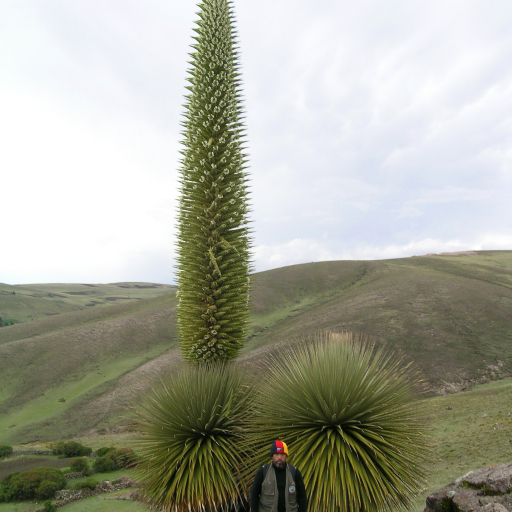
Often called the "Queen of the Andes," the Puya raimondii is the largest bromeliad in the world and a true giant of the high-altitude peaks. This prehistoric-looking titan lives for nearly a century, preparing for its grand finale—a single, magnificent bloom that can reach the height of a four-story building. Because it flowers only once in its 80 to 100-year lifespan and then immediately dies, witnessing a bloom is considered a once-in-a-lifetime event.
🔍 How to Identify
- 🌵 The Rosette: A massive, circular cluster of silver-green, sword-like leaves that can span over 3 meters (10 feet) across, resembling a giant, terrestrial pineapple.
- ⚔️ Spiny Margins: Each leaf is armed with dark, hooked teeth along the edges, designed to deter grazing animals in its harsh habitat.
- 🗼 The Flower Tower: When it finally matures, it produces a colossal spike reaching up to 10 meters (33 feet) tall, densely packed with thousands of creamy-white flowers.
🏡 In Your Garden
- ⛰️ High-Altitude Specialist: This is not a typical garden plant. It thrives exclusively in the thin air and rocky soil of the Andes (Peru and Bolivia) and requires extreme UV exposure and perfect drainage to survive.
- ⏳ Semelparous Nature: Like many agave species, this plant is "semelparous," meaning it puts all its energy into a single reproductive event. Once the seeds are released, the entire plant withers and turns into a standing skeleton.
- 🦅 Hummingbird Haven: In its native range, it acts as a vital oasis for high-altitude birds. The massive flower stalk provides an incredible amount of nectar, supporting local ecosystems where food is otherwise scarce.
⚠️ Safety & Toxicity
- 🩹 Physical Hazard: While the plant is not known to be chemically toxic to humans or pets, it is physically dangerous. The stiff, saw-toothed leaves can cause deep scratches or punctures if brushed against.
- 🐕 Pet Safety: Keep pets away from the foliage. The "hooks" on the leaves are designed to snag and can easily injure a curious dog's nose or paws.
✨ Fun Fact
- 🌬️ The Million-Seed Send-off: After its legendary bloom, a single Puya raimondii can produce between 6 and 10 million seeds. These seeds are tiny and winged, allowing the fierce mountain winds to carry them across the rocky slopes to start the 100-year cycle over again.

Detailed Care Instructions
To grow a Puya Raimondii plant, also known as Queen of the Andes, follow these steps:
- Climate: Puya Raimondii is native to the high-altitude regions of the Andes Mountains in South America. It prefers cool, moist conditions at altitudes of 9,000 to 15,000 feet. Simulating this environment is crucial for successful cultivation.
- Seeds: Obtain Puya Raimondii seeds from a reputable seed supplier. They can be challenging to find, so it might require some research or contacting specialized nurseries.
- Germination: Soak the seeds overnight to help with germination. Use a well-draining potting mix consisting of peat moss, perlite, and sand. Fill pots with this mixture, leaving some space at the top for watering. Place one or two seeds on top of the soil, pressing them lightly.
- Temperature: Provide cool temperatures for germination, ideally around 50-60°F (10-15°C). Place the pots in a cool area or a refrigerator where the temperature remains consistently cool.
- Watering: Water the pots regularly to keep the soil slightly damp but not waterlogged. Puya Raimondii prefers moist conditions, so ensure the soil doesn't dry out completely.
- Light: Once the seeds have germinated, move the pots to a bright location with indirect sunlight. Avoid placing them in direct sunlight, as this can scorch the young plants.
- Transplantation: When the seedlings are large enough to handle, usually with a few sets of true leaves, carefully transplant them into larger pots. Use a well-draining soil mix similar to the one used for germination.
- Repotting: As the plants grow, they will eventually outgrow their pots. Repot them into larger containers to accommodate their increasing size. Make sure the containers have good drainage holes to prevent waterlogging.
- Care: Provide regular watering, ensuring the soil is consistently moist but never waterlogged. Puya Raimondii prefers cooler temperatures, so try to maintain a cool environment. Fertilize the plant once or twice a year with a balanced, slow-release fertilizer.
- Patience: Puya Raimondii is a slow-growing plant that can take several years to reach its mature size. Be patient and provide the plant with the necessary care and conditions it requires.
Remember, Puya Raimondii is a large plant that can grow to impressive sizes in the wild. Therefore, consider your available space and ensure you can accommodate its rapid growth before attempting to grow it.
The watering regimen for this plant should be carefully monitored to ensure optimal growth. It is recommended to water this plant deeply but infrequently, ensuring that the soil is well-draining to prevent waterlogging. The soil should be allowed to slightly dry out between watering to prevent root rot and other fungal diseases. It is important to avoid getting water on the leaves to prevent rotting and disease. During the winter months, the plant may require less frequent watering. It is important to adjust the watering schedule based on environmental conditions such as temperature, humidity, and sunlight.
To fertilize this plant, use a balanced fertilizer with an NPK ratio of 10-10-10. Apply the fertilizer once every two months during the growing season, which is typically from spring to fall. Mix the fertilizer with water according to package instructions and apply it around the base of the plant, being careful not to get it on the leaves. Water the plant thoroughly after fertilizing. Avoid fertilizing during the winter months when the plant is dormant.
The Puya Raimondii plant grows well in well-draining soil that is rich in nutrients. The soil should be a mixture of loam, sand, and organic matter, with a pH level around 6.5 to 7.5. It should be moisture-retentive but not waterlogged, as excessive moisture can cause root rot. The plant thrives in semi-arid conditions and prefers to be in a location with good air circulation. It should be planted in a location that receives full to partial sunlight. It is recommended to fertilize the plant with a balanced fertilizer once a year, in the spring.
To propagate this plant, you'll need to start by collecting the seeds from the mature plant. Once you have collected the seeds, clean them and soak them in warm water for 24 hours to help soften the seed coat. After this, plant the seeds about 1/4 inch deep in a well-draining soil mix that is moist but not too wet. Place the pots in bright, indirect light and maintain a temperature between 60-70°F.
Once the plants have germinated and begun to sprout, it is important to adjust the lighting and water. Provide them with more direct sunlight and begin watering them when the top inch of soil is dry to the touch. As the plants begin to grow, they may need to be transplanted into larger pots, being careful not to damage the roots.
Once the plant is established and growing well, it can be propagated by division. This involves carefully removing the plant from its pot, separating the roots, and replanting the sections in their own pots with fresh soil.
It is important to note that this plant grows very slowly and can take several years to reach maturity.








