Plant Overview
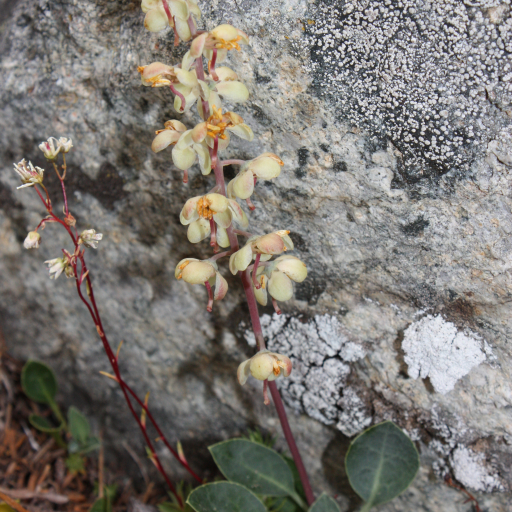
Known as the White-veined Wintergreen, this delicate forest dweller looks like a piece of Victorian lace dropped onto the pine needles. Its species name, picta, literally means "painted," referring to the stunning white marbling that decorates its evergreen foliage. Native to the coniferous forests of Western North America, it is a "quiet" plant that prefers the deep shade of old-growth trees.
🔍 How to Identify
- 🌿 The "Painted" Leaves: The most striking feature is the basal rosette of leathery, dark green leaves marked with vivid white or silver veins that follow the midrib and lateral veins.
- 🔔 Nodding Blooms: In summer, it sends up a reddish stalk carrying several bell-shaped flowers. These range from creamy white to greenish-yellow or even a muted purple.
- 🐘 The "Trunk": If you look closely at the flower, you’ll see a long, curved style (the female part) protruding downward like a tiny elephant's trunk or a hook.
🏡 In Your Garden
- 🍄 The Fungal Connection: This plant is incredibly difficult to cultivate in a traditional garden because it is mixotrophic. It doesn't just rely on the sun; it steals nutrients from underground fungal networks. If the specific forest fungi aren't in your soil, the plant won't survive.
- 🌲 Nature’s Carpet: In its natural habitat, it acts as a permanent groundcover. It thrives in acidic "duff"—the thick layer of decomposing pine needles and bark found under firs and pines—and actually prefers dry, rocky slopes where other plants struggle.
⚠️ Safety & Toxicity
- 🍃 Mild Assessment: Pyrola picta is generally considered non-toxic to humans and pets, but it should never be consumed in large quantities.
- 💊 Aspirin-like Compounds: Like many wintergreens, it contains methyl salicylate, a compound similar to aspirin. While it has been used in traditional folk medicine for skin sores, people with aspirin allergies or those on blood thinners should avoid contact with its crushed leaves or oils.
✨ Fun Fact
The White-veined Wintergreen is a bit of a "cheater." While it has green leaves to perform photosynthesis, it is partially parasitic. It "hacks" into the relationship between trees and mushrooms to siphon off extra sugars, allowing it to survive in deep forest shadows where sunlight almost never reaches the ground.

Detailed Care Instructions
To grow Pyrola picta (also known as white-veined wintergreen or striped wintergreen), follow these steps:
- Seed collection: Look for mature plants in the wild and collect ripe seed capsules with their seeds during summer or early fall.
- Seed preparation: Remove the seeds from the capsules and spread them out to dry on a paper towel for a few days in a cool, dry place.
- Soil preparation: Prepare a well-draining substrate, which is high in organic matter, by mixing equal parts of sphagnum peat moss and perlite or coarse sand. This plant prefers acidic soil with a pH between 4.5 and 6.0.
- Seed sowing: Sow the seeds on the prepared soil surface, but do not cover them with soil. Lightly mist the surface with water to settle the seeds.
- Germination environment: Place the sown seeds in a plastic bag or seed tray covered with plastic wrap. Keep the seeds in a cool location, around 10-15°C (50-59°F), for a few weeks to simulate winter conditions. This plant requires a cold stratification period to break seed dormancy.
- Seedling care: After the cold stratification period, move the seeds to a warmer location, around 18-21°C (64-70°F). Maintain high humidity by covering the container or tray with a clear plastic dome or plastic wrap until the seedlings emerge. Keep the soil consistently moist, but not waterlogged.
- Transplantation: When the seedlings have developed at least two true leaves, gently transplant them into individual pots or trays filled with the same soil mixture used for sowing. Provide bright, indirect light for the young plants.
- Growing conditions: Pyrola picta prefers partially shaded areas with filtered sunlight or dappled shade. It thrives in moist, cool woodland environments. Mimic these conditions by maintaining a moist soil and providing shade from direct sunlight.
- Maintenance: Regularly water the plants to keep the soil evenly moist but not waterlogged. Fertilize once a month during the growing season with a balanced, water-soluble fertilizer diluted to half the recommended strength.
- Repotting: As the plants grow, they may require repotting into larger containers. Use the same well-draining soil mixture, and be careful not to damage the delicate roots during transplantation.
Pyrola picta is a slow-growing plant, and it may take a few years for it to reach maturity and bloom. Patience and consistent care will reward you with beautiful white-veined wintergreen plants.

Place in a bright room that is sun drenched almost all day. Or directly in a south-facing window.

To water this plant, ensure the soil is moist but not waterlogged. Water it deeply once a week during the growing season and reduce watering frequency during dormant periods. Avoid getting water on the leaves as this can lead to diseases. Use lukewarm or room temperature water instead of cold water. Consider using a watering can with a narrow spout to deliver water directly to the soil and not the leaves.
To fertilize this plant, it is recommended to use a balanced water-soluble fertilizer once a month during its active growing season. Dilute the fertilizer according to the package instructions and apply to the soil around the base of the plant. Avoid getting any fertilizer on the leaves or stem of the plant, as this can cause damage. Water the plant well after fertilizing.
Pyrola Picta plant requires well-drained and moist soil that is rich in organic matter. The soil pH should be slightly acidic, between 4.5 to 6.5. It prefers loamy soil with a combination of sand, clay, and silt. Additionally, the soil must be well-aerated and loose, allowing for good water drainage and circulation. The plant should not be exposed to soils with high levels of sodium or potassium, which can damage the roots and stunt the plant's growth. Finally, it is recommended to add organic fertilizers and compost to the soil to provide necessary nutrients to the plant.
Pyrola Picta can be propagated through several methods. One way is through root division. This involves carefully digging up the plant and separating the roots into sections. Each section should have some of the plant's leaves and a few roots attached. The sections can be replanted in a new location or in a pot filled with well-draining soil.
Another method is through seed propagation. The plant produces small capsules that contain numerous tiny seeds. When the capsules turn black, they can be harvested and the seeds can be spread over a well-prepared planting area. The area should be kept moist until the seeds germinate.
Finally, Pyrola Picta can be propagated through stem cuttings. This method involves taking a stem cutting from a healthy plant and placing it in a rooting hormone solution. Once the cutting has developed roots, it can be planted in a well-draining soil mixture. This method is best done during the plant's active growing season.








