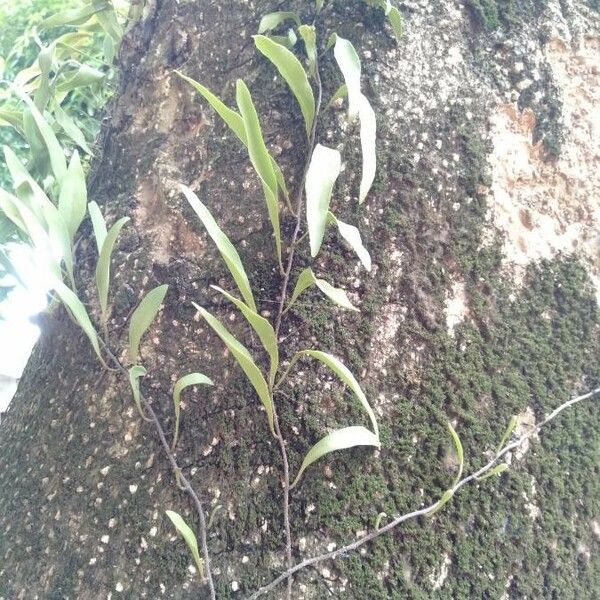
Plant Overview
Often called the Creeping Felt Fern or Tongue Fern, Pyrrosia adnascens is a charming, slow-growing epiphyte that looks more like a collection of leathery tongues than a traditional lacy fern. In its native tropical Asian habitats, it spends its life "hugging" the bark of ancient trees or scaling limestone cliffs. It is a "resurrection" plant of sorts, capable of shriveling up during dry spells and springing back to life with the first sign of rain.
🔍 How to Identify
- 🌿 The Fronds: Unlike feathery ferns, these leaves are simple, thick, and fleshy. They are often dimorphic, meaning the rounder, shorter leaves are sterile, while the longer, strap-like leaves are fertile.
- 🧶 Felt Texture: If you flip a leaf over, you’ll notice a dense coating of tiny, star-shaped hairs (stellate hairs). This gives the underside a dusty, felt-like appearance ranging from silver to light brown.
- 🦎 Creeping Rhizomes: Look for thin, wiry stems that "scramble" across surfaces. These rhizomes are covered in dark scales and act as the plant's anchor and nutrient transport system.
🏡 In Your Garden
- 🪵 Mounting is Best: Because this fern grows on trees in the wild, it hates being buried in heavy potting soil. It thrives best when mounted on a piece of cork bark or nestled into a slatted orchid basket with plenty of aeration.
- 💧 The "Drought-Resistant" Fern: While most ferns demand constant moisture, Pyrrosia adnascens is surprisingly tough. Its succulent-like leaves store water, making it a perfect choice for those who occasionally forget their watering schedule.
⚠️ Safety & Toxicity
- ✅ Status: Generally considered non-toxic.
- 🐾 Details: This fern is safe to keep around cats, dogs, and children. However, because its leaves are quite leathery and tough, they could cause mild digestive irritation if a curious pet decides to use them as a chew toy.
✨ Fun Fact
The silver "felt" on the leaves isn't just for decoration—it acts as a biological shield! These tiny hairs trap a layer of humid air against the leaf and reflect intense sunlight, allowing the fern to survive in exposed canopy spots where other ferns would quickly fry.

Detailed Care Instructions

Place in a window with dappled sun or a spot in the middle of a room. Or directly in a window facing west or east.

Water-loving plants flourish in wet or sloppy soil and near ponds. The extensive root system enables these plants to absorb plenty of water. The surface of the soil should be kept moist at all times. Place your pot in a container filled with water to guarantee that plants get enough water. If the ground becomes dry, it is recommended that you water it well. Plants in smaller pots will need to be watered more frequently. Water the soil in which the plant is standing thoroughly using a watering can.








