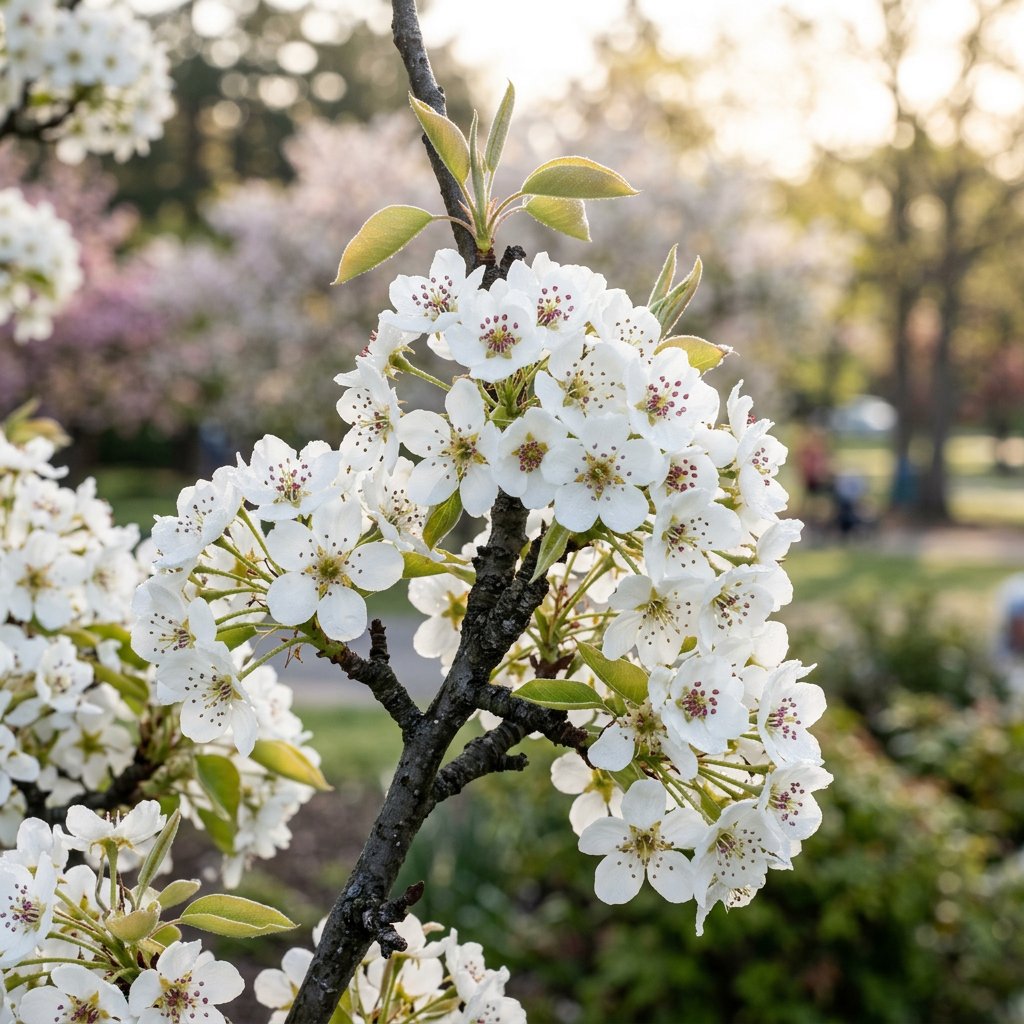
Plant Overview
Known as the "Bradford Pear" or "Cleveland Select," this tree is famous for transforming suburban streets into white, snowy corridors every spring. Originally brought from Asia to help combat fire blight in other pear species, it became the darling of 20th-century landscaping due to its rapid growth and symmetrical shape. However, its beauty comes with a controversial reputation due to its "unique" fragrance and its tendency to take over local ecosystems.
🔍 How to Identify
- 🌸 Floral Clouds: In early spring, the tree is completely covered in dense clusters of five-petaled white flowers that appear before the leaves emerge.
- 🍃 Glossy Foliage: The leaves are heart-shaped or oval with finely toothed, wavy edges. They have a distinct leathery texture and a deep, glossy green shine.
- 🌳 Pyramidal Form: Young trees grow in a very tidy, upright "teardrop" or pyramidal shape, though they become broader and more fragile as they age.
🏡 In Your Garden
- 🌬️ Structural Weakness: While they grow fast, they are notorious for "splitting" during wind or ice storms. Their branches grow too close together, creating weak points that often cause the tree to fall apart after 15–20 years.
- 🐜 Invasive Alert: In many regions, this plant is now considered a "pest." It escapes gardens and spreads into wild forests, where its thickets choke out native plants and develop nasty, 2-inch thorns in its "wild" form.
- 👃 The Scent Factor: Be prepared—while the flowers look like lace, they are famous for an odor often compared to rotting fish or wet gym socks, designed to attract flies for pollination.
⚠️ Safety & Toxicity
- 🐾 Pet Safety: The Callery Pear is generally considered non-toxic to dogs, cats, and horses. However, eating the small, hard fruits can cause mild stomach upset.
- 🦶 Physical Hazards: The wild-growing offspring of these trees can develop sharp, sturdy thorns that easily puncture tires or thin-soled shoes.
✨ Fun Fact
The Callery Pear is one of the "Early Risers" of the forest. Because it grows its leaves earlier in the spring and keeps them later into the fall than native trees, it effectively "steals" the sunlight from everything growing beneath it!

Detailed Care Instructions
| Color | White |
| Soil Ph | Slightly Acidic 6.0-7.0 |
| Lighting | Full Sun |
| Soil Type | Moist, Well-Drained, Tolerant Of Most Soils |
| Bloom Time | Spring |
| Plant Type | Deciduous Tree |
| Mature Size | 30 To 50 Feet |
| Native Area | China, Vietnam |
| Sun Exposure | Full Sun |
| Hardiness Zones | 4-9 |
To grow Pyrus Calleryana (commonly known as the Callery pear or Bradford pear), you can follow these steps:
- Obtain a young Pyrus Calleryana tree from a reputable nursery or garden center.
- Choose an appropriate location for planting. Pyrus Calleryana prefers well-draining soil and full sun to partial shade. Ensure the area is not prone to standing water.
- Dig a hole that is approximately two to three times wider than the tree's root ball. The hole should be deep enough so that the top of the root ball is level with or slightly above the ground.
- Gently remove the tree from its container or burlap covering, being careful not to disturb the roots excessively.
- Place the tree in the hole, making sure it is straight and centered. Backfill the hole with soil, firmly packing it around the roots to eliminate air pockets.
- Water the tree thoroughly after planting to help settle the soil and provide moisture for the roots. Water regularly, especially during dry periods, but avoid overwatering, as soggy soil can harm the tree.
- Apply a layer of organic mulch, such as wood chips or shredded bark, around the base of the tree, leaving space near the trunk to prevent moisture accumulation.
- Prune the tree as necessary to maintain its desired shape and remove any damaged or crossing branches. Pruning in late winter or early spring when the tree is dormant is generally recommended.
- Fertilize the tree once a year, preferably in early spring, with a balanced, slow-release fertilizer formulated for trees. Follow the instructions on the fertilizer packaging to determine the appropriate amount for your Pyrus Calleryana.
- Monitor the tree for pests and diseases, such as fire blight or leaf spot. Consult with a local arborist or horticulturist if you notice any concerning issues or for specific pest management recommendations.
By following these steps, you should be able to successfully grow a Pyrus Calleryana plant and enjoy its beautiful blossoms and foliage.

Place in a bright room that is sun drenched almost all day. Or directly in a south-facing window.

To water the Pyrus Calleryana plant, ensure that the soil around the base of the plant is dry to the touch before watering. Use a watering can or a hose with a gentle spray nozzle to water the plant. Be sure to direct the water towards the base of the plant to avoid getting water on the leaves, as this can encourage fungal growth. Water the plant slowly and evenly, ensuring that the soil is thoroughly moistened. Avoid over-watering the Pyrus Calleryana plant as this can cause root rot. Water only when the soil feels dry to the touch, and reduce watering during the winter months when the plant is dormant.
Apply a balanced fertilizer in early spring before new growth begins. Use a slow-release granular fertilizer with equal amounts of nitrogen, phosphorus, and potassium. Follow the manufacturer's instructions for specific application rates. Water the plant well after fertilizing. Avoid fertilizing during drought periods or when the plant is already stressed.
The Pyrus Calleryana plant prefers well-draining, loamy soil that is slightly acidic to neutral pH. It also prefers soil that is rich in organic matter and nutrients. The ideal soil mix for this plant would consist of equal parts of sand, peat moss, and loam. It is important to avoid using heavy clay soil as it can hold moisture and lead to root rot. The soil should also be kept consistently moist but not waterlogged. Adding a layer of mulch around the base of the plant can help retain moisture and regulate soil temperature.
The Pyrus Calleryana plant can be propagated through various methods such as softwood cuttings, hardwood cuttings, root cuttings, and grafting.
For softwood cuttings, select a healthy stem that is around 6-8 inches long and remove the lower leaves. Dip the stem in rooting hormone and plant it in a pot with moist soil. Cover the pot with a plastic bag to create a humid microclimate and keep the soil moist. In a few weeks, roots should start forming and the plant can be transplanted to a larger pot or in the ground.
For hardwood cuttings, select a stem that is around 8-10 inches long and has no leaves. Cut it at an angle and dip the end in rooting hormone. Bury the stem in a pot with moist soil and cover it with a plastic bag to create a humid environment. Keep the soil moist and in a few weeks, the cutting should start producing roots.
For root cuttings, dig up a small section of the plant's root system and cut it into small pieces. Plant the pieces in a pot with moist soil, cover them with a plastic bag, and keep the soil moist. In a few weeks, new shoots should start emerging from the soil.
Grafting is a more advanced propagation technique where a cutting from the desired plant is attached to the rootstock of another plant. This method requires specialized tools and skills, and is usually done by professionals.
Common pests of the bradford pear include Aphids, larvae. Make a habit of checking your bradford pear frequently for pests so that any infestations can be caught and managed early.








