Plant Overview
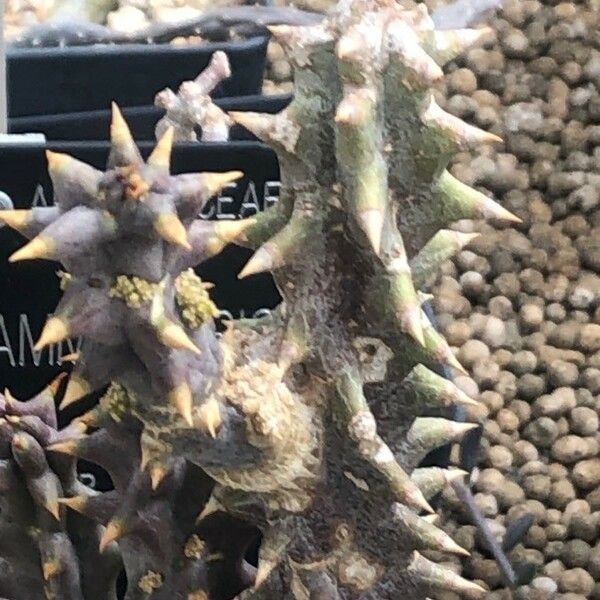
Often referred to as the "Toad Plant" or "Little Mammilla," Quaqua mammillaris is a strange and captivating succulent native to the arid Karoo region of South Africa. It looks less like a traditional plant and more like a collection of prehistoric sea creatures or weathered stones huddled together. Belonging to the "Stapeliad" family, it is famous for its "alien" appearance and its small, dark, star-shaped flowers that tell a fascinating evolutionary story.
🔍 How to Identify
- 🌵 The Stems: Features thick, four-angled stems that are heavily "mammillated," meaning they are covered in prominent, tooth-like bumps or tubercles.
- 🎨 Coloration: The skin is typically a dusty olive green but is frequently mottled with deep purplish-brown spots, a camouflage tactic used to blend into rocky landscapes.
- 🌸 The Flowers: Produces tiny, five-lobed flowers that are almost black or a very dark maroon. They appear in clusters along the sides of the stems rather than at the tips.
🏡 In Your Garden
- 🪨 The "Dry Feet" Rule: Because it evolved in desert cracks, this plant is highly susceptible to root rot. It requires extremely gritty, mineral-heavy soil—essentially a mix of pumice and sand—to ensure water never sits around the roots.
- ☀️ Light & Stress: To achieve those beautiful dark purple hues, the plant needs bright, indirect light. However, be cautious; while it likes "sun-stress," direct midday summer sun can scorch the stems.
- 🦟 The Scent of Science: Unlike flowers that attract bees with sweet perfumes, Quaqua flowers emit a faint, musky odor of decaying organic matter to attract flies, which act as its primary pollinators.
⚠️ Safety & Toxicity
- 🐾 Low Toxicity: Most members of the Quaqua genus are not known to be dangerously toxic to humans or pets.
- 🧪 Sap Irritant: Like many succulents, the internal fluids can cause mild skin irritation or digestive upset if a curious pet or child decides to take a bite. It is best kept on a high shelf out of reach.
✨ Fun Fact
In the wild, Quaqua mammillaris is a master of disguise. During extreme droughts, the plant can actually shrink and partially retract into the soil or hide under the shade of "nurse bushes" to protect itself from the blistering sun.

Detailed Care Instructions

Place in a bright room that is sun drenched almost all day. Or directly in a south-facing window.

When the top few inches of soil dry out, water your plants. If the top few inches of soil are still moist, do not water your plant. Wait a few days, then poke your finger into the soil to see if anything has changed. Overwatering poses a disease risk, such as the development of fungal diseases in the roots. These plants have adaptations in there leaves that allow them to survive in low water supply.
These plant needs regular fertilizing during growing seasons. Fertilizing your plants in dormant state during the winter, might result in scorching or browning of the leaf tips. If mature plants display signs of nutrient insufficiency, fertilizer administration is necessary to restore the plant to its previous state.
You may use All Purpose Plant Food or Flower Fertilizer or Cactus Fertilizer for your Thorn Club (ముళ్లగద)
Common pests of the thorn club (ముళ్లగద) include Scale insect, mealybugs, spider mites, thrips. Make a habit of checking your thorn club (ముళ్లగద) frequently for pests so that any infestations can be caught and managed early.








