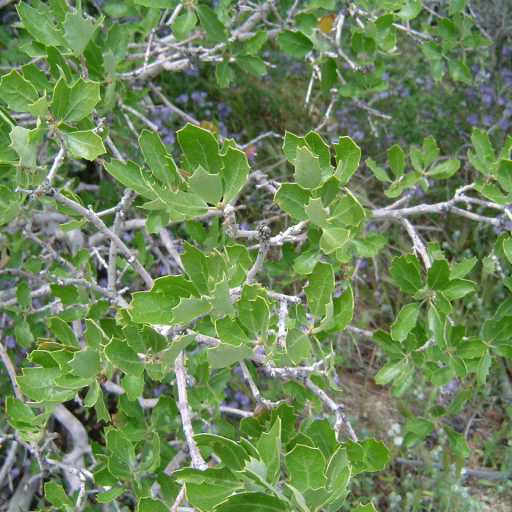
Plant Overview
Often called the Inland Scrub Oak, this rugged survivor is the backbone of the California chaparral. While it might look like a simple bush, it is a true oak that has traded towering height for a compact, armored frame to survive harsh droughts and wildfires. It serves as a vital "apartment complex" for local wildlife, providing dense cover and nutritious snacks for birds and small mammals.
🔍 How to Identify
- 🍃 Holly-like Foliage: The leaves are small, leathery, and dull green. They often feature sharp, spiny teeth along the edges, making them look remarkably like miniature holly leaves.
- 🌳 Bushy Stature: Unlike the giant Valley Oak, this species rarely forms a single straight trunk. Instead, it grows into a dense, multi-stemmed thicket that can reach up to 15 feet tall.
- 🌰 Pointed Acorns: It produces small, egg-shaped acorns that sit in thin, warty cups. These acorns usually mature in a single season and are a key food source for scrub jays.
🏡 In Your Garden
- 🏜️ Hardy Resilience: This plant is a master of "tough love." Once established, it requires almost no supplemental water. Its deep taproot seeks out moisture far underground, making it perfect for xeriscaping or slopes.
- 🚧 Root Sensitivity: Be very careful where you plant it! Scrub Oaks develop deep roots early in their lives and are notoriously difficult to transplant. They prefer to stay exactly where they were first sown.
- 🔥 Fire Adaptation: In its native habitat, it is known for its incredible ability to resprout from its root crown even after a severe wildfire, a testament to its survivalist nature.
⚠️ Safety & Toxicity
- 🐾 Pet Caution: Like most oaks, the acorns and young leaves contain tannins. While not typically lethal, they can cause digestive upset or kidney issues in dogs, cats, and horses if consumed in large quantities.
- 🧒 Child Safety: The plant is generally safe to be around, but the sharp, prickly leaf edges can cause minor scratches to sensitive skin. The acorns are not edible for humans unless processed extensively to remove bitterness.
✨ Fun Fact
Despite its humble appearance as a "scrub" plant, a single California Scrub Oak can live for over 100 years. It grows so slowly that a specimen only 10 feet tall might have been alive since the early 20th century!

Detailed Care Instructions
To grow Quercus berberidifolia, also known as the California Scrub Oak, you can follow these steps:
- Obtain seeds or saplings: You can obtain seeds from a local nursery, botanical garden, or online retailers specializing in native plants. You may also consider collecting acorns from existing trees with permission, but keep in mind that growing from seeds is a slower process compared to established saplings.
- Choose the right location: Quercus berberidifolia thrives in full sun to partial shade, and it prefers well-draining soil. Make sure the chosen location has enough space for the tree to grow, as it can reach a height of up to 15 feet.
- Soil preparation: Amend the soil if needed, as the tree prefers acidic to neutral soil. If the soil is heavy clay, consider adding organic matter like compost to improve drainage and fertility.
- Planting: If you are planting from seeds, follow the germination instructions provided with the seeds. Generally, you would plant them in a container with well-draining soil, keeping it evenly moist until they germinate. Transplant the seedlings outdoors when they are large enough and the weather is suitable.
If you are planting a sapling, dig a hole that is slightly wider and deeper than the root ball. Place the sapling into the hole, making sure it sits at the same level as it did in the container. Backfill the hole with soil, firming it gently around the roots.
- Watering: Initially, water the newly planted seedlings or saplings regularly to help establish strong roots. Once established, Quercus berberidifolia is generally drought-tolerant but will appreciate occasional deep watering during prolonged dry spells.
- Mulching: Apply a layer of organic mulch, such as wood chips or shredded bark, around the base of the tree. This will help conserve soil moisture, suppress weeds, and protect the roots from extreme temperatures.
- Pruning: Minimal pruning is required for Quercus berberidifolia. Remove any dead, damaged, or diseased branches as necessary. Prune sparingly to maintain the desired shape and remove any crossing or rubbing branches.
- Pest and disease management: Quercus berberidifolia is generally resistant to many pests and diseases. However, keep an eye out for common issues such as aphids, oakworms, or powdery mildew. If necessary, employ suitable pest and disease management techniques, including organic options.
Remember to check with local gardening and conservation agencies to ensure planting Quercus berberidifolia aligns with the region's ecological requirements and regulations.

Place in a bright room that is sun drenched almost all day. Or directly in a south-facing window.

To properly water this plant, ensure that the soil is completely dry to the touch before watering. When watering, pour water slowly and deeply around the base of the plant, making sure not to get water on the foliage. Avoid overwatering, as this can lead to root rot and other issues. It is important to keep the soil consistently moist, but not waterlogged. During periods of heavy rainfall, reduce the amount of watering accordingly. Additionally, make sure to use well-draining soil and a container with drainage holes to prevent water buildup.
When fertilizing this plant, use a balanced fertilizer with equal parts nitrogen, phosphorus, and potassium. Apply the fertilizer in early spring, just before the new growth appears. Spread the fertilizer evenly around the base of the plant, making sure not to allow any of it to touch the stems or leaves. Water the fertilizer in well, and repeat the application in late summer or early fall before the plant goes dormant. Avoid over-fertilizing, as this can harm the plant.
The ideal soil for Quercus Berberidifolia plants is well-draining with good water retention capacity. It should be made up of a mix of organic and inorganic materials, such as sand, perlite, peat moss, and compost. The pH level should be slightly acidic to neutral, ranging from 5.5 to 7.0. The soil should also be rich in nutrients, especially nitrogen, phosphorus, and potassium, to support the plant's growth and healthy development. Additionally, it is recommended to add a layer of mulch on top of the soil to retain moisture and prevent weed growth.
To propagate this plant, you can first collect acorns from a mature plant. They should be collected in the fall and should be free of any defects or damage. The acorns can be soaked in water for a few days to help remove any tannins that may prevent germination.
Next, fill a pot with a well-draining soil mixture and plant the acorn about an inch deep, making sure to keep the soil moist but not waterlogged. The pot should be kept in a bright, but not direct, light and at a constant temperature of around 65-75°F.
Germination should occur within a few weeks to a few months. Once the seedlings have grown to around 6 inches in height, they can be transplanted into larger pots or into the ground if conditions are suitable.
Alternatively, cuttings can also be taken from the plant in the summer months. Select a healthy stem and take a cutting that is around 4-6 inches long. Remove the leaves from the lower half of the stem and dip the cut end in rooting hormone.
Plant the cutting in a pot filled with a well-draining soil mixture and keep it moist and out of direct sunlight until roots have formed. Once the rooting process is complete, the cutting can be transplanted into a larger pot or into the ground if conditions are suitable.








