Plant Overview
Known as the "Canyon Live Oak" or "Maul Oak," this sturdy evergreen is a true titan of the American West. It earned its nickname from pioneers who found its wood so incredibly dense and tough that it was the only choice for making tool handles, wagon axles, and heavy mallets (mauls). Whether clinging to a rocky cliffside or shading a canyon floor, this tree is a symbol of resilience and ancient strength.
🔍 How to Identify
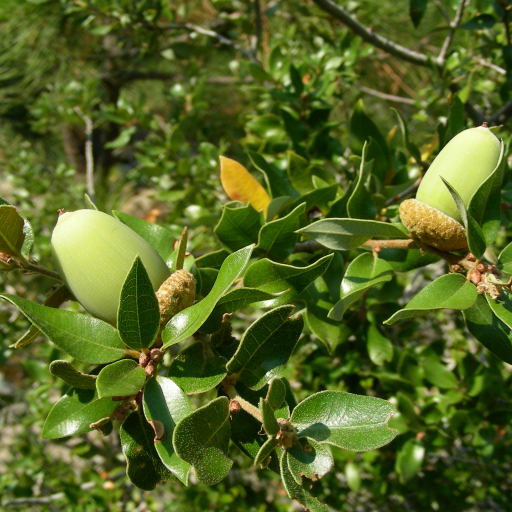
- 🍃 Chameleon Leaves: The foliage is leathery and dark green, but don't be fooled—the same tree can have smooth-edged leaves and "spiny" holly-like leaves at the same time to deter grazing animals.
- ✨ Golden Acorn Cups: Its scientific name, chrysolepis, means "golden scale." This refers to the beautiful, velvety yellow-gold "fuzz" that covers the thick, turban-like cups of its acorns.
- 🛡️ Scaly Armor: On mature trees, the bark is a soft gray and breaks into small, flaky scales, unlike the deeply furrowed ridges seen on many other oak species.
🏡 In Your Garden
- 🌱 The "Forever" Tree: Because of its deep taproot, the Canyon Live Oak is exceptionally drought-tolerant once established. However, this root system makes it very sensitive to being moved—choose its "forever home" carefully, as it hates transplanting.
- 🦉 A Biodiversity Hub: In a landscape setting, this tree acts as a natural hotel. It provides essential high-energy food for squirrels and deer, while its dense evergreen canopy offers year-round shelter for owls and songbirds.
⚠️ Safety & Toxicity
- 🟢 General Safety: This tree is non-toxic to touch and is generally safe for residential gardens.
- 🐕 Pet Caution: Like all oaks, the acorns contain tannins. If ingested in large quantities by dogs or horses, they can cause digestive upset or kidney issues. It is best to keep inquisitive pets away from a heavy "mast" (acorn) fall.
✨ Fun Fact
The wood of the Canyon Live Oak is so heavy that it barely floats in water! During the era of wooden shipbuilding, it was highly prized for its "natural knees"—the curved sections of the tree were used to reinforce the joints where the deck met the hull.

Detailed Care Instructions
Quercus chrysolepis, commonly known as canyon live oak or maul oak, is a species of oak native to California and Oregon. It typically grows in canyons and foothills. Here are some steps to help you grow Quercus chrysolepis plants:
- Find the right location: Quercus chrysolepis prefers full sun to partial shade. Look for a location in your garden or property that receives at least 6 hours of direct sunlight each day.
- Soil preparation: This oak species prefers well-draining soil with good organic content. If your soil is heavy or clayey, consider amending it with compost or organic matter to improve drainage.
- Planting: Dig a hole that is twice as wide and the same depth as the root ball. Gently place the plant in the hole, making sure the top of the root ball is level with the surrounding soil. Fill the hole with soil and tamp it down gently to remove air pockets.
- Watering: Newly planted Quercus chrysolepis should be watered regularly to establish roots. Water deeply, making sure the soil is moist but not waterlogged. Once established, this oak species is drought-tolerant and requires less water.
- Mulching: Apply a layer of mulch around the base of the plant, avoiding contact with the trunk. Mulch helps retain moisture, suppress weeds, and regulate soil temperature.
- Pruning: Prune young Quercus chrysolepis trees to establish a strong framework. Remove any dead or damaged branches. Generally, minimal pruning is required for mature trees unless there are specific structural concerns or safety issues.
- Pest and disease control: Quercus chrysolepis is generally resistant to pests and diseases. However, it is still important to monitor the plant and address any issues promptly. Regularly inspect for pests like oakworms or leafminers, and treat if necessary.
- Patience: Quercus chrysolepis is a slow-growing species, so it may take several years for your plant to reach significant size. Be patient and enjoy watching it grow over time.
Remember to check with local nurseries or garden centers for specific advice tailored to your region's climate and conditions.

Place in a window with dappled sun or a spot in the middle of a room. Or directly in a window facing west or east.

The best way to water this species of plant is to use a watering can or hose with a gentle stream. It is important to ensure that the water is applied directly to the soil around the base of the plant rather than the leaves or stem. The soil should be moist but not waterlogged, and the plant should be watered deeply enough to reach the root system. It is recommended to water the plant once or twice a week during the growing season and reduce watering during the winter months. It is also important to monitor the soil moisture level and adjust watering accordingly.
To fertilize this plant, choose a balanced fertilizer with equal parts nitrogen, phosphorus, and potassium. Apply the fertilizer evenly around the drip line of the tree, avoiding the trunk. Water the area thoroughly after fertilizing to allow the nutrients to reach the roots. Do not over-fertilize as this can harm the tree and lead to excessive leaf growth. It is recommended to fertilize this plant in the early spring or late fall when it is not actively growing.
The soil needed for the Quercus Chrysolepis plant should have a mixture of loam, sand, and peat moss. The soil should be well-draining and have a pH level between 6.0 and 7.0. The plant prefers soil that is rich in organic matter and has good water retention properties. It is important to avoid using heavy clay soils as they can cause waterlogged roots, which can lead to root rot. The soil should be amended with compost or well-rotted manure to improve its fertility. Additionally, it is beneficial to mulch the soil to retain moisture and regulate soil temperature.
In order to propagate this plant, you will need to employ several methods. One common method is to take cuttings from an existing plant. To do this, select a healthy, young stem and remove a section that is about 4-6 inches in length. Remove any leaves from the bottom of the stem and dip the cut end into rooting hormone. Plant the stem into potting soil, making sure that the cut end is buried about an inch into the soil. Keep the soil moist and place the pot in a warm, bright location.
Another method of propagation is to collect and sow seeds. Collect seeds from a mature plant and allow them to dry out for a few days. Once they are dry, plant them in potting soil and water well. Keep the soil damp and the pot in a warm, bright location. The seeds should germinate in a few weeks.
You can also propagate Quercus Chrysolepis by layering. Select a low-lying branch and bend it down to the ground. Make a small cut in the bark where the branch touches the soil. Cover the cut with soil and secure the branch to the ground with a stake or rock. Keep the soil moist and wait for roots to grow from the cut. Once roots have formed, cut the branch from the main plant and transplant it.
No matter which method you choose, it's important to be patient and consistent with care in order to successfully propagate Quercus Chrysolepis.








