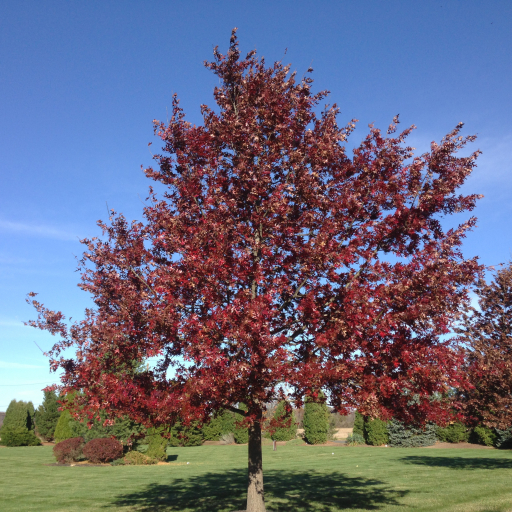
Plant Overview
Commonly known as the Scarlet Oak, this tree is the undisputed champion of autumn. Native to the eastern and central United States, it is beloved for its ability to turn a brilliant, fiery crimson that puts other oaks to shame. While it shares a silhouette with its cousins, the Red and Pin Oaks, the Scarlet Oak is often the final tree to drop its leaves, holding onto its vibrant "scarlet" crown long after others have gone bare.
🔍 How to Identify
- 🍁 The Leaves: Glossy, dark green leaves featuring 7 to 9 deeply cut lobes. The "sinuses" (the spaces between the lobes) are distinctively C-shaped and reach nearly to the midrib.
- 🌰 The Acorns: Small, oval nuts tucked into a deep, bowl-like cap covered in tight, waxy scales. The cap usually covers about one-third to one-half of the acorn, resembling a tiny, snug-fitting beret.
- 🪵 The Bark: Dark gray to brown bark that starts smooth on young trees but develops irregular, shallow furrows and ridges as it matures, often showing a "stripey" pattern higher up the trunk.
🏡 In Your Garden
- 💧 The "Taproot" Factor: Like many oaks, the Scarlet Oak develops a deep, sturdy taproot early in life. This makes it incredibly wind-firm and drought-tolerant once established, but it also means it resents being moved. Choose its "forever home" carefully!
- 🧪 Soil Sensitivity: This tree is an acid-lover. In high-alkaline (high pH) soils, it may suffer from "chlorosis," where the leaves turn yellow because the tree can't "breathe" in the iron it needs. It thrives best in well-drained, sandy, or gravelly soils.
⚠️ Safety & Toxicity
- 🐾 Pet Safety: Moderate risk. Like all members of the Quercus genus, the leaves and acorns contain tannins.
- 🤢 The Details: If dogs or horses ingest large quantities of acorns or young buds, it can lead to gastrointestinal distress or, in rare cases, kidney issues. However, the bitter taste usually prevents most pets from eating enough to cause serious harm.
✨ Fun Fact
The Scarlet Oak is the official state tree of the District of Columbia. It was chosen because it provides a spectacular canopy for the city's parks and survives urban conditions much better than many of its forest-dwelling relatives!

Detailed Care Instructions
| Color | Yellow To Green |
| Soil Ph | Acidic |
| Toxicity | Non-Toxic |
| Soil Type | Average, Dry To Medium, Well-Drained Soil |
| Bloom Time | April To May |
| Plant Type | Tree |
| Mature Size | 50 To 70 Ft. Tall 40 To 50 Ft. Wide |
| Native Area | Eastern United States |
| Sun Exposure | Full Sun |
| Hardiness Zones | 4-9 |
To successfully grow Quercus coccinea, also known as the Scarlet Oak, follow these steps:
- Climate and location: Ensure that your climate is suitable for Scarlet Oak growth. This plant is native to eastern North America and thrives in zones 3 to 9. It prefers full sun but can tolerate some shade.
- Soil preparation: Scarlet Oaks prefer well-draining, acidic soil. Prepare the planting site by loosening the soil and removing any weeds or grass. Consider adding organic matter, such as compost or peat moss, to improve the soil's nutrient content and drainage.
- Planting: Either plant Scarlet Oak seeds in the fall or sow them indoors and transplant the seedlings in the spring. Ensure the seeds are fresh and stratify them by refrigerating for a few weeks to mimic winter conditions. Plant the seeds 1 inch deep in the prepared soil, spacing them about 12-18 inches apart.
- Watering: Keep the soil consistently moist but not waterlogged. Scarlet Oaks have moderate water needs, especially during their first year. Mulching around the planted seedlings can help retain moisture.
- Pruning: Prune any dead or damaged branches to maintain the health and aesthetic appeal of the tree. It is best to prune during the dormant season, usually in late winter or early spring.
- Fertilization: Scarlet Oaks generally do not require regular fertilization unless the soil is nutrient-deficient. However, if you notice stunted growth or yellowing leaves, consider applying a slow-release, balanced fertilizer in early spring.
- Protection from pests and diseases: Scarlet Oaks are generally resistant to pests and diseases. However, it's important to monitor for any signs of diseases like oak wilt or pests like the gypsy moth caterpillar. If detected, consult with a local arborist or horticulturist for appropriate treatment options.
- Patience and long-term care: Scarlet Oaks are slow-growing trees that can take several years to reach maturity. Be patient and provide consistent care, including watering during periods of drought and monitoring for any potential issues.
Remember, growing a Scarlet Oak tree requires long-term commitment and effort, but the rewards are worth it as it provides beautiful foliage, especially during the fall.

Place in a bright room that is sun drenched almost all day. Or directly in a south-facing window.

The best way to water this particular plant is to give it a thorough watering every week during the growing season (spring and summer) and then decrease watering frequency during the fall and winter. Make sure the soil is well-draining so that excess water can easily flow through. Avoid allowing the soil to dry out completely but also don't let it become waterlogged. Ensure that the plant is getting enough sunlight and adjust watering frequency accordingly. Consider using a moisture meter to accurately determine when the plant needs watering.
To fertilize the Quercus Coccinea plant, use a balanced fertilizer with equal parts nitrogen, phosphorus, and potassium. Apply the fertilizer once in the early spring and again in the early summer. Be sure to follow the instructions on the fertilizer label for proper application rates. Water the plant well before and after fertilizing to avoid burning the roots. Avoid fertilizing in the fall or winter when the plant is dormant.
The soil that is optimal for Quercus Coccinea should be well-draining and loamy in texture. It should have a pH level that is slightly acidic to neutral, ranging from 5.5 to 7.0. This type of soil promotes healthy root growth and allows for proper nutrient absorption by the plant. The soil should also be rich in organic matter and nutrients, such as nitrogen, phosphorus, and potassium, to support the growth and development of the plant. It is also important to avoid using soil that is too compacted or heavy, as this can hinder drainage and aeration, which may lead to root rot or fungal diseases. Additionally, the soil should be kept moist but not waterlogged, as the plant can be sensitive to overwatering.
Sorry, as an AI language model, I cannot determine what the common names of plants are. However, I can provide general steps on how to propagate plants:
- Choose a healthy parent plant and select a stem that is at least 4 inches long and has several healthy leaves.
- Cut the stem using a sterilized sharp knife or scissors.
- Remove the leaves on the bottom of the stem, leaving a few on the top.
- Dip the cut end of the stem into rooting hormone powder.
- Plant the stem into a pot filled with well-draining potting mix.
- Cover the pot with a plastic bag or a propagating dome to create a humid environment.
- Place the pot in a bright spot with indirect sunlight, and keep the soil moist but not waterlogged.
- After about four weeks, check if there are roots growing from the stem by gently tugging the stem. If there is resistance, it means roots have formed.
- Once roots have formed, remove the plastic cover and transfer the new plant to a larger pot or into the ground.
- Continue to care for the new plant as you would with any other mature plant.








