Plant Overview
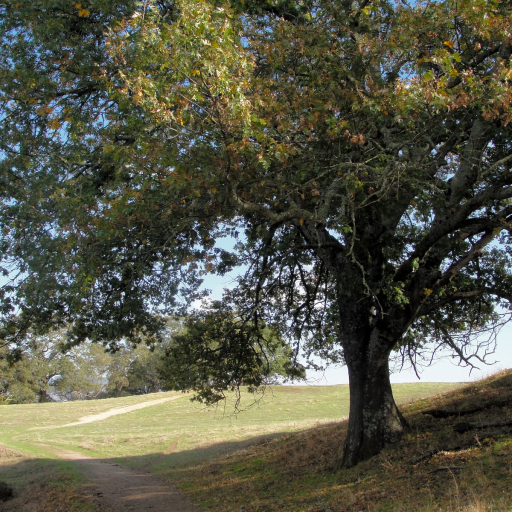
Known as the "King of the Foothills," the California Black Oak is a deciduous masterpiece of the Western United States. With its dramatic dark bark and brilliant golden-yellow autumn foliage, it provides a striking contrast against evergreen pines in mountainous landscapes. This tree is more than just scenery; it is a legendary "provider" that has sustained both wildlife and human cultures for millennia.
🔍 How to Identify
- 🍃 Bristle-Tipped Leaves: The leaves are large and deeply lobed, with each lobe ending in a sharp, hair-like bristle—a key feature that distinguishes it from white oaks.
- 🖤 Dark, Rugged Bark: In maturity, the bark turns a very dark grey or charcoal black, featuring deep furrows and ridges that give the tree a "shadowy" aesthetic.
- 🌰 Fringed Acorns: It produces large, oblong acorns held in deep, scaly cups that look slightly "fringed" or tattered at the edges.
🏡 In Your Garden
- 🪵 Taproot Sensitivity: These oaks develop a massive, deep taproot very early in life. They are notoriously difficult to transplant, so it is best to plant them from seed or very young saplings in their "forever home."
- 💧 Summer Dryness: Adapted to the Mediterranean climate of the West, this tree expects dry summers. Excessive irrigation near the trunk of a mature Black Oak can lead to fatal root rot or "Oak Root Fungus."
- 🦋 A Living Ecosystem: Planting one is an invitation to local nature. They are critical host plants for various California butterflies and provide essential high-energy food for squirrels, deer, and woodpeckers.
⚠️ Safety & Toxicity
- 🐾 Mildly Toxic to Pets: Like most members of the Quercus genus, the leaves and raw acorns contain tannins. If ingested in large quantities, they can cause gastrointestinal distress or kidney irritation in dogs, cats, and horses.
- 🥣 Human Preparation: While the acorns were a staple food for Native American tribes, they are intensely bitter and toxic if eaten raw. They require a lengthy process of grinding and leaching in water to remove the tannins before they are safe to eat.
✨ Fun Fact
- 📜 Ancient Grinding Stones: Throughout California, hikers can still find "bedrock mortars"—large flat rocks with deep holes—directly under ancient Black Oaks. These were the communal kitchens where indigenous people ground acorns into flour for centuries, often under the very same trees that are still standing today.

Detailed Care Instructions
To grow a Quercus kelloggii plant, also known as California black oak, you can follow these steps:
- Choose the right location: Quercus kelloggii plants thrive in full sunlight, so select a spot in your garden that receives at least six to eight hours of direct sunlight each day. Additionally, ensure the soil is well-draining to prevent waterlogging.
- Prepare the soil: California black oaks prefer slightly acidic to neutral soil. Amend the soil by adding organic matter like compost to improve its texture and fertility.
- Planting process:
- Dig a hole that is about twice as wide and equally deep as the root ball of your Quercus kelloggii plant.
- Gently loosen the roots to prevent them from becoming root-bound.
- Place the plant in the hole and backfill the soil around the roots, ensuring there are no air pockets.
- Water the newly planted tree thoroughly to help settle the soil.
- Dig a hole that is about twice as wide and equally deep as the root ball of your Quercus kelloggii plant.
- Watering routine: While California black oaks are drought-resistant, they still require regular watering during the establishment period. Water deeply once a week, ensuring the soil remains evenly moist but not saturated. Once established, these trees are known to withstand dry periods without regular watering.
- Mulching: Apply a layer of organic mulch around the base of the tree, leaving space around the trunk to prevent moisture accumulation. Mulching helps retain soil moisture, suppresses weed growth, and insulates roots from extreme temperature fluctuations.
- Pruning and maintenance: Quercus kelloggii generally has a nice, uniform growth habit and does not require extensive pruning. However, you can remove any dead, damaged, or diseased branches as needed. Regularly monitor the tree's health and address any issues promptly.
- Fertilization: California black oaks typically do not require much fertilization. However, if your soil lacks nutrients, you can apply a balanced slow-release fertilizer specifically formulated for trees in early spring.
- Pest and disease control: Quercus kelloggii trees are generally resistant to pests and diseases. However, monitor them for common oak tree pests like gypsy moths, oak worms, and oak gall wasps. If necessary, consult with a local arborist or extension service for appropriate treatment options.
Remember that Quercus kelloggii trees can grow quite large, so make sure you have enough space to accommodate their mature size before planting.

Place in a bright room that is sun drenched almost all day. Or directly in a south-facing window.

Quercus Kelloggii is a plant that is native to North America, and it requires a specific type of care to thrive. When it comes to watering this plant, there are several things to keep in mind.
First, it's important to note that Quercus Kelloggii is a drought-tolerant plant. This means that it can withstand dry conditions and doesn't need to be watered as frequently as other plants. With that said, it's still important to provide the plant with enough water to keep it healthy.
When watering Quercus Kelloggii, you should aim to provide deep, infrequent watering. This means that you should water the plant deeply enough to saturate the soil and reach the plant's roots. However, you should only water the plant when the soil is dry to the touch. This may mean watering the plant once or twice a week, depending on your climate and the soil conditions.
Additionally, it's important to avoid over-watering Quercus Kelloggii. Too much water can cause the roots to rot and damage the plant's overall health. To prevent over-watering, make sure that the plant is in well-draining soil and water slowly to avoid water pooling on the surface.
Overall, watering Quercus Kelloggii requires a balance between providing enough moisture to keep the plant healthy and avoiding over-watering. By following these guidelines, you can ensure that your Quercus Kelloggii plant thrives and remains healthy.
To fertilize this plant, apply a slow-release, balanced fertilizer in early spring. Make sure to avoid applying fertilizer directly to the base of the plant, as this can cause root burn. Instead, apply the fertilizer in a circle around the plant's drip line. Water the plant deeply after fertilizing to help distribute the nutrients into the soil. Avoid over-fertilizing, as this can result in excessive growth and reduced hardiness.
Quercus Kelloggii is a type of tree that requires well-draining soil with a pH level between 5.5 to 7.5. The soil should be rich in organic matter and have good water holding capacity. Heavy clay soils should be avoided as they can cause waterlogging and root rot. The ideal soil for Quercus Kelloggii should be a mixture of loam, sand, and peat, with a high amount of organic matter added to it. It is important to note that excessive fertilization should be avoided as it can cause damage to the tree. Overall, the soil should be well balanced, well-draining, and contain all the necessary nutrients to support the growth and development of Quercus Kelloggii.
Propagation of this plant can be done through both sexual and asexual means. The sexual means involves collecting acorns from the mature trees and planting them in well-drained soil during the fall season. The acorns should be planted at a depth three times their size and should be kept watered until they show signs of germination, which could take six months or more.
Asexual propagation can be done through grafting. The ideal time to graft is in the late spring once the rootstock has started to grow. The rootstock should be a young plant of the same species, and the cutting should be taken from a mature, healthy specimen. The cutting should be trimmed, ensuring it is free of any buds, and then grafted onto the rootstock.
Another asexual propagation method is through layering. This method entails burying a horizontal branch of a mature plant under the soil and securing it with a stick. The branch should be left in place until it starts to form roots, which could take several months. Once the new roots have formed, the branch can be cut from the parent plant and transplanted to a new location.
Lastly, cuttings can also be taken from hardwood branches in the winter and placed in a rooting hormone. The cuttings should then be planted in a well-draining soil mix and kept moist but not saturated until they root, which could take several weeks to a couple of months.








