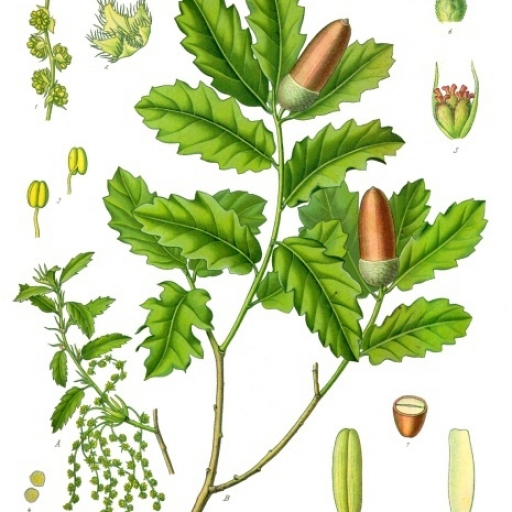
Plant Overview
Known famously as the Gall Oak, Quercus lusitanica is a resilient, low-growing oak species native to the rocky landscapes of the Iberian Peninsula and North Africa. Unlike its towering cousins, it often presents as a charming, gnarled shrub or a small tree, making it a rugged survivor of Mediterranean droughts. Its most distinctive legacy isn't its height, but its role in history—producing the "oak apples" used to write some of the world’s most famous medieval manuscripts.
🔍 How to Identify
- 🍃 Leathery Foliage: The leaves are small, thick, and leathery with a shiny green top and a paler underside. They usually feature wavy or shallowly toothed edges.
- 🍎 Oak Galls: You will often find round, brownish, marble-sized growths called "galls" on the branches. These are not fruit, but a reaction to tiny gall wasps.
- 🌰 Small Acorns: It produces tiny acorns nestled in scaly, hairy cups, which typically ripen in late autumn.
- 🪵 Gnarled Form: Because it grows slowly in harsh conditions, the trunk often looks twisted and ancient even when the tree is relatively young.
🏡 In Your Garden
- 🌱 Deep Roots: This oak develops a vigorous taproot early in life. This makes it incredibly drought-tolerant, but it also means it "hates" being moved—choose its forever home carefully.
- 🪨 Hardy Survivor: It thrives in poor, rocky, or sandy soils where other trees might wither. It is a fantastic choice for "xeriscaping" (low-water gardening) or Mediterranean-themed landscapes.
- 🦋 Wildlife Magnet: Despite its small size, it provides a massive service to the ecosystem, acting as a host for various beneficial insects and providing food for birds.
⚠️ Safety & Toxicity
- 🐕 Pet Caution: Like most oaks, the leaves and acorns contain high concentrations of tannins. If ingested in large quantities, they can cause digestive upset or kidney issues in dogs, horses, and cattle.
- 🚫 Not for Foraging: While not "poisonous" to touch, the acorns are extremely bitter and are not considered palatable for humans without extensive processing.
✨ Fun Fact
The galls from this specific tree were the primary ingredient for Iron Gall Ink. This ink was the standard for European scribes for over 1,000 years and was used to write the Magna Carta and the United States Constitution!

Detailed Care Instructions
To grow Quercus lusitanica (Portuguese oak), you can follow these steps:
- Select a suitable location: Choose a spot that receives full sun to partial shade and has well-draining soil. Portuguese oak is adaptable to a range of soil types but prefers slightly acidic or neutral soil.
- Prepare the soil: Loosen the soil in the planting area and amend it with organic matter like compost to improve drainage and nutrient content.
- Acquire a young tree or oak acorn: You can either purchase a young tree from a nursery or germinate an acorn.
- To germinate an acorn: Collect fresh acorns during autumn, remove the caps, and store them in a cool, dry place for a few weeks. Sow the acorns in pots filled with well-draining potting soil, burying them about an inch deep. Keep the soil moist but not waterlogged. Place the pots outdoors in a protected area that receives partial shade. After a few months, the acorns will germinate, and you can transplant the seedlings.
- Planting: Dig a hole that is slightly wider and deeper than the root ball or seedling. Place the root ball in the hole (or the young tree if purchased), ensuring that the soil level of the tree is at the same height as the surrounding soil. Backfill the hole with soil, firming it gently around the root ball.
- Watering: Water the newly planted tree thoroughly after planting, and then water it regularly to keep the soil consistently moist but not waterlogged. Increase the frequency of watering during hot, dry spells.
- Mulching: Apply a layer of mulch around the base of the tree, but ensure that it doesn't touch the trunk. Mulching helps to retain soil moisture, prevent weeds, and regulate soil temperature.
- Pruning: Portuguese oak doesn't require extensive pruning, but you can prune to remove any dead or damaged branches. Prune in late winter or early spring before new growth begins.
- Fertilizing: Fertilization may not be necessary if the tree is growing in a nutrient-rich soil. However, if the growth is weak or the leaves show signs of nutrient deficiency, you can apply a balanced slow-release fertilizer in early spring.
- Protecting from pests and diseases: Monitor the tree regularly for pests like oakworms or diseases such as oak wilt. Treat any issues promptly with suitable organic or chemical strategies recommended by a local arborist or gardening expert.
- Patience: Quercus lusitanica grows slowly, so be patient with its growth. It may take several years for the tree to mature and reach its full potential.

Place in a bright room that is sun drenched almost all day. Or directly in a south-facing window.

To water this plant, ensure that the soil is thoroughly moistened but not waterlogged. This plant prefers well-draining soil and may suffer if there is excess water retention or if the soil is too dry. Water the plant deeply, being sure to saturate the entire root zone. It is important to avoid letting the soil dry out completely between watering, as this can cause stress to the plant. Frequency of watering will depend on the climate and humidity of the plant's location. It is recommended to water when the top inch of soil is dry to the touch.
To fertilize this plant, apply a slow-release granular fertilizer with a balanced N-P-K ratio in the spring. Apply at the base of the plant, avoiding contact with the foliage. Water thoroughly after application. Avoid fertilizing in the fall as it may encourage new growth that is susceptible to frost damage. Monitor the plant for signs of nutrient deficiencies such as yellowing leaves or stunted growth, and adjust fertilization as needed.
For Quercus Lusitanica, it is recommended to use well-draining soil that is rich in nutrients. The soil should be slightly acidic, with a pH level between 5.5 and 6.5, and should have good water-holding capacity to ensure consistent moisture. The use of organic matter, such as compost, can help improve soil quality and increase fertility. It is important to avoid soils that are overly compacted or heavy, as this can inhibit root growth and lead to waterlogging. Additionally, the soil should be well-aerated to promote healthy oxygen levels for the roots.
Propagation of this plant can be achieved through a number of methods, including hardwood cuttings and seed propagation. In order to propagate using hardwood cuttings, a mature plant should be selected and a cutting should be taken from the woody portion of the plant. This cutting should be stripped of all leaves and placed in a rooting hormone or rooting powder prior to being placed in a well-draining soil mix. The cutting should be watered regularly and placed in a humid environment with indirect sunlight until it roots and begins to grow.
Seed propagation is another potential method of propagating this plant. Seeds can be collected from a mature plant and planted in a well-draining soil mix. Seedlings should be kept moist and placed in a warm and humid environment with indirect sunlight until they begin to grow and take root. With proper care and attention, these seedlings can be transplanted into larger containers or directly into the garden once they have matured.








