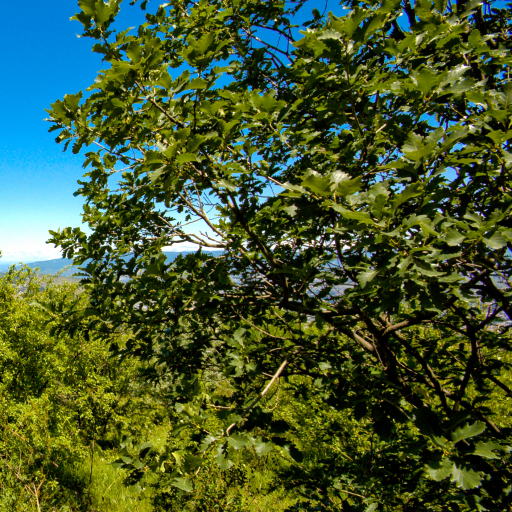
Plant Overview
Known as the Persian Oak or Caucasian Oak, this majestic tree is a resilient mountaineer hailing from the high-altitude forests of the Caucasus, Northern Iran, and Turkey. It is celebrated for its "velvet touch"—a unique fuzziness that protects it from harsh mountain winds and intense sunlight. In its native lands, it stands as a symbol of endurance, often found growing at elevations where other deciduous trees struggle to survive.
🔍 How to Identify
- 🍃 The Foliage: Large, leathery leaves with 8 to 12 pairs of rounded lobes. The upper side is a deep, matte green, while the underside is notably paler.
- 🧶 Velvety Shoots: One of its most distinctive features is the thick, yellowish-grey "felt" or fuzz covering the young twigs and the undersides of the leaves.
- 🌰 The Acorns: Small, oval acorns that sit tucked into cups covered in narrow, downy scales, giving them a slightly "shaggy" appearance.
- 🌳 Growth Habit: A slow-growing tree that eventually forms a broad, rounded, and dense crown, providing excellent deep shade.
🏡 In Your Garden
- 🏔️ Mountain Resilience: Because it evolved in high altitudes, this oak is exceptionally cold-hardy and much more drought-tolerant than many of its European cousins. It is a fantastic choice for "tough" spots in larger landscapes.
- 🌱 Soil & Drainage: While it isn't too picky about soil pH, it absolutely demands well-drained ground. It has a deep taproot, meaning once it is planted, it does not like to be moved, so choose its "forever home" carefully.
- 🌬️ Windbreak Hero: Its sturdy nature and dense branching make it an excellent candidate for windbreaks or as a focal "legacy tree" that will stand for centuries.
⚠️ Safety & Toxicity
- 🟢 General Safety: Like most oaks, the Persian Oak is considered non-toxic to humans upon touch, and its wood is safe to handle.
- 🐾 Pet Warning: The acorns and leaves contain high concentrations of tannins. If ingested in large quantities by dogs, horses, or cattle, they can cause digestive upset or, in rare cases, kidney issues. Keep an eye on curious pets during the autumn acorn drop.
✨ Fun Fact
The Persian Oak is a true "clamberer" of the plant world; it has been found growing at altitudes of up to 2,400 meters (nearly 8,000 feet) in the Alborz Mountains of Iran, where it survives sub-zero temperatures and thin mountain air with ease.

Detailed Care Instructions
To grow a Quercus Macranthera plant, also known as the Persian oak, you can follow these steps:
- Climate and Soil Requirements: Check if your climate is suitable for Quercus Macranthera. It typically grows in temperate regions with hot, dry summers and cold winters. Make sure the soil is well-draining and loamy, with a pH between 6 and 7.
- Seed Collection: Collect ripe acorns from mature Persian oak trees. Look for acorns that have fallen from the tree naturally and show a healthy color and size. Avoid damaged or discolored acorns.
- Cold Stratification: To promote germination, the acorns need a process called cold stratification. Place them in a plastic bag with slightly damp sphagnum moss, sawdust, or sand. Seal the bag and refrigerate it for about two to three months. This mimics the cold winter, breaking the dormancy of the seed.
- Germination: After the stratification period, remove the acorns from the refrigerator and sow them immediately in pots or directly in the ground. Plant them at a depth of about 1 to 2 inches, either horizontally or vertically.
- Location and Sunlight: Select a suitable location with full sun or partial shade. Ensure the site has enough space for the tree to grow to its full size.
- Watering: Keep the soil slightly moist but not waterlogged. Water regularly and deeply, especially during the establishment period. Once the tree matures, it can tolerate drought conditions.
- Mulching and Weeding: Apply a layer of mulch around the base of the plant to retain moisture and suppress weed growth. However, keep the mulch away from the tree trunk to prevent rotting.
- Pruning: Prune any dead or diseased branches to maintain tree health. Additional pruning might not be necessary as Quercus Macranthera generally has a pleasing, symmetrical shape.
- Pest and Disease Control: Monitor the tree for pests such as oak leafrollers, aphids, and gypsy moths. Treat infestations promptly with appropriate organic or chemical solutions. Protect the tree from common oak diseases like oak wilt or powdery mildew by keeping the area clean and providing good airflow.
- Patience and Care: Growing a Quercus Macranthera tree from an acorn is a long-term commitment. It may take several years for the tree to establish and start showing significant growth. Be patient and provide consistent care throughout its lifespan.
Remember to check local regulations and obtain any necessary permits before planting Quercus Macranthera or any other tree species.
To water this plant, first make sure that the soil is completely dry. Then, slowly pour water near the base of the plant, allowing it to soak in thoroughly. Do not overwater, as this can lead to root rot and other issues. Check the soil regularly to ensure that it is not too wet or too dry, and adjust watering accordingly. It is also important to provide good drainage to prevent waterlogging.
To effectively fertilize the Quercus Macranthera plant, use a slow-release fertilizer with a balanced ratio of N-P-K (nitrogen, phosphorus, and potassium). Apply the fertilizer evenly around the base of the plant, avoiding direct contact with the trunk. Water the plant immediately after fertilizing to help the nutrients reach the roots. Fertilize the plant in the early spring and again in the summer, but avoid fertilizing during the dormant season. Be mindful not to over-fertilize, as excess nutrients can harm the plant and surrounding environment.
The ideal soil for the plant in question should be well-draining and loamy in texture. It should have a pH range of 5.5-7.5 and be rich in organic matter. Adding perlite or sand to the soil mix can improve its drainage and aeration properties. Additionally, the soil should be free from any contaminants such as chemicals or heavy metals that could harm the plant. The plant typically prefers a slightly acidic soil, and if the soil is too alkaline, it may suffer from nutrient deficiencies and poor growth. When planting, it is also recommended to include some slow-release fertilizer in the soil to provide essential nutrients to the plant over an extended period.
To propagate the plant, select a healthy stem cutting from the parent plant. The stem should be approximately 6-8 inches in length and have at least two nodes. Remove the lower leaves from the stem, leaving only a few leaves at the top.
Prepare a planting mix using a mixture of well-draining soil and sand. Dip the end of the stem cutting in rooting hormone and plant it in the prepared soil mix. Water the cutting thoroughly and cover it with a plastic bag or clear plastic wrap to maintain high humidity levels.
Place the cutting in a warm, bright location, but out of direct sunlight to prevent wilting. Keep the soil moist and check for signs of rooting after 2-3 weeks. Once the cutting has rooted, gradually acclimate it to lower humidity levels by removing the plastic cover for a few hours each day.
Once the plant has developed a strong root system, it can be transplanted into a larger pot or directly into the ground in a suitable location. Water the plant regularly and provide it with adequate sunlight and nutrients for healthy growth.








