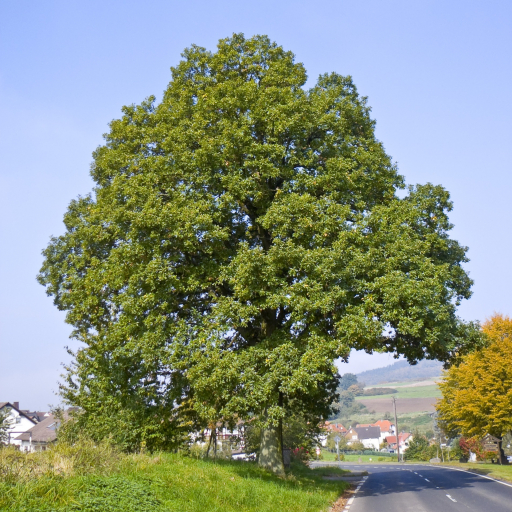
Plant Overview
Known as the "Sessile Oak" or "Durmast Oak," this majestic giant is the silent guardian of European forests. It is often celebrated as the national tree of Ireland and France, symbolizing endurance and ancient strength. Unlike its close cousin, the English Oak, this tree carries its acorns tucked tight against the branches, like precious jewels held close to the heart rather than hanging on long stems.
🔍 How to Identify
- 🍃 The Leaves: Look for long, distinct stalks (petioles) connecting the leaf to the branch. The leaf itself is wavy with rounded lobes and a neat, symmetrical shape.
- 🌰 The Acorns: The defining feature! They are "sessile," meaning they lack a stalk (peduncle) and sit directly on the twig in small clusters.
- 🌳 The Silhouette: In maturity, it forms a tall, straight trunk with an upward-reaching branch structure that creates a stunning, cathedral-like canopy.
🏡 In Your Garden
- ⛰️ A Legacy Tree: This is a "slow-burn" plant. It grows steadily but can live for over 500 years, making it a masterpiece for large estates or parklands rather than small suburban plots.
- 🪵 Soil Preference: It is much more tolerant of acidic, rocky, or well-drained soils than other oak species. It dislikes "wet feet," so avoid planting it in boggy areas where water pools frequently.
⚠️ Safety & Toxicity
- 🐾 Livestock & Pet Warning: While magnificent, the leaves and raw acorns contain high concentrations of tannins. These are toxic to horses, cattle, and dogs if ingested in significant quantities.
- 👶 General Safety: It is perfectly safe to touch or climb. However, the raw acorns are extremely bitter and can cause stomach upset in children if swallowed.
✨ Fun Fact
Because Quercus petraea grows more slowly than other oaks, its wood is exceptionally fine-grained. This makes it the worldwide gold standard for crafting high-end French wine barrels, as it subtly infuses spirits with delicate notes of vanilla and spice.

Detailed Care Instructions
To grow Quercus petraea, also known as the sessile oak or European oak, follow the steps below:
- Soil preparation: Choose a location with well-draining soil that is rich in organic matter. The pH level should be between slightly acidic to neutral. Remove any weeds or grass from the area.
- Germination: Collect acorns from a healthy Quercus petraea tree in autumn. Choose plump, fully mature acorns. Soak the acorns in water for 24 hours to help remove any natural inhibitors that may hinder germination.
- Stratification: Place the soaked acorns in a plastic bag filled with slightly moistened peat moss or vermiculite. Seal the bag and leave it in the refrigerator for 3-4 months. This cold stratification process mimics the natural winter conditions required for germination.
- Potting: After stratification, sow the acorns in small pots or seed trays filled with a well-draining potting mix. Plant them with their pointed ends facing downwards and gently cover them with a thin layer of soil.
- Watering and care: Keep the potting mix moist, but not waterlogged, throughout the germination process. Place the pots in a location with bright, indirect sunlight. Maintain a temperature around 68-75°F (20-24°C). Germination can take several weeks to a few months.
- Transplanting: Once the seedlings develop a few sets of true leaves and are strong enough to handle, transplant them into larger pots or a prepared outdoor planting site. Choose a sunny or partially shaded area for planting.
- Growth and maintenance: Regularly water the young tree, ensuring the soil remains consistently moist. Provide mulch around the base to conserve moisture and suppress weed growth. Prune any damaged or crossing branches to maintain a strong framework. Fertilize annually with a balanced slow-release fertilizer.
- Protection: Protect the young tree from pests like deer or rabbits by using tree guards or fencing. Monitor for diseases like oak wilt and take necessary actions if detected.
It's important to note that growing Quercus petraea from seeds can be a long-term project, as it can take several years for the tree to reach a significant size. Patience and consistent care are key.

Place in a bright room that is sun drenched almost all day. Or directly in a south-facing window.

When watering this plant, it is important to ensure that the soil is moist but not waterlogged. It is recommended to water deeply and infrequently, allowing the soil to dry out slightly between waterings. Avoid overwatering as this can lead to root rot. Monitor the plant closely and adjust watering frequency based on the plant's needs and environmental conditions such as temperature and humidity. Consider using a moisture meter or checking the soil with your finger to determine if it's time to water. Additionally, water the plant early in the morning or late in the evening to prevent water from evaporating too quickly in the heat of the day.
- Choose a high-quality fertilizer specifically formulated for deciduous trees.
- Apply the fertilizer evenly around the base of the tree, avoiding contact with the trunk.
- Use a rake or hand tool to gently work the fertilizer into the top layer of soil.
- Water the tree deeply after fertilizing to ensure the nutrients reach the roots.
- Repeat fertilization annually, preferably in early spring or late fall when the tree is not actively growing.
The recommended soil for a particular plant species depends on various factors such as the natural habitat of the plant, its nutrient requirements, soil texture, pH level, drainage, and climate. Therefore, a specific soil recommendation cannot be made without knowing the specific requirements of the plant in question. However, in general, it is advisable to use well-draining, fertile soil with a pH range of 6.0-7.5 for most trees, including Quercus Petraea. The soil should be rich in organic matter and have a loamy texture with a good water-holding capacity. Additionally, it is essential to ensure that the soil is free from any pathogens or contaminants that may harm the plant. This can be achieved by sterilizing the soil before planting or purchasing sterile potting soil from a reputable supplier.
To propagate this plant, you can take hardwood cuttings from a mature tree during the dormant season. Choose a stem that is at least 1 year old and has a diameter of about ½ inch. Cut the stem into pieces about 8-10 inches long, making sure each cutting has at least one bud. Remove any leaves or side shoots from the bottom half of the cutting. Dip the bottom end of the cutting into rooting hormone and plant it in a pot filled with a well-draining soil mix. Water the cutting and cover the pot with a plastic bag to create a greenhouse-like environment. Place the pot in a warm, bright location, but out of direct sunlight. After about 6-8 weeks, roots should start to develop. Once roots have formed, remove the plastic bag and gradually acclimate the cutting to outdoor conditions. After about a year, the cutting should be ready to transplant into a larger pot or directly into the ground.








