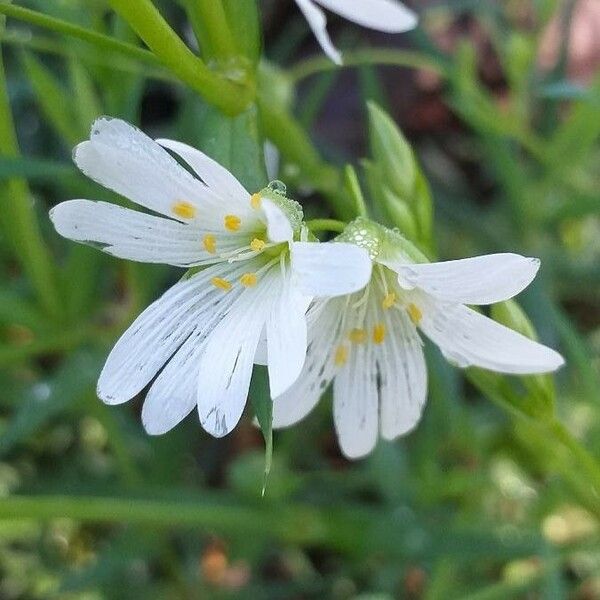
Plant Overview
Commonly known as Greater Stitchwort, this charming wildflower is a hallmark of the European spring. Often called "Wedding Cakes" or "Addersmeat," its brilliant white blossoms seem to float above the grass in woodlands and hedgerows. Historically, it was believed to be a cure for a "stitch" in the side (hence the name), making it a favorite in ancient folk medicine.
🔍 How to Identify
- 🌸 The Petals: Each flower has five white petals, but they are so deeply notched (cleft) halfway down that it often looks like the plant has ten petals.
- 🌿 The Foliage: The leaves are narrow, grey-green, and lance-shaped, resembling blades of grass. They grow in opposite pairs along the stem.
- 📏 The Stem: The stems are distinctive for being square-shaped and remarkably brittle; they "snap" easily if handled roughly, which is why it is sometimes called "Snapdragon" in rural England.
🏡 In Your Garden
- 🌱 Naturalizing: Greater Stitchwort is perfect for "wild" corners of the garden or under deciduous trees. It thrives in dappled shade where it can scramble through other low-growing vegetation for support.
- 🦋 Pollinator Magnet: While it looks delicate, it is a powerhouse for biodiversity, attracting hoverflies, bees, and the occasional butterfly looking for early-season nectar.
- 🍂 Soil Preferences: It prefers well-drained but moist soil. Because it spreads via underground rhizomes, it can form beautiful, dense mats over time, though it is rarely aggressive enough to be considered a nuisance.
⚠️ Safety & Toxicity
- 🟢 General Safety: Greater Stitchwort is not considered highly toxic to humans or common household pets.
- 🤢 Ingestion: While not deadly, ingesting large quantities may cause mild stomach upset or nausea. It is best kept as an ornamental rather than a culinary herb.
- 🐾 Pets: It is generally safe around cats and dogs, though as with any wild plant, discourage them from grazing on it to avoid digestive irritation.
✨ Fun Fact
When the seed capsules of the Greater Stitchwort ripen in early summer, they dry out and eventually "pop" with a distinct clicking sound. This miniature explosion can fire the seeds several feet away from the parent plant, helping it colonize new territory!

Detailed Care Instructions
To grow Rabelera Holostea plants, you can follow these steps:
- Obtain seeds or seedlings: Look for a reliable source to obtain Rabelera Holostea seeds or seedlings.
- Choose an appropriate location: Rabelera Holostea thrives in partially shaded areas with moist, well-draining soil. Choose a spot in your garden or balcony that meets these criteria.
- Prepare the soil: Ensure the soil in the chosen location is loose, fertile, and well-draining. Remove any weeds or rocks and amend the soil with organic matter, such as compost, to improve its nutrient content and drainage.
- Plant the seeds or seedlings: If using seeds, sow them directly into the prepared soil, following the recommended depth and spacing on the seed packet. If using seedlings, dig a hole slightly larger than the root ball and gently place the plant in the hole. Backfill with soil and lightly press down to secure the plant.
- Water regularly: Keep the soil consistently moist, but avoid overwatering. Rabelera Holostea prefers soil that remains moist but not waterlogged. Regularly check the soil moisture and adjust watering accordingly.
- Mulch: Apply a layer of organic mulch around the base of the plants to help conserve moisture, suppress weed growth, and provide insulation to the roots.
- Provide support: Rabelera Holostea is a climbing plant, so it benefits from having something to climb on. Install trellises, stakes, or provide other support structures for the plant to twine around.
- Fertilize: Apply a balanced, slow-release fertilizer once or twice a year to provide necessary nutrients. Consult the fertilizer packaging for specific instructions for application rates.
- Pruning: Regularly prune the plant to control its size and shape. Trim any damaged or dead branches and remove excessive growth to encourage air circulation and prevent disease.
- Monitor for pests and diseases: Keep an eye out for common pests, such as aphids or mealybugs, and promptly address any infestations. Also, watch for any signs of diseases like powdery mildew or leaf spot, and take appropriate actions, such as using organic fungicides or removing affected parts of the plant.
By following these steps, you can successfully grow Rabelera Holostea plants and enjoy their beautiful foliage and flowers.

Place in a bright room that is sun drenched almost all day. Or directly in a south-facing window.

To properly water Rabelera Holostea plants, it is important to follow a certain set of guidelines:
1. Assess the moisture level: Prior to watering, check the moisture level of the soil by inserting your finger about 2 inches deep. If the soil feels dry at this depth, it is an indication that the plant requires water.
2. Choose an appropriate watering method: Rabelera Holostea plants are ideally watered using a gentle watering method, such as a watering can or a spray bottle, to prevent excessive water pressure that may harm the delicate roots.
3. Water thoroughly: Pour water slowly and evenly around the base of the plant to ensure a thorough and even distribution of water. Avoid splashing water on the leaves as this may lead to the development of diseases or fungal infections.
4. Allow proper drainage: Ensure that the pot or container has drainage holes at the bottom to allow excess water to escape. Waterlogging can cause root rot and other problems, so it is essential to prevent water from pooling in the container.
5. Water consistently: Rabelera Holostea plants prefer consistent watering rather than irregular or sporadic watering. Aim to water the plant whenever the top inch or two of soil feels dry, but avoid overwatering as it can cause root rot.
6. Observe watering frequency: The frequency of watering Rabelera Holostea plants can vary depending on factors such as environmental conditions, pot size, and plant size. It is advisable to monitor the plant closely and adjust the watering schedule accordingly.
Remember, while watering is crucial for the health of Rabelera Holostea plants, it is equally important to strike a balance to prevent water-related issues.
To properly fertilize the Rabelera Holostea plant, follow these instructions:
- Choose a well-balanced fertilizer: Look for a general-purpose, slow-release fertilizer with an NPK ratio of around 10-10-10 or similar. This will provide balanced nutrients for the plant's overall health.
- Dilute the fertilizer: Mix the fertilizer with water according to the manufacturer's instructions. Generally, a diluted solution is better as it helps to prevent fertilizer burn and nutrient overload.
- Apply the fertilizer during the active growth period: Start fertilizing the Rabelera Holostea plant when it is actively growing, typically in spring or early summer. Avoid fertilizing during dormancy or when the plant shows signs of stress.
- Apply fertilizer evenly: Pour the diluted fertilizer solution around the base of the plant, making sure to distribute it evenly. Avoid direct contact with leaves or stems to prevent potential damage.
- Water thoroughly after fertilizing: After applying the fertilizer, water the soil thoroughly to help the plant absorb the nutrients and prevent any potential salt build-up in the soil.
- Follow a regular fertilizing schedule: Repeat the fertilization process every four to six weeks throughout the active growing season. Adjust the frequency and dosage based on the plant's response and any specific recommendations provided by the manufacturer.
Remember, it is always a good practice to carefully monitor your plants for any signs of nutrient deficiencies or excessive fertilizer use. Adjust the fertilizing regimen accordingly to ensure the best care for your Rabelera Holostea plant.
The Rabelera Holostea plant thrives in well-draining soil that is rich in organic matter. It prefers a slightly acidic to neutral pH level, typically ranging from 6.0 to 7.5. The soil should be able to retain moisture while also allowing excess water to drain away, avoiding waterlogging.
To provide the appropriate soil texture, a combination of loam and sandy loam is often recommended. This allows for both water retention and good drainage. The loamy soil ensures that the plant can easily take up nutrients and water, while the sandy component enhances drainage and prevents it from becoming too compacted.
The soil should ideally be nutrient-rich, containing a good balance of macronutrients such as nitrogen, phosphorus, and potassium. Additionally, micronutrients like iron, magnesium, and zinc are essential for the plant's overall health. Incorporating organic matter such as compost or well-rotted manure into the soil before planting can help improve its fertility and nutrient content.
It is important to note that the Rabelera Holostea plant is a species that is often found growing in its native habitat in rocky or limestone-rich areas. Therefore, for optimal growth, it can be beneficial to mimic these conditions when recreating its natural environment. Including crushed limestone or rock chips in the soil mix can help provide the plant with the necessary minerals and create a suitable substrate.
Overall, by using soil that is well-draining, slightly acidic to neutral in pH, nutrient-rich, and with added organic matter or rock chips, you can create an ideal growing medium for the Rabelera Holostea plant.
To propagate Rabelera Holostea plant, you can follow these steps:
- Begin by choosing a healthy and mature Rabelera Holostea plant from which to take cuttings. Look for a plant with strong growth and vibrant foliage.
- Prepare a clean and sharp pair of pruning scissors or shears. It is important to use clean tools to minimize the risk of introducing pests or diseases to the plant.
- Identify suitable stem cuttings on the Rabelera Holostea plant. Look for stems that are firm and woody, preferably without any flowers or buds. The stems should be around 4-6 inches in length.
- Make a clean and angled cut just below a node, which is the point where a leaf or bud is attached to the stem. The angle should be around 45 degrees.
- Remove any lower leaves or branches from the stem, leaving only a few sets of leaves at the top. This will help direct the plant's energy towards root development rather than supporting excess foliage.
- Dip the cut end of the stem in a rooting hormone powder or gel. This optional step can enhance the chances of successful rooting by promoting the growth of roots.
- Prepare a well-draining propagation medium for the Rabelera Holostea cuttings. A mixture of perlite and peat moss or a specialized seedling mix can work well. Moisten the medium slightly to ensure adequate moisture but avoid excessive wetness.
- Make small holes in the propagation medium using a pencil or similar tool. Place the dipped end of each cutting carefully into the holes, ensuring that the bottom leaves do not touch the medium.
- Gently press the medium around the base of the cutting to provide stability.
- Place the cuttings in a warm and bright location with indirect sunlight. Avoid exposing them to harsh, direct sunlight, as it may damage the delicate cuttings.
- Maintain a consistent level of moisture in the propagation medium by misting it occasionally or using a spray bottle. Ensure that the medium does not become overly wet or dry.
- After a few weeks, the cuttings should start developing roots. You can gently tug on the cuttings to check for resistance, indicating the presence of roots.
- Once the roots are well-established, carefully transplant the cuttings into individual pots with well-draining potting soil. Continue to provide them with appropriate care, including adequate watering and indirect sunlight.
By following these steps, you can successfully propagate Rabelera Holostea plant and expand your collection or share it with others.
Common pests of the greater stitchwort include Aphids. Make a habit of checking your greater stitchwort frequently for pests so that any infestations can be caught and managed early.








