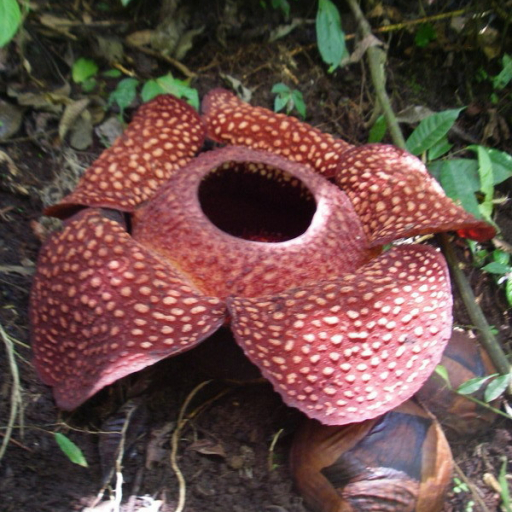
Plant Overview
Often called the "Corpse Lily" or "Monster Flower," Rafflesia arnoldii is the undisputed heavyweight champion of the botanical world. Native to the steaming rainforests of Sumatra and Borneo, this plant holds the record for producing the largest individual flower on Earth. It is a biological enigma—a parasite that lacks leaves, stems, and even roots, living entirely hidden within its host until it’s time to bloom.
🔍 How to Identify
- 🌸 Gigantic Bloom: The flower is unmistakable for its size, often reaching over three feet (one meter) in diameter and weighing up to 24 pounds.
- 🎨 Fleshy Texture: It features five thick, leathery, reddish-brown lobes (petals) covered in raised, pale-white spots that look like warts.
- 🕳️ Central Well: The middle of the flower contains a deep, bowl-like cavity with a "diaphragm" and various spikes called processes that help distribute its infamous scent.
🌿 In the Wild (Habitat Context)
- 🧬 A Ghostly Lifestyle: Because it cannot photosynthesize, you will never see this plant growing in soil. It lives as a series of microscopic threads inside the Tetrastigma vine, emerging only to reproduce.
- 🕰️ Short-Lived Spectacle: It takes nearly nine months for a bud to grow from a small "cabbage-like" lump into a full bloom, yet the flower only stays open for 5 to 7 days before rotting into a black puddle.
⚠️ Safety & Toxicity
- 👃 Sensory Warning: While not "poisonous" to the touch, the bloom emits a powerful stench of rotting meat. This is a deliberate tactic to attract carrion flies for pollination.
- 🚫 Non-Edible: There is no history of this plant being used for food. Its rare status and specific chemical makeup make it something to be observed from a distance, not consumed.
✨ Fun Fact
- 🐘 Despite its massive size, Rafflesia seeds are tiny and dust-like. Scientists believe they are spread when large rainforest animals, like elephants or wild boars, accidentally step on a rotting flower and carry the sticky seeds to a new host vine!

Detailed Care Instructions
Growing Rafflesia arnoldii is a challenging endeavor due to its unique requirements and the rarity of its seeds. However, if you are committed and have access to the necessary resources, you can try the following steps:
- Acquiring seeds: Obtain fresh Rafflesia arnoldii seeds from a trusted source. These seeds are incredibly rare, as the plant itself is threatened and protected in its native habitat. You may need to check with specialized botanical institutions.
- Germination: Rafflesia arnoldii is a parasitic plant that requires a host vine to grow. Obtain a suitable host vine, such as Tetrastigma or other related species. Plant the seeds next to the vine's root system.
- Optimal conditions: Provide the optimum growing conditions for the host vine and the Rafflesia arnoldii seeds. This includes ensuring proper temperature, humidity, and light levels. Mimic the natural habitat of the plant, which is typically tropical rainforests.
- Patience: It can take many years for the Rafflesia arnoldii plant to grow from seed to maturity. Be patient and provide consistent care during this time. The germination and growth process can be quite slow and unpredictable.
- Expert guidance: Seek advice and guidance from botanists or experts who have experience with Rafflesia arnoldii. They can provide specific recommendations based on your local environment and conditions.
Remember that successfully growing Rafflesia arnoldii can be extremely challenging, and even with the best efforts, there is no guarantee of success. It is also crucial to respect and protect the natural conservation of this unique plant species.

The plant in question requires a specific type of watering regimen to grow and thrive. It is important to provide adequate moisture, while also ensuring that the soil does not become waterlogged.
To water this plant, it is recommended to use a spray bottle or watering can with a narrow spout to target the soil directly around the roots of the plant. Watering should be done sparingly, only when the soil is completely dry to the touch.
When watering, it is important to avoid getting water on the leaves or flowers of the plant, as this can lead to fungal growth and damage to the delicate structures of the flower. Additionally, it is important to use room temperature or slightly warm water to avoid shocking the plant's system with cold water.
Overall, watering this plant requires attention to detail and a delicate touch to ensure that it receives the right amount of moisture to thrive.
To fertilize this plant, use a fertilizer with high levels of nitrogen and phosphorus. Apply the fertilizer once every three months during the growing season. Avoid over-fertilizing, as this can lead to stunted growth or damage to the plant. Always follow the manufacturer's instructions for application and dosage. Additionally, make sure to provide adequate water and sunlight for the plant to thrive.
The ideal type of soil for the Rafflesia Arnoldii plant should have a pH level of 5.5 to 6.5. The soil must be well-draining to avoid waterlogging, which can lead to root rot. The soil should also be rich in organic matter to provide essential nutrients to the plant. A combination of peat moss, perlite, and sand is recommended to create light, airy soil that drains well. It is important to avoid using heavy, clay-based soils as they can hold too much moisture. When planting the Rafflesia Arnoldii, it is important to ensure that the soil is loose and well-aerated to provide the roots with access to oxygen.
To propagate this plant, you would need to collect the seeds from mature flowers and sow them in a suitable soil mixture. The area where the plant is grown should be kept warm and humid, with regular watering to ensure that the soil remains moist. Once the seedlings emerge, they should be transplanted carefully into individual pots until they reach a sufficient size to be planted into the ground. It is important to note that this plant requires a specific host plant to survive, and so it is crucial to plant it in close proximity to the host plant.








