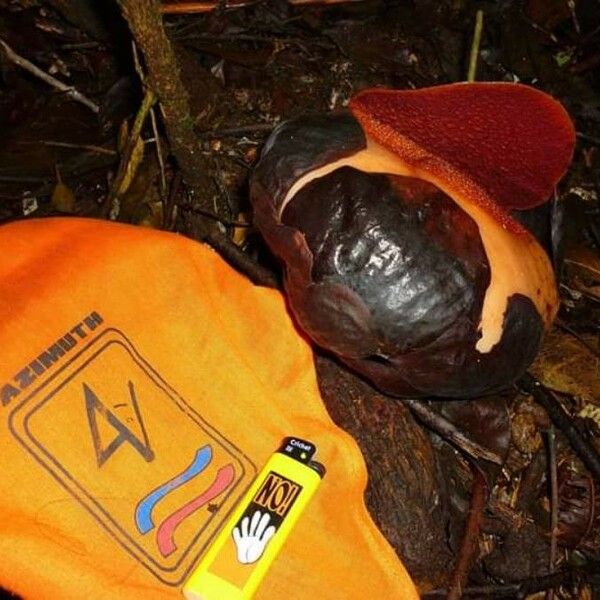
Plant Overview
Known as the "Miniature Corpse Lily," Rafflesia rochussenii is a botanical enigma that defies almost every rule of plant life. Found deep in the misty mountain forests of Java and Sumatra, this rare parasite spends most of its life hidden entirely inside the stems of a specific vine, only emerging as a fleshy, alien-looking bloom that smells like a graveyard to attract its pollinators.
🔍 How to Identify
- 🍄 The "Flower" Body: It lacks stems, leaves, or roots. The bloom emerges directly from the host vine as a dark, cabbage-like bud before opening into a five-lobed fleshy star.
- 🎨 Color and Texture: The petals (perigone lobes) are a deep brick-red or mahogany, densely covered in small, pale, wart-like spots that look like spilled salt.
- 🕳️ The Central Well: In the center is a wide opening (diaphragm) leading to a hollow "cup" where the reproductive organs sit, often surrounded by a ring of spiked structures called ramenta.
🌲 Habitat & Ecology
- 🔗 The Host Connection: This plant is an "obligate parasite." It cannot survive on its own and relies entirely on the Tetrastigma vine for nutrients. It is so specialized that it has lost the ability to perform photosynthesis entirely.
- ☁️ Cloud Forest Resident: Unlike its famous giant cousin (Rafflesia arnoldii), this species prefers higher elevations. It is typically found in moist, montane forests where the air is cool and the humidity is perpetually high.
⚠️ Safety & Toxicity
- ✅ Harmless to Humans: While its appearance and smell might be off-putting, Rafflesia rochussenii is not known to be toxic to humans or pets.
- 🛑 Strictly Protected: This is an extremely rare and endangered species. Because of its complex relationship with its host and its specific habitat needs, it is almost impossible to cultivate in home gardens. If you find one in the wild, admire it from a distance to avoid damaging the delicate host vines.
✨ Fun Fact
Rafflesia species are biological "thieves." Beyond just stealing water and sugar, research suggests they have actually stolen segments of DNA from their host vines over millions of years, a rare phenomenon in the plant world called horizontal gene transfer!

Detailed Care Instructions








