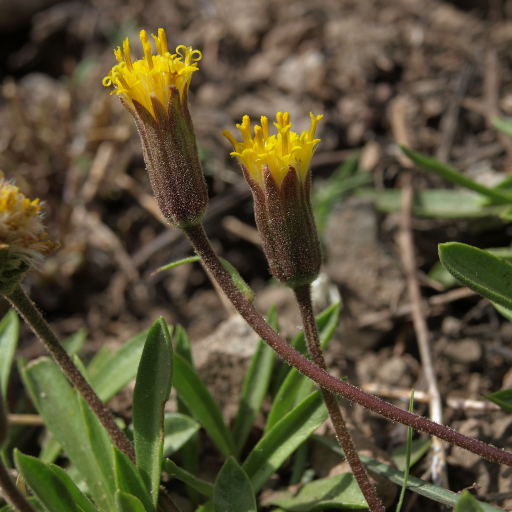
Plant Overview
Often found clinging to the wind-swept, rocky ridges of the Sierra Nevada, Raillardella scaposa—frequently called the Stemmed Raillardella—is a resilient alpine specialist. Unlike many of its flashy cousins in the daisy family, this plant opts for a minimalist aesthetic, trading large, showy petals for striking, golden-yellow "pincushion" flowers. It is a true survivor of high altitudes, thriving in harsh conditions where most garden favorites would wither.
🔍 How to Identify
- 🍃 Basal Foliage: The leaves form a tight, grounded rosette at the base. They are narrow, lance-shaped, and typically covered in fine, sticky glandular hairs that help trap moisture and deter insects.
- 📏 The Scape: The plant gets its name from its "scape"—a single, leafless, and upright stalk that rises directly from the center of the leaves, reaching anywhere from 4 to 15 inches tall.
- 🟡 The Flower Head: It produces a solitary flower head at the top of the stalk. Interestingly, it lacks "ray florets" (the parts we usually call petals), consisting entirely of dense, fuzzy disc florets that create a brilliant yellow pom-pom effect.
🏡 In Your Garden
- 🏔️ The Alpine Specialist: This isn't your average backyard perennial. It is an "extremophile" that prefers the thin, mineral-rich soils of subalpine scree slopes. In a home setting, it is best suited for specialized rock gardens or alpine troughs that mimic mountain peaks.
- 💧 Drainage is Vital: Because it evolved on rocky slopes where water moves rapidly, it is highly sensitive to stagnant water. It requires a gritty, volcanic, or sandy soil mix; ordinary potting soil will almost certainly lead to root rot.
⚠️ Safety & Toxicity
- ✅ Safe Status: Raillardella scaposa is not known to be toxic to humans, dogs, or cats. It is generally considered a "safe" plant for high-altitude landscapes.
- ✋ Skin Sensitivity: The leaves and stems are often "glandular," meaning they are sticky to the touch. While not poisonous, this resinous coating can occasionally cause minor skin irritation or a "tacky" feeling on the hands of sensitive individuals.
✨ Fun Fact
Genetic testing has revealed a fascinating family secret: this modest mountain plant is one of the closest mainland relatives to the spectacular and rare Hawaiian Silverswords! Scientists believe their common ancestors "island-hopped" across the Pacific millions of years ago.

Detailed Care Instructions

Some plants require more regular watering than others, which should be done every few days. It's critical to maintain the soil moist all of the time. The water requirements of the same plant placed in pots with varying sizes will differ. Because the water in the smaller pot evaporates faster than the water in the larger pot, it will require more watering. Regardless of pot size, the surface should constantly be maintained moist.








