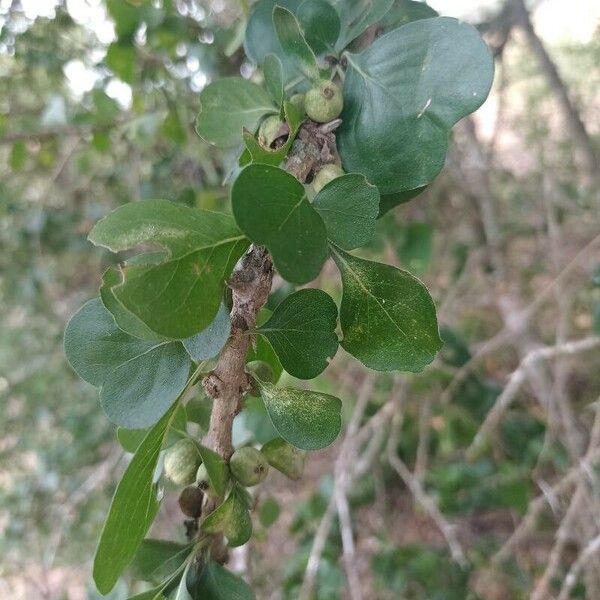
Plant Overview
Known as the "Peabush" or "Box-leaf Randia," this resilient shrub is a master of the coastal landscape. With its dense, architectural branching and tiny heart-shaped leaves, it often resembles a natural bonsai sculpted by the wind. While it appears delicate from a distance, it is a rugged survivor that commands respect in any garden.
🔍 How to Identify
- 🍃 Heart-Shaped Foliage: The hallmark feature is the "obcordate" leaf—meaning it is shaped like a heart with the narrow point attached to the stem. The leaves are small, leathery, and a deep, glossy green.
- ⚔️ Geometric Spines: Look for stiff, greyish branches that grow at right angles. These stems are armed with sharp, paired thorns that emerge from the leaf axils, giving the plant a distinct "zigzag" skeletal structure.
- 🌼 Fragrant Stars: It produces tiny, creamy-white flowers that are shaped like five-pointed stars. Despite their small size, they emit a heavy, jasmine-like fragrance that carries on the evening breeze.
🏡 In Your Garden
- 🏖️ Coastal Warrior: This plant is incredibly salt-tolerant. It is one of the few shrubs that can thrive in the direct salt spray of a beachfront property without losing its leaves or vigor.
- 🛡️ Living Security: Because of its dense growth habit and sharp thorns, it serves as an excellent "defensive hedge." It creates an impenetrable barrier that deters trespassers while providing a safe haven for local wildlife.
- 🏜️ Drought Resilience: Once established, the Peabush is remarkably water-wise. It prefers "tough love" and well-draining soil; overwatering or planting it in soggy ground is the quickest way to cause root stress.
⚠️ Safety & Toxicity
- 🌵 Physical Hazard: While the plant is not known to be chemically toxic, its spines are exceptionally sharp. They can easily pierce thin gardening gloves and cause painful puncture wounds.
- 🐾 Pet & Child Safety: It is generally considered non-toxic if accidentally ingested. However, the thorns pose a significant physical risk to curious pets or children playing nearby. Position it toward the back of garden beds to avoid accidental stabs.
✨ Fun Fact
The Peabush is a favorite "fortress" for small songbirds. Its dense, thorny interior creates a protected nesting site that is almost entirely unreachable by climbing predators like cats or hawks, making it a five-star hotel for backyard birds.

Detailed Care Instructions

Place in a window with dappled sun or a spot in the middle of a room. Or directly in a window facing west or east.

Some plants require more regular watering than others, which should be done every few days. It's critical to maintain the soil moist all of the time. The water requirements of the same plant placed in pots with varying sizes will differ. Because the water in the smaller pot evaporates faster than the water in the larger pot, it will require more watering. Regardless of pot size, the surface should constantly be maintained moist.








