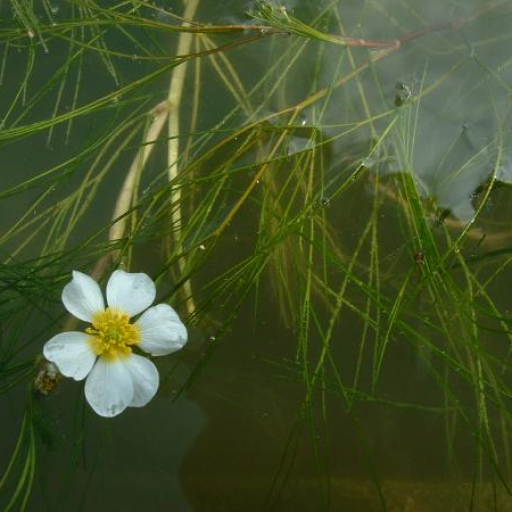
Plant Overview
Often called "River Snow" or the "River Water-crowfoot," this aquatic beauty creates breathtaking white blankets across fast-moving streams in early summer. A specialized member of the buttercup family, it has traded the meadow for the riverbed, evolving long, flowing tresses that dance gracefully with the water's current. It is a hallmark of clean, oxygen-rich chalk streams and rivers across Europe.
🔍 How to Identify
- 🌼 The Flowers: Small, cup-shaped white blossoms with five delicate petals and a bright yellow "eye" at the center, usually held just above the water's surface on sturdy stalks.
- 🌿 Streamlined Foliage: Long, dark green submerged leaves that look like fine, parallel tassels or hair; they are specifically designed to offer minimal resistance to rushing water.
- 📏 Growth Habit: Unlike pond lilies that sit still, these plants form long, trailing mats that can stretch up to 6 meters in length, following the direction of the flow.
🏡 In Your Garden & Ecology
- 💧 Moving Water Preference: This isn't your average pond plant; it is an "obligate" lover of moving water. It thrives in high-oxygen environments and will struggle in stagnant or still garden ponds.
- 🐟 Wildlife Sanctuary: It is a vital "nursery" plant. The dense, trailing tresses provide essential hiding spots for young trout and salmon, and the submerged stems are often covered in tiny invertebrates that fish love to eat.
⚠️ Safety & Toxicity
- 🚫 Irritant Status: Like all members of the Ranunculus family, the plant contains ranunculin, which turns into a bitter, acrid toxin called protoanemonin when the plant is crushed or bruised.
- 🐾 Skin & Digestion: Contact with the sap can cause skin redness or blistering in sensitive individuals. If ingested by pets or livestock, it can cause salivation, abdominal pain, and digestive distress.
✨ Fun Fact
- 🐝 Waterborne Pollination: Although it lives most of its life underwater, the River Water-crowfoot is an "over-achiever." It sends its flowers above the surface specifically to attract bees and hoverflies, but if the water level rises suddenly, it can actually pollinate itself while submerged!

Detailed Care Instructions
To grow Ranunculus fluitans, also known as water buttercup, follow these steps:
- Choose a proper container: Select a wide and shallow container or pond to plant your Ranunculus fluitans. Make sure it has adequate drainage holes.
- Prepare planting medium: Fill the container with a mixture of aquatic potting soil or sand. Avoid using regular garden soil as it can be too heavy and negatively affect the plant's growth.
- Acquire plant or seeds: You can obtain Ranunculus fluitans by purchasing established plants or by collecting seeds. If using seeds, scarify them gently by rubbing them between two sheets of fine sandpaper to improve germination.
- Planting: If using established plants, dig a hole in the planting medium and place the plant into it. Cover the roots with soil/sand, leaving the crown exposed. If starting from seeds, sprinkle them evenly over the soil/sand surface.
- Placement: Place the container or plant in a location that receives full or partial sunlight. Ensure the water level covers the crown of the plant. Ranunculus fluitans prefers slightly acidic to neutral water (pH 6.0-7.5).
- Watering: Keep the water level consistent, ensuring it covers the crown of the plant. Avoid letting the plant dry out but also prevent waterlogging. Stagnant water can harm the plant, so provide some movement if possible.
- Fertilizing: Use a slow-release aquatic fertilizer or add liquid fertilizer specifically formulated for aquatic plants. Follow the instructions on the fertilizer packaging to avoid overfeeding.
- Maintenance: Regularly remove any dead or dying foliage from the plant to maintain its appearance. If the plant becomes overcrowded, divide it by gently pulling it apart and replanting the individual clumps.
- Winter care: In colder regions, move the container indoors or to a warmer location if possible, as Ranunculus fluitans is sensitive to cold temperatures. Provide enough light during the winter months to ensure the plant survives until spring.
Remember to check if Ranunculus fluitans is an invasive species in your area before growing it, as it can spread rapidly and disrupt local ecosystems.

Place in a bright room that is sun drenched almost all day. Or directly in a south-facing window.

Ranunculus Fluitans is an aquatic plant that requires constant moisture to thrive. To water this plant, it is crucial to keep it submerged in water at all times. In a home aquarium, this can be achieved by placing the plant in the bottom of the tank and ensuring the water level is high enough to cover the plant. If the water level drops, it is important to add more water promptly to prevent the plant from drying out. In outdoor water gardens, the plants can be kept in shallow areas of the water feature to ensure they are always submerged. Regular monitoring of the water level is essential, especially during hot and dry weather conditions where evaporation can reduce the water level rapidly. When adding water, it is important to do so gently to avoid disturbing the plant and its surroundings. Proper watering of Ranunculus Fluitans is critical to ensure its vibrancy and overall health.
- Begin fertilizing when the plant is actively growing.
- Use a balanced liquid fertilizer, mixing according to package instructions.
- Apply the fertilizer once every two weeks, diluting the concentration to half strength.
- Avoid over-fertilizing as it may cause damage to the plant.
- Apply the fertilizer directly to the water and not to the leaves or flowers.
- Monitor the plant's growth and adjust the fertilization schedule as needed.
- Stop fertilizing before the plant goes dormant for the winter.
The best type of soil for the Ranunculus Fluitans plant should have a neutral pH level and be rich in nutrients. It should also be able to hold moisture without becoming waterlogged. A mixture of aquatic plant soil and sand is ideal for this plant. The soil should be well-draining and be able to provide good aeration to the plant's roots. Additionally, it is important to avoid using soil that has high levels of phosphates or nitrates since this can lead to excessive algae growth and damage the plant.
- Identify the plant - Ranunculus fluitans is an aquatic plant that grows in water bodies such as ponds, lakes, and streams. It has small yellow flowers and long green leaves.
- Choose healthy plants - Select healthy and well-established plants that have strong roots and are clearly identifiable as Ranunculus fluitans.
- Prepare cutting equipment - Get a sharp pair of scissors or pruning shears and a clean and sharp knife to make a clean cut.
- Take stem cuttings - Cut a stem from the mother plant that is about 10-20cm long. Make sure there are enough leaves on the stem.
- Remove the lower leaves – Remove the lower leaves on the stem leaving the smaller ones on the top.
- Treat the cuttings with rooting hormone – Dip the end of the cutting into rooting hormone to increase the chance of rooting and growth.
- Plant the cutting – Fill a container with water and place the cutting in it so that the cut end is submerged in the water.
- Place the container in a sunny location - Place the container in a warm, well-lit location where it can get plenty of sunlight.
- Change the water regularly - Change the water in the container every few days to keep it fresh and prevent the growth of algae.
- Wait for roots to grow – Within a few weeks, roots should begin to grow on the cutting.
- Transfer to soil – Once roots have grown, transfer the cutting to soil in another container. Water it regularly and place it in a sunny location where it can continue to grow.








