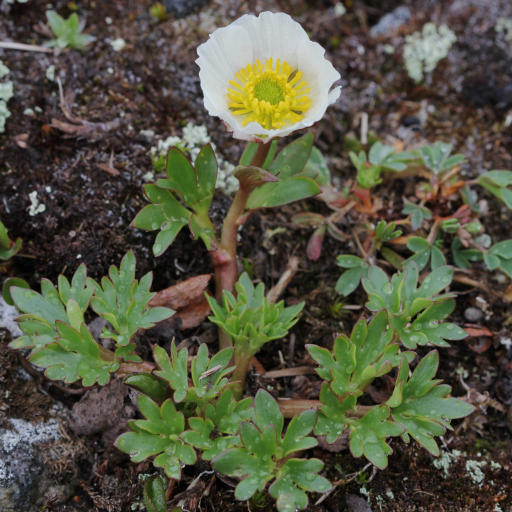
Plant Overview
Known as the "Mountaineer of the Plant World," the Glacier Crowfoot holds the record for being one of the highest-climbing flowering plants on Earth. Found clinging to the rocky peaks of the Alps and the icy tundras of the Arctic, this resilient buttercup thrives where most life fails. It is famous among hikers for its "color-shifting" petals that transition from snowy white to a deep, bruised purple as they age.
🔍 How to Identify
- 🌸 The Color-Changing Bloom: The flowers emerge a brilliant, waxy white. Once pollinated, they undergo a dramatic transformation, turning pink and eventually a dark reddish-brown to absorb more solar heat for seed development.
- 🍃 Succulent-Like Foliage: The leaves are thick, fleshy, and deeply lobed with a distinct blue-green or grayish tint. This "succulence" helps the plant store nutrients and withstand the biting mountain winds.
- 🏔️ Compact Growth: Standing only 5 to 20 cm tall, it grows in low, sturdy clumps. The stems are often tinged with red and are surprisingly thick to support the heavy blooms against the elements.
🏡 In Your Garden
- ❄️ The Ultimate Cold-Lover: Unlike most garden plants, the Glacier Crowfoot is nearly impossible to grow in traditional backyard soil. It requires a "scree" environment—essentially a mix of crushed rock and freezing meltwater—to mimic its high-altitude home.
- 💧 The Meltwater Mimic: It hates stagnant water but demands constant moisture. In the wild, it drinks from melting glaciers; in a rock garden, it needs perfectly draining volcanic or granite grit and should never be allowed to fully dry out or overheat.
- 🚫 Sensitive Roots: Because it relies on a deep, specialized root system to anchor itself in shifting rocks, it is notoriously difficult to transplant. If you are lucky enough to have one in an alpine trough, "look but don't touch" is the best policy.
⚠️ Safety & Toxicity
- 🚫 Toxic if Ingested: Like all members of the Buttercup family (Ranunculaceae), this plant contains ranunculin, which turns into a bitter, toxic oil called protoanemonin when the plant is crushed or chewed.
- 🖐️ Skin Irritant: Handling the plant with bare hands can cause localized skin redness or blistering in sensitive individuals. It is best to wear gloves or keep curious pets and children away from it.
✨ Fun Fact
The Glacier Crowfoot is a true record-breaker; it has been found growing on the Finsteraarhorn in the Swiss Alps at an elevation of over 4,200 meters (nearly 14,000 feet), making it the highest-occurring flowering plant in all of Europe!

Detailed Care Instructions

Place in a bright room that is sun drenched almost all day. Or directly in a south-facing window.

Some plants require more regular watering than others, which should be done every few days. It's critical to maintain the soil moist all of the time. The water requirements of the same plant placed in pots with varying sizes will differ. Because the water in the smaller pot evaporates faster than the water in the larger pot, it will require more watering. Regardless of pot size, the surface should constantly be maintained moist.








