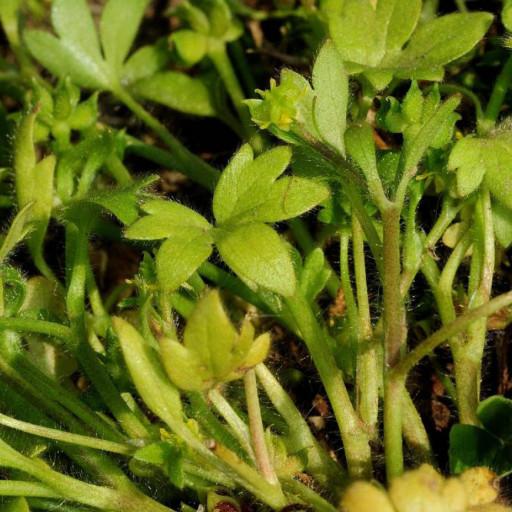
Plant Overview
Known affectionately as the Small-flower Crowfoot, this delicate herb is a humble cousin to the flashy meadow buttercups we often see in wildflower bouquets. While it doesn't boast giant golden blooms, its intricate, hairy leaves and tiny, pale yellow stars tell a story of resilience in disturbed soils. It is a master of "hiding in plain sight" along pathways, woodland edges, and garden borders.
🔍 How to Identify
- 🌼 The Blooms: Look for exceptionally tiny flowers, usually only 3–6 mm across. Unlike most buttercups, the pale yellow petals are often shorter than the green sepals behind them.
- 🌿 Fuzzy Foliage: The stems and leaves are covered in soft, fine white hairs, giving the plant a slightly frosted or matte appearance compared to its shiny-leaved relatives.
- 🍃 Leaf Shape: The leaves are generally heart-shaped or divided into three rounded lobes with "toothed" edges, resembling a tiny, soft bird's footprint.
🏡 In Your Garden
- 🌱 Opportunistic Nature: This plant is an "annual colonizer," meaning it loves disturbed soil. If you’ve recently tilled a bed or have patches of bare earth, don't be surprised to see this guest move in quickly.
- 👣 The Hitchhiker: It produces small, bumpy seeds (achenes) with tiny hooks. These are designed to catch onto your socks or a dog's fur, which is how the plant effortlessly "travels" across your lawn or garden.
⚠️ Safety & Toxicity
- 🚫 Status: Toxic to ingest and a skin irritant.
- 🐾 Details: Like all members of the Ranunculus family, it contains a compound called ranunculin. When the plant is crushed or chewed, this turns into protoanemonin, an acrid oil that can cause mouth blistering, digestive upset, and skin rashes. Keep it away from curious pets and grazing livestock.
✨ Fun Fact
The nickname "Crowfoot" isn't just a random name—it dates back centuries to when people believed the deeply lobed leaves of this family perfectly mirrored the distinct footprint of a crow!

Detailed Care Instructions
To grow Ranunculus parviflorus, also known as small-flowered buttercup, you can follow these steps:
- Choose a suitable location: Select a location that receives full to partial sunlight. Ranunculus parviflorus prefers well-draining soil.
- Prepare the soil: Amend the soil with organic matter, such as compost, to improve fertility and drainage. Remove any weeds or debris from the planting area.
- Plant the tubers: Ranunculus parviflorus grows from tuberous roots. Plant the tubers in the soil, making sure they are planted about 2-3 inches deep. Space the tubers about 6-8 inches apart.
- Watering: Water the tubers immediately after planting and then keep the soil consistently moist throughout the growing season. However, be careful not to overwater as it can lead to root rot.
- Fertilization: Fertilize Ranunculus parviflorus with a balanced, slow-release fertilizer at the beginning of the growing season and then again a few months later. Follow the package instructions for proper application rates.
- Mulching: Apply a layer of organic mulch, such as straw or wood chips, around the plants to help retain moisture, suppress weeds, and moderate the soil temperature.
- Pruning: Remove any dead or faded flowers to encourage continuous blooming. After the blooming season, you can trim back the foliage to ground level.
- Pests and diseases: Ranunculus parviflorus is generally resistant to pests and diseases. However, keep an eye out for slugs or snails, which may feed on the foliage. Use appropriate measures to control them if necessary.
- Winter care: Since Ranunculus parviflorus is a perennial plant, it needs protection during winter. Mulch around the base of the plants with a layer of leaves or straw to insulate them from freezing temperatures.
- Propagation: You can propagate Ranunculus parviflorus by dividing the tubers in the early spring or fall. Dig up the tubers, divide them into smaller sections, and then replant them in suitable locations.
By following these guidelines, you should be able to successfully grow Ranunculus parviflorus and enjoy its beautiful small flowers.

Place in a bright room that is sun drenched almost all day. Or directly in a south-facing window.

To properly water this plant, it is important to take into consideration its specific watering needs. Make sure to check the soil moisture level before watering to avoid over or under watering. This can be done by sticking a finger 1-2 inches into the soil or by using a moisture meter. It is also important to water the plant at the base, avoiding getting water on the leaves or flowers. The frequency of watering will depend on the environment the plant is in, such as temperature and humidity. It is recommended to water when the soil feels dry to the touch, but not completely dried out. Lastly, make sure the plant has proper drainage to avoid root rot.
To fertilize this particular plant, you should choose a balanced fertilizer with equal levels of nitrogen, phosphorus, and potassium (N-P-K). Apply the fertilizer in early spring before the plant begins to flower, and then again after the flowers have bloomed. Be careful not to over-fertilize, as this can lead to excess foliage growth at the expense of flowers. Water the plant well after fertilizing to help the nutrients penetrate the soil.
The soil requirements for the Ranunculus Parviflorus plant are specific and must be considered carefully. The plant requires well-drained soil that is rich in organic matter. A loamy soil that is slightly acidic with a pH level of 6 to 6.5 is ideal for this plant.
The soil must be fertile, and the plant should be fed with a balanced organic fertilizer. Additionally, the soil should be kept moist but not waterlogged to prevent root rot. The plant should be grown in a sunny location that receives at least six hours of direct sunlight a day.
A complex soil mixture can be created by combining equal parts of peat moss, perlite, and garden soil. This mixture should be mixed thoroughly and used for planting the Ranunculus Parviflorus plant. The soil mixture should be amended with additional organic matter, such as compost or well-rotted manure, before planting.
Overall, the soil for the Ranunculus Parviflorus plant should be well-draining, fertile, and rich in organic matter. It should be kept moist but not waterlogged and should have a slightly acidic pH level. A mixture of peat moss, perlite, and garden soil combined with additional organic matter is ideal for planting this plant.
To propagate this plant, start by collecting seeds from mature flowerheads in the fall. Sow the seeds in a seed tray filled with well-draining soil and cover with a thin layer of soil. Keep the soil moist and place the tray in a warm, bright spot. Once the seedlings have developed true leaves, transfer them to individual pots and continue to grow them in a warm, well-lit spot. After a few months, the plants should be strong enough to be planted outdoors in a sunny, well-draining spot. Alternatively, the plant can be propagated by dividing mature clumps in the spring or fall, carefully separating individual small bulbs and replanting them in a new location.








