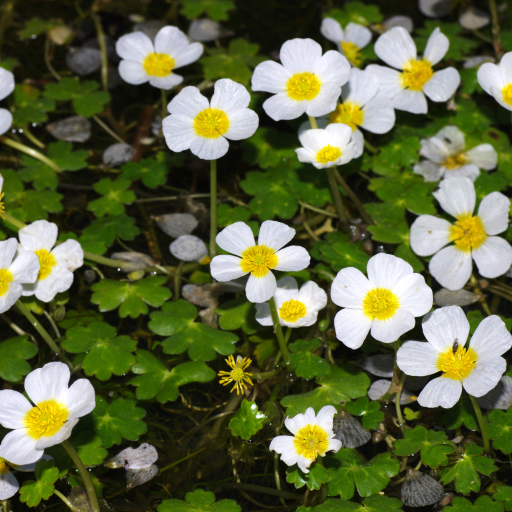
Plant Overview
Often called the Pond Water-crowfoot, this aquatic beauty belongs to the buttercup family but has traded the meadow for the lake. It is a master of adaptation, looking completely different depending on whether its leaves are swimming or floating. During the peak of summer, it transforms dark, still ponds into shimmering white landscapes that look like a galaxy of "watery stars."
🔍 How to Identify
- 🍃 Two-Faced Foliage: It produces two distinct leaf types. The floating leaves are broad and round (like tiny lily pads), while the submerged leaves are finely divided into hair-like threads to catch oxygen under the surface.
- 🌼 Buttercup Blooms: The flowers are classic buttercups but in "white-tie" attire. They feature five snowy-white petals with a bright, sunny yellow center, held just an inch or two above the water.
- 🥖 Trailing Stems: The long, succulent stems are surprisingly tough and flexible, allowing the plant to anchor itself in the mud while stretching toward the light.
🏡 In Your Garden
- 💧 The Great Oxygenator: In a home pond, this plant is a powerhouse. It helps keep the water clear by competing with algae for nutrients and provides essential hiding spots for tadpoles and small fish.
- ☀️ Sun Chaser: It requires plenty of direct light hitting the water's surface to trigger its impressive flowering display. If grown in deep shade, it may stay entirely submerged and skip the blooming phase altogether.
⚠️ Safety & Toxicity
- 🚫 Toxic if Ingested: Like its terrestrial buttercup cousins, the Pond Water-crowfoot contains protoanemonin, a bitter chemical that serves as a defense mechanism against being eaten.
- 🐾 Irritant Potential: The sap can cause skin irritation or "buttercup burn" in humans and pets. While it is rarely fatal because it tastes so foul, it should be kept away from curious dogs or livestock grazing near pond edges.
✨ Fun Fact
- 🧬 The Shape-Shifter: Ranunculus peltatus is a biological marvel of "phenotypic plasticity." If the pond dries up during a hot summer, the plant can actually transition to a land-based form, growing tougher, smaller leaves to survive the mud until the water returns!

Detailed Care Instructions
| Humidity | High |
| Lighting | Part Sun |
| Difficulty | Easy |
| Temperature | 20°C - 27°C |
| Hardiness Zones | 4 - 8 |
To grow Ranunculus Peltatus plant, also known as the water buttercup, follow these steps:
- Choose a planting spot: Ranunculus Peltatus is an aquatic plant and prefers to grow in shallow water or in wet soil near ponds, lakes, or streams. Ensure that the planting area receives partial shade.
- Obtain the plants or seeds: You can either purchase Ranunculus Peltatus plants or collect seeds from existing plants.
- Prepare the planting area: Clear any weeds or debris from the intended planting spot. If planting in a pond or water feature, place the container with the Ranunculus Peltatus plant at an appropriate depth, ensuring it is not completely submerged.
- Planting in soil: If you are planting Ranunculus Peltatus in soil, ensure that the soil is loamy and moist. Dig a hole deep enough to accommodate the roots of the plant. Place the plant in the hole, backfill with soil, and gently firm the soil around the plant.
- Planting in water: If planting Ranunculus Peltatus in water, it is best to use pots or containers submerged in the water. Create a mixture of loamy soil and aquatic compost and fill the container. Place the plant in the container and submerge in the water to the appropriate depth.
- Maintenance: Ensure that the soil or water around the plant is consistently moist. In case of planting in water, monitor the container's water level to avoid drying out. Regularly remove any dead or decaying plant material from the planting area.
- Fertilization: Ranunculus Peltatus does not require heavy fertilization. However, you can apply a balanced aquatic plant fertilizer according to the manufacturer's instructions if desired.
- Propagation: Ranunculus Peltatus can propagate by both seeds and division. If collecting seeds, allow the plant to flower and then collect the ripe seeds. To propagate through division, lift the plant out of its pot or planting area and carefully divide the clumps. Replant the divided sections in suitable planting locations.
- Winter care: In cooler regions, Ranunculus Peltatus may need protection during the winter months. If planted in soil, add a layer of mulch over the plant's roots to protect them from freezing. If planted in water, move the container to a deeper area of the pond or water feature where the water is less likely to freeze.
By following these steps, you can successfully grow Ranunculus Peltatus plants and enjoy their beautiful blooms.

Place in a bright room that is sun drenched almost all day. Or directly in a south-facing window.

Ranunculus Peltatus is a plant that requires regular watering to thrive. It is recommended to water the plant deeply and thoroughly, ensuring that the entire root zone is moistened. The amount of water required will depend on the size of the plant, the size of the container or planting area, and the climate.
To water the plant, gently and slowly pour water at the base of the plant, being careful not to splash water on the leaves or flowers, as this can lead to fungal diseases. It is recommended to water in the early morning or evening to reduce the amount of water lost due to evaporation.
It is important to avoid overwatering, as this can lead to root rot and other problems. Allow the soil to partially dry out between waterings, and adjust the frequency of watering in response to changes in weather conditions.
Additionally, it is important to provide good drainage to prevent waterlogging and ensure that the roots have access to oxygen. If the soil is heavy or compacted, consider adding sand or perlite to improve drainage.
Overall, by providing consistent and appropriate watering, Ranunculus Peltatus can thrive and produce vibrant, beautiful flowers.
To fertilize this plant, you will want to use a balanced fertilizer with equal ratios of nitrogen, phosphorus, and potassium. Apply the fertilizer at the base of the plant, being careful not to get any on the leaves. It is best to fertilize once every two weeks during the growing season, which typically runs from early spring to late fall. Be sure to follow the instructions on the fertilizer packaging for proper dilution and application rates.
The ideal soil for the Ranunculus Peltatus plant is one that is well-draining and rich in organic matter. This soil should have a pH level that is slightly acidic to neutral (between 6.0 and 7.0). The soil should also be moist but not waterlogged, as this can cause root rot in the plant. It is recommended to use a high-quality potting mix that is specifically designed for flowering plants and vegetables. Additionally, adding a slow-release fertilizer to the soil can help provide the plant with essential nutrients throughout the growing season.
To propagate this plant, you can start by collecting seeds from the mature flowers. Sow the seeds in moist soil and cover them lightly with a thin layer of soil. Keep the soil consistently moist and warm, ideally at a temperature of around 70-75 degrees Fahrenheit. After a few weeks, the seeds should germinate and start to grow.
Another way to propagate this plant is through division. Dig up the mature plant and carefully separate the roots into smaller clumps, making sure to keep some leaves and stems attached to each clump. Plant these clumps in separate containers or in a new location in the garden. Water them regularly and keep them in a warm, sunny location until they have established themselves.








