Plant Overview
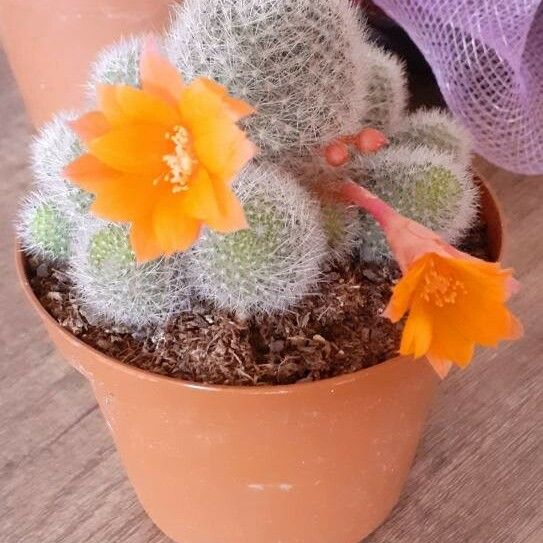
Known affectionately as the Orange Snowball Cactus, this Bolivian native looks like a soft puff of winter frost has landed on your windowsill. Despite its delicate, furry appearance, it is a hardy survivor from the high-altitude Andes mountains. It is a favorite among succulent collectors for the stunning, high-contrast visual of its snow-white spines against fiery, trumpet-shaped orange blooms.
🔍 How to Identify
- ☁️ The Body: A small, globose (round) cactus that grows in clusters. It stays low to the ground, rarely exceeding 4 inches in height, but creates a beautiful "cushion" effect as it spreads.
- 🧶 Spines: The plant is densely wrapped in fine, hair-like white spines. These give the cactus a "fuzzy" or "wooly" texture that completely obscures the green body underneath.
- 🧡 The Bloom: During spring and early summer, it produces large, vivid orange flowers. Unlike many cacti that bloom from the top, these flowers often emerge from the base or the sides of the stems.
🏡 In Your Garden
- 🏔️ Mountain Resilience: Because it originates from high elevations, it appreciates a "cool" winter dormancy period. Keeping it in a bright but unheated room during winter actually encourages a more spectacular flower show in the spring.
- 💧 The "Rot" Rule: This cactus has a delicate root system that hates sitting in water. Use a very gritty, porous soil mix (heavy on perlite or pumice) to ensure the roots can breathe and dry out quickly after a drink.
⚠️ Safety & Toxicity
- ✅ Pet Friendly: The Rebutia muscula is considered non-toxic to cats, dogs, and horses. It is one of the safest cacti to keep in a home with curious pets.
- 🧤 Physical Caution: While the spines are "soft" compared to a Prickly Pear, they are still glochids that can lodge in the skin and cause mild irritation. Always handle with gardening gloves or a folded piece of cardboard.
✨ Fun Fact
Unlike many desert cacti that can take decades to flower, the Orange Snowball is a "precocious" bloomer. It often begins producing its signature orange crowns when it is just a tiny seedling, barely an inch wide!

Detailed Care Instructions
To grow a Rebutia muscula plant, you can follow these steps:
- Lighting: Place the plant in a location that receives bright but indirect sunlight for most of the day. Rebutia muscula prefers around 6-8 hours of sunlight per day.
- Temperature: Rebutia muscula can tolerate a wide range of temperatures, but it tends to grow best in temperatures between 60-80°F (15-27°C). It can withstand lower temperatures but may not grow as vigorously in cooler conditions.
- Watering: Water the plant thoroughly when the top inch of soil is dry. Rebutia muscula prefers well-draining soil, so make sure the pot has drainage holes to prevent waterlogging. During the growing season (spring and summer), water more frequently but allow the soil to dry slightly between waterings. Reduce watering during the dormant period (fall and winter).
- Fertilizer: Feed Rebutia muscula with a balanced cactus or succulent fertilizer once every 4-6 weeks during the growing season. Dilute the fertilizer to half the recommended strength and apply it to damp soil.
- Potting: Choose a pot that is slightly larger than the plant's current size and has drainage holes. Repot the plant every 1-2 years or when it outgrows its current pot. Use a well-draining cactus or succulent potting mix to ensure good root health.
- Propagation: Rebutia muscula can be propagated from offsets (also known as pups) or seeds. To propagate from offsets, gently separate the pups from the parent plant and plant them in a separate pot. For seed propagation, sow the seeds in a well-draining cactus or succulent mix and keep them moist until they germinate.
- Pests and diseases: Monitor the plant for common pests such as mealybugs or spider mites. If detected, treat the plant with a mild insecticidal soap or neem oil. Ensure good airflow around the plant to prevent fungal diseases.
Remember to research the specific needs of Rebutia muscula and adjust the care accordingly. Additionally, observing and responding to the plant's condition and requirements will help ensure successful growth.

Place in a bright room that is sun drenched almost all day. Or directly in a south-facing window.

When watering this particular plant, it is important to use a watering can with a small spout to avoid getting water on the foliage. Water should be applied to the base of the plant, avoiding direct contact with the stem as this may cause rotting. The frequency of watering will depend on the environment in which the plant is kept, but it is generally recommended to water sparingly, allowing the soil to dry out completely between waterings. It is also important to use well-draining soil and a pot with adequate drainage holes to prevent water-logging and root rot.
To fertilize this plant, mix a balanced fertilizer with water at half strength. Apply the solution to the soil once a month during the growing season. Avoid fertilizing during winter or when the plant is dormant. Be careful not to over-fertilize as it can cause damage to the plant.
The ideal soil for the plant in question should be well-draining, with good ventilation and water retention. The soil should be slightly acidic with a pH between 6.0 and 7.0. A mixture of coarse sand, perlite, and peat moss is often recommended, along with small amounts of compost or other organic matter for nutrients. It's important to avoid using heavy soils or soils that can hold too much moisture as this can lead to root rot and other issues. Regular watering is necessary, but care should be taken not to over-water, and the plant should be allowed to dry out slightly between waterings.
There are several ways to propagate this plant. One method is through division, where the clumps of the plant are separated into smaller sections, each with their own roots and stems. Another technique is to take stem cuttings, which involves cutting off a section of the stem and allowing it to dry for a few days before planting it in soil. This method is best done in the spring and summer when the plant is actively growing. Finally, seeds can also be used to propagate this plant. This method is best done in the spring and involves planting the seeds in a well-draining soil mixture and keeping them moist until they germinate. Once the plant has germinated, it can be transplanted into its own pot or container.








