Plant Overview
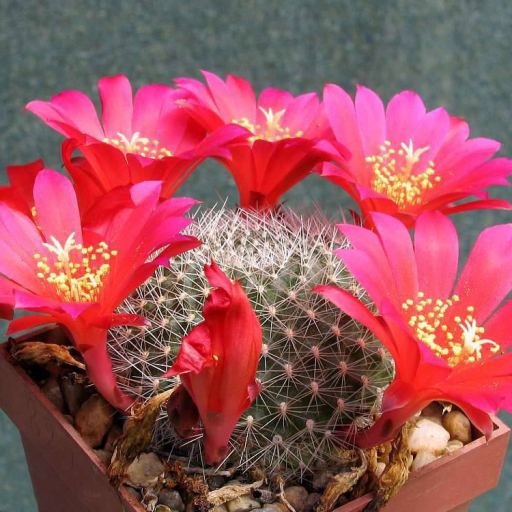
Known as the "Crown Cactus" or "Jewel of the Andes," the Rebutia is a favorite among succulent collectors for its petite size and disproportionately large, vibrant flowers. These charming South American natives are often the first cacti to bloom in a collection, signaling the arrival of spring with a ring of fiery color. Unlike many of their towering desert cousins, Rebutias stay close to the ground, forming delightful little "pin cushions" that are perfect for sunny windowsills.
🔍 How to Identify
- 🌵 The Body: Small, globose (spherical) or slightly flattened stems that rarely exceed a few inches in height. They often grow in dense clusters or "clumps."
- 🌸 Low-Slung Blooms: Unlike many cacti that flower from the very top (the apex), Rebutia flowers emerge from the lower sides or the base of the plant, creating a "skirt" of blossoms.
- 🧶 Spine Texture: Most species feature short, bristly, or hair-like spines that can appear white, gold, or copper. They often look "fuzzy" from a distance rather than menacing.
🏡 In Your Garden
- ❄️ The Winter Chill: To see those famous neon flowers, Rebutias need a "tough love" period in winter. Keeping them in a cool (but not freezing) spot and completely withholding water for a few months mimics their high-altitude habitat and triggers bud production.
- ⛰️ High-Altitude Origins: Because they hail from the mountains of Bolivia and Argentina, they appreciate more fresh air and slightly cooler evening temperatures than tropical houseplants. They prefer gritty, fast-draining soil to prevent their sensitive roots from sitting in moisture.
⚠️ Safety & Toxicity
- 🟢 Non-Toxic: Rebutia plants are generally considered non-toxic to cats, dogs, and humans. They are a "pet-safe" choice for a sunny shelf.
- 🌵 Mechanical Injury: While their spines are often softer than those of a Prickly Pear, they can still prick sensitive skin or curious paws. Handle with tongs or thick gloves during repotting to avoid "cactus finger."
✨ Fun Fact
The genus was named in honor of Pierre Rebut, a 19th-century French cactus nurseryman who was world-renowned for his collection, even though he reportedly never actually saw a Rebutia growing in its natural wild habitat!

Detailed Care Instructions
| Humidity | Dry |
| Lighting | Full Sun |
| Difficulty | Easy |
| Temperature | 20°C - 35°C |
| Hardiness Zones | Min 10A |
To grow Rebutia plants successfully, follow these steps:
- Provide the right conditions: Rebutia plants require bright, indirect sunlight. Place them near a south or east-facing window that receives at least 6 hours of sunlight per day. They prefer temperatures between 65-80°F (18-27°C) during the growing season and around 50-60°F (10-15°C) during the dormant period in winter.
- Choose the right pot and soil: Select a pot with drainage holes to prevent waterlogging. Use a well-draining cactus or succulent potting mix that contains perlite or sand to help with drainage.
- Watering: Water the Rebutia plant thoroughly when the top inch of soil is dry. Pour water until it drains out from the bottom of the pot, then wait for the soil to dry before watering again. Avoid overwatering as it may lead to root rot.
- Fertilization: Feed the Rebutia plant with a balanced cactus or succulent fertilizer during the growing season (spring and summer). Dilute the fertilizer to half strength and apply every 4-6 weeks. Do not fertilize during the dormant period.
- Propagation: You can propagate Rebutia plants through offsets or seeds. To propagate from offsets, gently separate the offsets from the mother plant and let them callus for a few days. Plant them in a well-draining soil mixture, mist the soil, and keep them in a warm and bright location. For seed propagation, sow them in sandy soil mix and keep them in a warm, bright location until they sprout.
- Repotting: Rebutia plants have shallow root systems, so they do not require frequent repotting. Repot only when the plant outgrows its current pot or every 2-3 years. Use a slightly larger pot and fresh potting mix.
- Pests and diseases: Rebutia plants are generally hardy, but they can be susceptible to mealybugs, aphids, and scale insects. Keep an eye out for these pests and treat them immediately. Ensure good air circulation to prevent fungal diseases.
Remember to research the specific care requirements for the species or variety of Rebutia plant you have, as they can vary slightly. With proper care and attention, your Rebutia plant should grow and thrive.

Place in a bright room that is sun drenched almost all day. Or directly in a south-facing window.

To water this plant, use a watering can. Only water when the soil is completely dry and make sure to thoroughly saturate the soil. Avoid getting water on the body of the plant, as this can lead to rot. During the winter months, water sparingly as the plant goes into dormancy. Provide good drainage to prevent water from sitting in the soil for too long.
To fertilize this plant, use a balanced fertilizer with equal amounts of nitrogen, phosphorus, and potassium. Apply the fertilizer every two weeks during the growing season, which is typically from spring to fall. Be sure to dilute the fertilizer to half the recommended strength to avoid burning the plant's roots. Water the plant before and after fertilizing to prevent the minerals from accumulating in the soil.
The recommended soil for this specific plant is a well-draining mix that contains a mixture of coarse sand, gritty perlite, and small pieces of bark or gravel. This type of soil should provide enough space for air pockets to form, which will allow water to drain away from the roots and prevent them from becoming waterlogged. The plant prefers a slightly acidic soil with a pH between 6.0 and 7.0. Additionally, it is important to avoid high-nitrogen fertilizers, as they may cause the plant to produce too much foliage at the expense of flowering. Finally, ensure that the soil is not too rich in organic matter, as this can also cause issues with water retention and drainage.
Rebutia is a type of flowering plant that is commonly propagated by seed in order to obtain new plants. In general, the process of propagating Rebutia plants involves collecting fresh seeds from the plant, preparing the planting medium, and sowing the seeds in the medium. The seeds should be evenly spaced and covered with a thin layer of soil. After sowing, the medium should be kept moist and warm until the seeds germinate. Once the plants have reached a certain size, they can be transplanted into individual pots and grown to maturity. Other propagation methods such as stem cuttings and offsets can also be utilized for some varieties of Rebutia plants.







