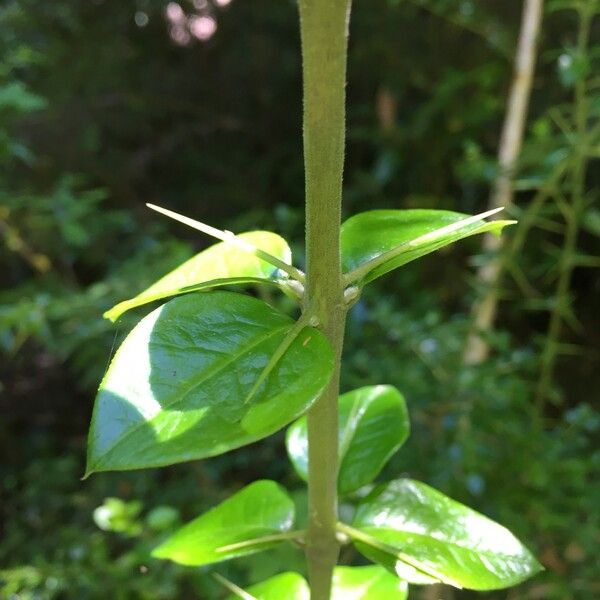
Plant Overview
Known as the Arrayán de Espino or the Prickly Myrtle, Rhaphithamnus spinosus is a striking evergreen shrub hailing from the temperate rainforests of Chile and Argentina. It is a plant of dramatic contrasts, pairing delicate, trumpet-shaped purple flowers with formidable, needle-like spines. In its native habitat, it’s a beloved member of the Valdivian flora, often found clinging to forest edges where it can bask in the cool, misty air.
🔍 How to Identify
- ⚔️ The Spines: Its most defining feature is the pair of long, sharp, woody thorns that emerge at the base of each leaf pair, acting as a natural deterrent to herbivores.
- 🔔 The Flowers: During spring, it produces small, tubular, drooping flowers that range from pale lavender to a rich, royal purple.
- 🔮 The Berries: Following the blooms, the plant produces glossy, fleshy drupes in an almost "neon" shade of violet or turquoise-purple that look like polished gemstones.
- 🍃 The Foliage: The leaves are small, dark green, leathery, and oval-shaped, providing a dense, lush backdrop for the colorful fruit.
🏡 In Your Garden
- 💧 Soil & Moisture: Because it originates from rainforest regions, this plant craves consistent moisture and high humidity. It struggles in dry, arid heat and prefers "cool feet"—mulching the root zone is highly recommended.
- 🛡️ Strategic Placement: Due to its aggressive thorns, it makes an excellent "security hedge" to deter intruders or roaming animals, but it should be kept away from high-traffic paths where a passerby might snag their clothes or skin.
- 🐦 Pollinator Support: It is a magnet for hummingbirds and long-tongued insects who are the only ones capable of reaching the nectar hidden deep within its tubular blossoms.
⚠️ Safety & Toxicity
- 🌵 Physical Hazard: The primary danger of Rhaphithamnus spinosus is its spines. They are very sharp and can easily puncture skin or bicycle tires. Wear heavy-duty gloves when pruning.
- 🐾 Pet & Child Safety: While the bright violet berries are often considered edible and are used in traditional Chilean sweets, they should be consumed with caution. In a garden setting, it is best to treat them as ornamental to avoid any stomach upset in curious pets or toddlers.
✨ Fun Fact
In Chilean folklore, the wood of the Arrayán de Espino is prized for being incredibly hard and durable; it was traditionally used to craft tool handles and even specialized parts for weaving looms!

Detailed Care Instructions
To grow Rhaphithamnus Spinosus (Mistletoe cactus), follow these steps:
- Propagation: The easiest way to grow Rhaphithamnus Spinosus is through stem cuttings. Take a cutting about 3-4 inches long from a healthy plant. Remove the lower leaves from the cutting and allow it to dry for a couple of days.
- Potting: Fill a small pot with well-draining potting soil. Make a hole in the soil and place the cutting in it, burying about one-third of the stem. Gently press the soil around the cutting to secure it.
- Watering: Water the cutting moderately, ensuring the soil is evenly moist but not waterlogged. Overwatering can lead to root rot, so allow the top inch of soil to dry out between waterings.
- Placement and Light: Place the pot in a location that receives bright, indirect sunlight. Rhaphithamnus Spinosus prefers bright, filtered light rather than direct sunlight. A south-facing window that is not in direct sunlight is ideal.
- Temperature and Humidity: This plant prefers temperatures between 60-80°F (15-27°C) and moderate humidity levels. Avoid placing it near drafts or temperature extremes.
- Fertilization: Feed the plant with a balanced, water-soluble fertilizer every 4-6 weeks during the growing season (spring and summer) to promote healthy growth. Follow the package instructions for the correct dilution ratios.
- Maintenance: Rhaphithamnus Spinosus requires minimal maintenance. Prune any dead or yellow leaves to maintain its appearance and encourage new growth.
- Repotting: As the plant grows, you may need to repot it to accommodate its size. Wait until the plant outgrows its current pot and shows signs of root crowding before repotting. Choose a slightly larger pot with fresh potting soil and ensure it has good drainage.
By following these steps, you should be able to successfully grow Rhaphithamnus Spinosus.

Place in a bright room that is sun drenched almost all day. Or directly in a south-facing window.

Rhaphithamnus Spinosus is a plant that requires regular watering to help it thrive. It is important to water the plant deeply but infrequently, rather than giving it a light watering every day. One way to ensure that the plant is receiving enough water is to check the soil moisture level by inserting a finger into the soil up to the second knuckle; if the soil is dry at this depth, it's time to water the plant.
When watering, be sure to direct the water at the base of the plant, rather than onto the leaves or flowers. This will ensure that the root system receives adequate moisture. It is also important to avoid overwatering, as this can lead to root rot and other issues.
In addition to watering, Rhaphithamnus Spinosus benefits from occasional fertilization. This can help to promote healthy growth and vibrant blooms. However, be sure to follow the manufacturer's instructions and avoid overfertilizing, as this can lead to burning of the foliage.
Overall, the key to successfully watering Rhaphithamnus Spinosus is to provide consistent, deep watering and to avoid both underwatering and overwatering. With proper care, this plant can thrive and add beauty to any landscape.
To fertilize the plant, apply a balanced, slow-release fertilizer in early spring before new growth emerges. Follow the manufacturer's instructions for application rate and method, taking care not to over-fertilize as this can harm the plant. Water the plant well after fertilizing to ensure the nutrients are absorbed properly. Repeat the fertilization process once or twice throughout the growing season, but reduce the amount of fertilizer used each time. Always water the plant thoroughly before and after fertilizing to prevent damage to the roots. Avoid fertilizing in winter when the plant is dormant.
The ideal type of soil to use for this plant should be a well-draining, nutrient-rich soil that has good moisture retention. It should have a pH range between 6.0 and 7.5. The soil should be loose and aerated to promote healthy root growth. Adding organic matter to the soil can also enhance soil fertility. Avoid using heavy, clay-like soils or soils that do not drain well, as this can cause root rot and other plant diseases. It is recommended to perform a soil test to determine the nutrient composition of the soil before planting.
To propagate this plant, it is best to take stem cuttings in the spring or summer. Choose healthy stems that are about 4-6 inches long and have several leaves attached. Use a sharp and clean pair of pruning shears to make a clean cut just below a node (where a leaf is attached to the stem) at a 45-degree angle.
Remove the lower leaves of the cutting, leaving only a few leaves at the top. This will reduce water loss from the cutting and encourage root development. Dip the cut end of the stem into rooting hormone powder, which will help stimulate root growth.
Prepare a potting mix of equal parts of perlite and peat moss. Moisten the mix until it is evenly moist but not soggy. Make holes in the mix using a pencil or chopstick and insert the cuttings, making sure that the bottom of the stem is in contact with the potting mix.
Cover the pot with a plastic bag or a clear plastic container to create a humid environment for the cuttings. Place the pot in a bright but indirect light location, with temperatures around 70-75°F. Check the moisture level of the potting mix regularly and water as needed to keep it moist but not waterlogged.
After a few weeks, gently tug on the cuttings to see if they have rooted. If there is resistance, the cuttings have rooted and can be gradually exposed to lower humidity levels. Once they have several new leaves, they can be transplanted into individual pots with well-draining soil.








