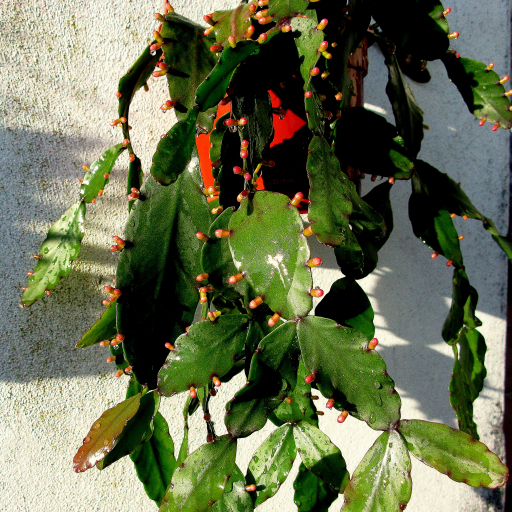
Plant Overview
Known as the Elliptic Mistletoe Cactus, this Brazilian beauty is a master of disguise. While it is technically a true cactus, it traded its sharp spines for elegant, leaf-like segments that cascade like a green waterfall. In its native Atlantic forests, it lives high in the canopy as an epiphyte, soaking up filtered sunlight and misty jungle humidity.
🔍 How to Identify
- 🍃 Segment Shape: Unlike the "pencil-like" stems of its cousins, this species features flat, wide segments that are distinctly elliptical or oval-shaped.
- 🎨 Color & Texture: The segments are a deep, waxy green, but they often develop stunning reddish-purple margins when "sun-kissed" by bright, indirect light.
- 🌸 Bloom Style: Tiny, star-shaped flowers in shades of creamy white or pale yellow sprout directly from the notched edges (areoles) of the segments, followed by small, translucent berries.
🏡 In Your Garden
- 🌳 The "Air Plant" Strategy: Because it naturally grows on tree trunks rather than in the ground, it hates heavy, compacted soil. It thrives in a chunky, airy mix—think orchid bark, perlite, and peat—that allows its roots to breathe.
- 💧 Humidity is Key: Unlike desert cacti that store water for droughts, this jungle dweller craves moisture in the air. It is the perfect candidate for a bright bathroom or a shelf near a humidifier, as long as its "feet" aren't sitting in stagnant water.
⚠️ Safety & Toxicity
- 🐾 Pet Friendly: Good news for furry friends! Rhipsalis elliptica is generally considered non-toxic to cats and dogs.
- 👶 Gentle Touch: It lacks the sharp, irritating spines (glochids) of typical cacti, making it safe for households with curious children. However, the segments are somewhat brittle and can snap if handled roughly.
✨ Fun Fact
The Rhipsalis genus holds a unique botanical title: it is the only cactus group found naturally growing wild outside of the Americas! While this specific species is a Brazilian native, its ancestors managed to "hitchhike" across the Atlantic to Africa and Asia, likely via migratory birds.

Detailed Care Instructions
| Humidity | Normal |
| Lighting | Full Sun |
| Difficulty | Easy |
| Hibernation | Cold Period |
| Temperature | 14°C - 25°C |
| Hardiness Zones | 10B - 11 |
To grow a Rhipsalis Elliptica plant, follow these steps:
- Choose the right location: Rhipsalis Elliptica is an epiphytic plant that thrives in bright, indirect sunlight. Find a location in your home that provides bright, filtered light, away from direct sunlight.
- Temperature and humidity: Rhipsalis Elliptica prefers a moderate to warm temperature, ideally between 60-80°F (15-27°C). It also appreciates a moderately humid environment, so misting the plant occasionally or placing a humidity tray nearby can help.
- Soil: Use a well-draining potting mix that retains some moisture but does not become waterlogged. A mixture of peat moss, perlite, and orchid bark is suitable for Rhipsalis Elliptica.
- Watering: Water your Rhipsalis Elliptica thoroughly but allow the top inch (2.5 cm) of soil to dry out between waterings. It is better to underwater this plant than to overwater it, as it is susceptible to root rot. Adjust watering frequency based on the conditions in your home.
- Fertilizer: Feed your Rhipsalis Elliptica with a balanced, water-soluble fertilizer diluted to half-strength once a month during the growing season (spring and summer). Reduce or stop fertilizing during the dormant period (fall and winter).
- Repotting: Repot your Rhipsalis Elliptica every two years or when it outgrows its container. Choose a pot that is slightly larger than the current one. Gently loosen the roots when repotting, being careful not to damage them.
- Pruning: Prune your Rhipsalis Elliptica plant to maintain its shape and remove any dead or damaged growth. You can also propagate from the cuttings or use them to grow new plants.
- Propagation: Rhipsalis Elliptica can be propagated through stem cuttings. Take a healthy stem cutting about 4-6 inches (10-15 cm) long, remove the lower leaves, and allow the cutting to callous for a few days. Plant the cutting in a small pot with well-draining soil, and keep it slightly humid until it roots.
By following these steps, you can successfully grow a Rhipsalis Elliptica plant and enjoy its unique and beautiful foliage.

Place in a window with dappled sun or a spot in the middle of a room. Or directly in a window facing west or east.

Rhipsalis Elliptica is a type of plant that requires regular watering to thrive. However, the amount of water it needs will depend on several factors, such as the temperature and humidity level of its environment, the soil type, and the size of the plant.
When watering Rhipsalis Elliptica, it is best to use a watering can or a hose with a gentle spray nozzle to avoid damaging the delicate stems and leaves. The soil should be moist, but not too wet or too dry, as both can be harmful to the plant.
It is important to avoid overwatering, as this can lead to root rot and other diseases. To prevent this, allow the soil to dry out slightly between each watering. In general, Rhipsalis Elliptica should be watered once a week during the growing season and less frequently during the winter months.
Additionally, it is recommended to fertilize the plant every few weeks during the growing season with a balanced fertilizer. This will help to ensure that the plant has all the nutrients it needs to thrive.
In summary, to properly water Rhipsalis Elliptica, you should use a gentle spray nozzle, water once a week, allow the soil to dry out slightly, and fertilize every few weeks during the growing season.
To fertilize this plant, use a balanced water-soluble fertilizer once a month during the growing season (spring and summer). Dilute the fertilizer to half strength and apply it to the soil evenly. Do not fertilize in the winter months as the plant's growth slows down during this time.
Rhipsalis Elliptica plant prefers a well-draining soil that is slightly acidic with a pH range of 5.5 to 6.5. The soil should be rich in nutrients and organic matter to provide sufficient nourishment to the plant. A potting mix with a combination of peat moss, perlite, and coarse sand is ideal for this plant. The mixture should be loose and airy to allow for proper air circulation and water drainage. It's important to avoid overwatering as this plant is susceptible to root rot, so a well-draining soil is essential. Additionally, adding a slow-release fertilizer to the soil once a month during the growing season can help promote optimal growth and health.
To propagate this plant, you will need to take stem cuttings from the parent plant. Make sure to use a clean, sharp blade to avoid damaging the plant or introducing any diseases.
Choose a healthy stem that is at least 4 inches long and has several nodes. Cut the stem just below a node and remove any leaves from the lower part of the stem.
Dip the cut end of the stem in rooting hormone (optional) and plant it in a well-draining soil mix. You can also place the cutting in a glass of water until roots develop.
Make sure to keep the soil moist and the cutting in a warm, humid location with indirect light. It can take several weeks for the cutting to develop roots and new growth.
Once the cutting has developed a healthy root system and new growth, you can transplant it into a larger pot with well-draining soil and continue to care for it like the parent plant.
Common pests of the bride cactus include Scale insect, mealybugs, spider mites. Make a habit of checking your bride cactus frequently for pests so that any infestations can be caught and managed early.








