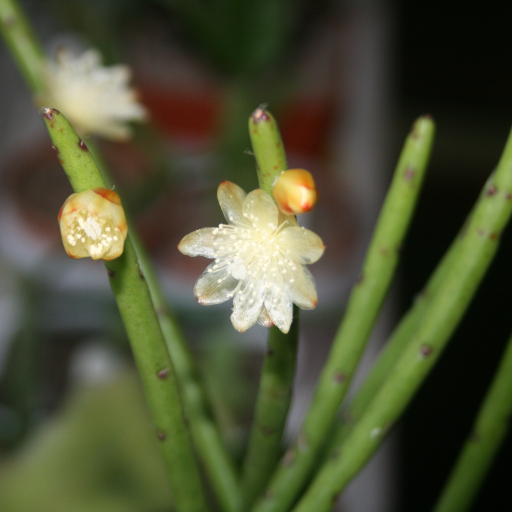
Plant Overview
Known affectionately as the Mistletoe Cactus, Rhipsalis floccosa is a cascading wonder from the rainforests of South America. Unlike the prickly desert cacti most people imagine, this epiphyte spends its life clinging to tree branches, resembling a green waterfall of tangled yarn. It is a favorite for those who love "living decor" that softens the edges of a shelf or a hanging basket with its elegant, weeping habit.
🔍 How to Identify
- 🌀 The Stems: Long, slender, and perfectly cylindrical segments that can grow several feet long, often branching out in pairs or triplets.
- ☁️ Woolly Areoles: The species name floccosa comes from the Latin word for "woolly," referring to the small, fuzzy white tufts found at the joints where the stems branch.
- ⚪ Pearl Berries: After its modest white flowers fade, it produces small, translucent, white or pinkish berries that look remarkably like traditional mistletoe fruit.
🏡 In Your Garden
- ☁️ Humidity over Aridity: Because its ancestors lived in humid jungles, this plant thrives on regular misting or a pebble tray; dry indoor air can cause the delicate stem tips to shrivel.
- 🧺 The "Airy" Secret: It prefers a very loose, orchid-like bark mix. In the wild, its roots are designed to breathe while gripping tree bark, so heavy, compressed soil can quickly lead to root rot.
- 💡 Dappled Light: Think of the jungle canopy; this cactus craves bright, filtered light but will scorch and turn yellow if left in the direct, harsh afternoon sun.
⚠️ Safety & Toxicity
- ✅ Pet-Friendly: Rhipsalis floccosa is generally considered non-toxic to cats, dogs, and horses, making it a worry-free addition to a lively household.
- 🖐️ Physical Fragility: While it lacks sharp spines, the stems are quite brittle and "jointed." It is best placed in a low-traffic area where it won't be accidentally bumped, as the segments can snap off easily.
✨ Fun Fact
🧪 The Great Traveler: Rhipsalis is the only genus of cactus naturally found outside of the Americas. While most cacti are strictly "New World" plants, Rhipsalis species managed to cross the Atlantic to Africa and Sri Lanka long ago, possibly as seeds carried in the guts of migratory birds!

Detailed Care Instructions
| Humidity | High |
| Lighting | Full Sun |
| Difficulty | Medium |
| Temperature | 14°C - 25°C |
| Hardiness Zones | 10B - 11 |
To grow Rhipsalis floccosa, follow these steps:
- Choose a suitable location: Rhipsalis floccosa prefers bright, indirect sunlight. It can tolerate some morning or evening sun, but avoid direct afternoon sun which can scorch the leaves. Place the plant near a window with filtered sunlight or in a partially shaded outdoor area.
- Provide the right temperature: Rhipsalis floccosa prefers temperatures between 60-75°F (15-24°C). Avoid extreme temperature fluctuations or cold drafts.
- Use well-draining soil: Rhipsalis floccosa prefers well-draining soil. You can use a cactus or succulent potting mix or make your own by combining regular potting soil with perlite or sand to improve drainage.
- Water properly: Rhipsalis floccosa is a tropical plant, so it prefers slightly more water than typical cacti. Water the plant thoroughly when the top inch of soil feels dry, and then allow excess water to drain out. It is better to underwater than overwater, as excessive moisture can cause root rot.
- Humidity: Rhipsalis floccosa appreciates higher humidity levels. You can increase humidity around the plant by misting it regularly or placing it near a humidifier. Alternatively, you can place a tray filled with water and pebbles beneath the plant's pot to increase humidity through evaporation.
- Fertilize sparingly: Use a balanced, water-soluble fertilizer diluted to half strength and apply it once a month during the growing season (spring to fall). Do not fertilize during winter when the plant is dormant.
- Pruning: Pruning is not necessary for the Rhipsalis floccosa plant, but you may trim back any leggy or overgrown branches to maintain its appearance and shape.
- Propagation: Rhipsalis floccosa can be propagated by stem cuttings. Take a cutting from a healthy stem, remove the lower leaves, and place the cutting in moist, well-draining soil or a mix of perlite and peat moss. Keep the cutting in a warm, bright location and lightly mist it to maintain humidity. The cutting should root within a few weeks.
By following these guidelines, you can successfully grow Rhipsalis floccosa and enjoy its beautiful trailing greenery.

Place in a window with dappled sun or a spot in the middle of a room. Or directly in a window facing west or east.
To water this plant, monitor the soil moisture and wait until the topsoil becomes slightly dry before watering. When watering, pour water slowly and evenly around the base of the plant until it starts to drain out of the pot’s drainage holes. Avoid letting the pot sit in standing water as this can lead to root rot. It’s important not to overwater this plant as it prefers to dry out between waterings. During cooler months, the plant will require less water, so adjust watering frequency accordingly.
To fertilize this plant, use a balanced liquid fertilizer during the plant's active growing season in the spring and summer. Dilute the fertilizer to half strength and apply every two weeks. Reduce fertilization during the fall and winter months. Always water the plant thoroughly before fertilizing to prevent fertilizer burn.
Rhipsalis Floccosa plant requires a well-draining soil mix with a slightly acidic pH level. A good soil mixture for this plant should consist of peat moss or coco coir, perlite, and sand to ensure adequate drainage and aeration. The soil should retain moisture but must not be too wet, which can lead to root rot. It is important to avoid using heavy or compact soil, as it can restrict root growth and cause stress to the plant. Additionally, adding organic matter such as compost or worm castings can help provide nutrients and improve soil structure. When repotting, make sure to use a pot with drainage holes to prevent water from accumulating at the bottom.
To propagate Rhipsalis Floccosa plant, you will need to take stem cuttings and root them. Begin by selecting a healthy stem on the plant that is free from disease or damage. Use a pair of clean, sharp scissors or pruning shears to make a clean cut on the stem just above a set of leaves. The cutting should be around 4 to 6 inches long.
Once you have your cutting, remove the lower leaves so that there is a bare stem that can be planted in soil. Dip the cut end of the stem in rooting hormone powder to encourage root growth.
Fill a small pot with well-draining soil, such as cactus or succulent mix, and create a hole in the center with your finger. Place the cutting in the hole and gently press the soil around it to ensure it is in firm contact with the soil. Water the cutting thoroughly but avoid over-watering as this can cause rot.
Place the pot in a bright, indirect location and wait for the cutting to root. This can take several weeks to a few months, so be patient. Keep the soil moist but not soggy during this time.
Once the cutting has rooted and begins to show new growth, you can transfer it to a larger pot or outdoor location if desired. Rhipsalis Floccosa plants prefer bright but indirect light and well-draining soil.








