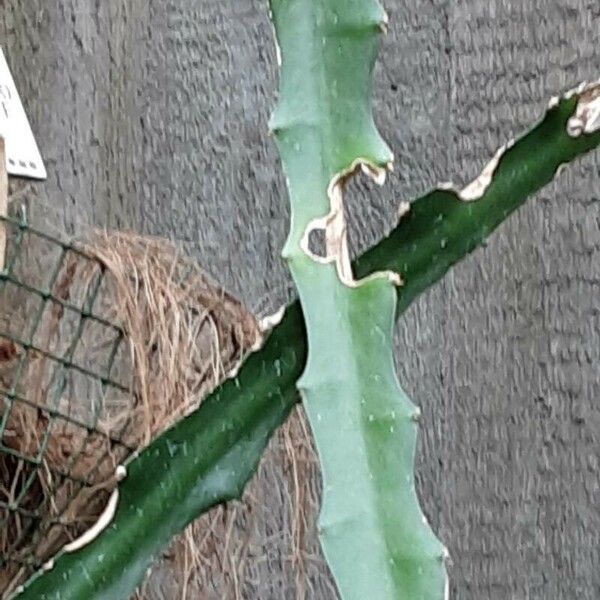
Plant Overview
Known as the "Rhomboid Mistletoe Cactus," Rhipsalis rhombea is a stunning departure from the prickly desert plants we usually associate with the word "cactus." Hailing from the lush Atlantic forests of Brazil, this epiphyte lives high in the tree canopy, draping itself over branches like a living emerald necklace. Its unique, geometric segments make it a favorite for collectors looking for a "low-spine, high-style" indoor plant.
🔍 How to Identify
- 💎 Geometric Segments: Unlike cylindrical cacti, this species features flat, leaf-like stems that are shaped like rhombs or diamonds with scalloped edges.
- 🎨 Sun-Kissed Blushing: While naturally a deep forest green, the margins of the stems will turn a beautiful reddish-purple or bronze when given bright, filtered light.
- 🌸 Delicate Blooms: It produces tiny, creamy-yellow or white flowers that emerge directly from the notches along the sides of the flat segments.
🏡 In Your Garden
- ☁️ The "Air Plant" Strategy: Because it grows on trees in the wild (an epiphyte), it hates heavy, water-logged soil. Use a chunky orchid bark or peat-free cactus mix to ensure the roots "breathe" as much as they drink.
- 💧 Rainforest Vibes: This plant craves humidity more than it craves direct sun. It is the perfect candidate for a bright bathroom or a hanging basket near a kitchen sink where it can soak up ambient moisture.
⚠️ Safety & Toxicity
- ✅ Non-Toxic: Rhipsalis rhombea is generally considered safe and non-toxic for both cats and dogs, making it a "worry-free" addition to a pet-friendly home.
- 👶 Child Safe: Unlike many of its cousins, it lacks the sharp, painful spines typical of cacti, though it may have very minute, soft bristles that are rarely irritating.
✨ Fun Fact
The genus Rhipsalis holds a special botanical secret: it is the only group of cacti naturally found outside the New World. While almost all cacti are native to the Americas, certain Rhipsalis species managed to cross the Atlantic to Africa and Sri Lanka long ago—likely as seeds hitched a ride in the digestive systems of migratory birds!

Detailed Care Instructions
To grow Rhipsalis Rhombea plant, follow these steps:
- Choose a suitable location: Rhipsalis Rhombea is a trailing plant that thrives in bright but indirect light. Select a spot near a window that receives filtered sunlight or place it in a room with bright and indirect light.
- Provide the right temperature and humidity: Rhipsalis Rhombea prefers a temperature range of 60-75°F (15-24°C). Avoid exposing the plant to drafts or extreme temperature fluctuations. The plant also appreciates higher humidity, so consider misting the leaves or placing it on a humidity tray.
- Watering and drainage: Keep the plant evenly moist but do not let it sit in soggy soil. Water thoroughly but allow the top inch of soil to dry between waterings. Ensure the pot has proper drainage to prevent root rot.
- Potting and soil: Use a well-draining potting mix for cacti or succulents. The soil should be loose and airy to prevent waterlogging. Repot the plant every few years when it outgrows its pot.
- Fertilization: Feed the Rhipsalis Rhombea plant with a diluted balanced fertilizer during the growing season (spring and summer). Apply the fertilizer every 4-6 weeks following the instructions on the package.
- Pruning and grooming: Regularly trim back overgrown or leggy stems to encourage branching and bushier growth. Remove any dead or yellowing parts of the plant to maintain its health and appearance.
- Propagation: Rhipsalis Rhombea can be propagated from cuttings. Take stem cuttings about 4-6 inches long and allow them to callus for a few days. Plant the cuttings in a well-draining soil mix and keep them lightly moist. Place the cuttings in a warm and bright area but away from direct sunlight until they root.
Remember, patience is essential when growing Rhipsalis Rhombea. It is a slow-growing plant, so don't be discouraged if it takes time to see significant growth.

Place in a window with dappled sun or a spot in the middle of a room. Or directly in a window facing west or east.

To effectively water a Rhipsalis Rhombea plant, several key factors need to be considered. The frequency and amount of water required for this plant largely depend on its environment, potting mix, and overall health. However, here are some general guidelines to help you water it properly:
1. Observe the soil: Before watering, check the soil moisture level by gently inserting your finger about an inch deep into the potting mix. If it feels dry, it's usually an indication that watering is needed.
2. Use the right water: The Rhipsalis Rhombea plant prefers to be watered with room temperature water. Avoid using extremely cold or hot water as it may shock the roots.
3. Avoid overwatering: Like many succulent plants, Rhipsalis Rhombea is susceptible to root rot caused by overwatering. Ensure the pot has adequate drainage holes to prevent excess water from accumulating at the bottom.
4. Water thoroughly: When watering, aim to moisten the entire potting mix until water drains out of the drainage holes. This ensures that the water reaches the roots evenly.
5. Allow for proper drainage: After watering, it's essential to remove any excess water collected in the saucer or tray to prevent the plant from sitting in a pool of water.
6. Adjust watering according to the season: During the active growing season, typically spring and summer, Rhipsalis Rhombea may require more frequent watering. However, reduce the frequency during the dormant period in fall and winter.
7. Consider environmental factors: Factors such as humidity levels, temperature, and air circulation can affect the plant's watering needs. In a dry and warm environment, the plant may require more frequent watering compared to cooler and more humid conditions.
8. Monitor for signs of underwatering or overwatering: Keep an eye on how the plant responds to your watering routine. Wilting, yellowing, or drooping leaves may indicate underwatering, while yellowing and mushy roots or a foul smell may suggest overwatering.
Remember that these guidelines provide a starting point, and it's important to adjust your watering routine based on the specific needs of your Rhipsalis Rhombea plant and the local conditions it is grown in.
To fertilize and care for Rhipsalis Rhombea plant, follow these instructions:
- Choose a balanced liquid houseplant fertilizer with equal or slightly higher nitrogen (N), phosphorus (P), and potassium (K) levels. A 10-10-10 or 20-20-20 formula works well.
- Dilute the fertilizer according to the package instructions. Typically, mixing 1/4 to 1/2 teaspoon per gallon of water is suitable.
- Water the plant thoroughly before applying fertilizer to ensure the roots are well-hydrated.
- Slowly pour the diluted fertilizer solution onto the soil around the base of the plant until it evenly saturates the top layer.
- Do not allow the fertilizer to touch the foliage or stem directly, as it may cause burns or damage.
- Repeat fertilization once every 2-4 weeks during the growing season, which is typically spring and summer. Reduce or stop fertilization during the dormant period in fall and winter.
- Monitor the plant for signs of over or under-fertilization. If you notice yellowing leaves, burned tips, or stunted growth, reduce the frequency or concentration of fertilizer. Conversely, if the growth is weak and pale, slightly increase the fertilizer dosage.
Remember, it's essential to read and follow the specific instructions provided by the fertilizer manufacturer as the concentration and frequency may vary based on the product used.
The ideal soil for Rhipsalis Rhombea plants should have specific characteristics to support their healthy growth and development. This type of soil should be well-draining, as Rhipsalis Rhombea plants are sensitive to overwatering and require soil that allows excess moisture to flow through easily. This helps prevent the roots from sitting in water, which can lead to root rot.
The soil should also be lightweight and loose in texture, providing ample aeration to the plant's roots. This ensures proper oxygen flow and prevents soil compaction. A loose soil texture also aids in water retention without becoming waterlogged.
In terms of nutrient content, Rhipsalis Rhombea plants prefer a soil that is slightly acidic to neutral, with a pH level around 6 to 7. This allows for efficient nutrient uptake by the plant roots. It is recommended to use a well-balanced, organic potting mix to provide the necessary nutrients for healthy growth.
It is important to note that Rhipsalis Rhombea plants are epiphytic in their natural habitat, meaning they grow on other plants and obtain nutrients from air and rain. Thus, incorporating some organic matter, such as compost or orchid bark, into the soil can mimic their natural environment and provide additional moisture retention and nutrition.
Overall, the best soil for Rhipsalis Rhombea plants should be well-draining, lightweight, loose in texture, slightly acidic to neutral in pH, and enriched with organic matter to provide the necessary nutrients for optimal growth.
To propagate Rhipsalis rhombea, you can follow these steps:
- Prepare a cutting: Select a healthy stem from the parent plant that is approximately 4-6 inches long. Ensure that it has at least two segments or joints.
- Remove leaves: Remove the lower few leaves from the stem to create a bare section.
- Callus formation: Allow the cut end of the stem to dry out and form a callus. This typically takes about a week. Placing the cutting in a dry, shaded area helps facilitate callus formation.
- Prepare the potting mix: While the cutting is callusing, prepare a well-draining potting mix suitable for cacti or succulents. Use a mix consisting of equal parts of peat moss, perlite, and sand.
- Plant the cutting: Once the callus has developed, plant the cutting in the prepared potting mix. Ensure that the lower segment is inserted into the soil, leaving the upper segment exposed.
- Provide optimal conditions: Place the cutting in a bright, indirect light location. Avoid direct sunlight during this rooting stage, as it may cause excessive drying or scorching.
- Watering: Water the cutting sparingly, as Rhipsalis plants prefer slightly dry conditions. Allow the soil to dry out partially between waterings to prevent overwatering, which can lead to root rot.
- Maintain humidity: Since Rhipsalis rhombea is a tropical plant, it appreciates some humidity. You can provide this by placing a clear plastic bag over the cutting, creating a mini greenhouse. This helps to maintain a humid environment for root development.
- Monitor and wait: Keep an eye on the cutting for the next few weeks, ensuring it remains healthy. It may take 4-8 weeks (or sometimes longer) for roots to develop.
- Transplanting: Once the cutting has developed a substantial root system, it is ready for transplantation into a larger pot. Carefully remove the cutting from the rooting pot and transfer it into a well-draining potting mix that matches its mature plant's requirements.
Remember, patience is key when propagating plants. It may take some time for the cutting to establish roots and develop into a mature plant.
Common pests of the rhipsalis rhombea include Scale insect, mealybugs, spider mites. Make a habit of checking your rhipsalis rhombea frequently for pests so that any infestations can be caught and managed early.








