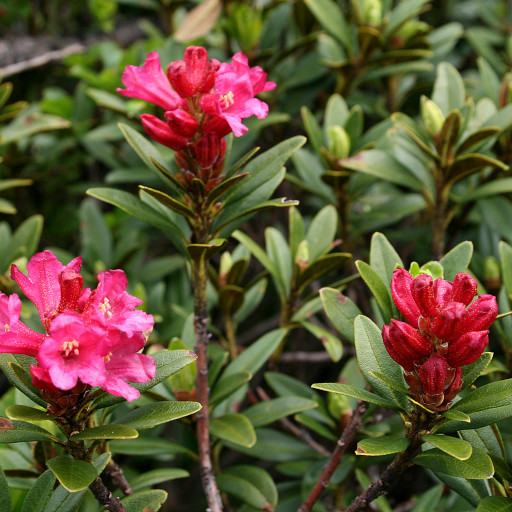
Plant Overview
Commonly known as the Alpenrose or Rusty-leaved Rhododendron, this legendary mountain dweller is a symbol of the European Alps. In mountain folklore, it is often celebrated as a prize for brave climbers, painting high-altitude rocky slopes in vibrant pink hues during the summer months. Despite its name, it isn't a rose at all, but a rugged evergreen shrub that has adapted to survive some of the harshest environments on Earth.
🔍 How to Identify
- 🌸 Bell-Shaped Blooms: Features dense clusters of trumpet-like flowers that range from bright pink to a deep, rosy crimson.
- 🍂 Rusty Undersides: The easiest way to identify it is by looking under the leaves; young leaves have yellowish scales that turn a distinctive rusty brown as they age.
- 🌿 Leathery Foliage: The leaves are dark green, glossy on top, and thick to help the plant retain moisture against high-altitude winds.
🏡 In Your Garden
- ⛰️ The Acid Test: This plant is a "calcifuge," meaning it is physically incapable of tolerating lime or chalk. It requires very acidic soil (high peat or leaf mold content) to thrive; otherwise, its leaves will turn yellow and drop.
- ❄️ Snow Protection: In its natural habitat, it spends months tucked under a deep blanket of snow, which acts as insulation. In a home garden, it prefers a cool, sheltered spot and struggles in regions with hot, humid summers.
⚠️ Safety & Toxicity
- 🚫 Toxic Status: All parts of the Alpenrose contain grayanotoxins, making it poisonous if eaten.
- 🐾 Pet & Child Risk: If ingested, it can cause salivation, vomiting, and in severe cases, heart complications. It is toxic to dogs, cats, and horses, so it should be planted away from curious nibblers.
✨ Fun Fact
The Alpenrose is incredibly long-lived and slow-growing. Some specimens in the wild have been recorded at over 100 years old, surviving decades of freezing winters and thin mountain air!

Detailed Care Instructions
| Color | Hot Pink |
| Soil Ph | Acidic |
| Humidity | Normal |
| Lighting | Part Sun |
| Toxicity | Poisonous |
| Soil Type | Fertile, Well-Drained |
| Bloom Time | April To June |
| Difficulty | Medium |
| Plant Type | Broadleaf Evergreen Shrub |
| Hibernation | Cold Period |
| Mature Size | 3 To 6 Ft. Tall |
| Native Area | Japan |
| Temperature | 22°C - 32°C |
| Sun Exposure | Partial Shade To Full Shade |
| Hardiness Zones | 4-8 |
To grow Rhododendron Ferrugineum, also known as alpine rose or rusty-leaved alpenrose, follow these steps:
- Choose a suitable location: Rhododendron Ferrugineum prefers cool, high-altitude environments with well-drained soil. They grow well in rocky areas or on slopes with good air circulation and partial shade.
- Soil preparation: Before planting, prepare the soil by adding organic matter like compost or peat moss to improve drainage and fertility. Rhododendrons prefer acidic soil with a pH level between 4.5 and 6.0.
- Planting: Dig a hole that is twice as wide and slightly deeper than the root ball of the plant. Gently place the plant in the hole, ensuring that it sits at the same level as it was previously growing. Backfill the hole with soil, firming it gently around the roots. Water thoroughly after planting.
- Watering: Keep the soil consistently moist but not waterlogged. Rhododendrons have shallow root systems, so they require regular watering, especially during dry periods. Mulching around the base of the plant can help retain moisture and regulate soil temperature.
- Fertilization: Use a balanced, slow-release fertilizer specifically formulated for acid-loving plants. Apply it according to the instructions on the packaging, typically in late winter or early spring before new growth appears.
- Pruning: Rhododendron Ferrugineum generally does not require extensive pruning. However, remove any dead or diseased branches to maintain plant health. Light pruning to shape or control size can be done in early spring after blooming.
- Pest and disease control: Monitor the plant for common pests such as aphids or lace bugs and treat accordingly with appropriate insecticides or by introducing beneficial insects. Proper watering and good air circulation can also help prevent diseases like powdery mildew or root rot.
- Winter protection: Depending on your climate, you may need to protect Rhododendron Ferrugineum from severe winter weather by covering it with burlap or providing some form of wind protection.
Remember that Rhododendron Ferrugineum is a native alpine plant and may have specific requirements that differ from other rhododendron species. Therefore, it is beneficial to closely observe the natural habitat of this plant to better replicate its ideal growing conditions.

Place in a bright room that is sun drenched almost all day. Or directly in a south-facing window.

To water this plant, you should first make sure that the soil is moist but not waterlogged. This can be achieved by watering deeply but infrequently, allowing the soil to dry out slightly between waterings. It is also important to avoid getting water on the leaves or flowers, as this can cause damage or disease. Instead, aim your watering can or hose at the base of the plant, watering slowly and evenly. In addition, it may be beneficial to mulch around the base of the plant to help retain moisture and regulate temperature.
To fertilize this plant, use a slow-release fertilizer designed for acid-loving plants. Apply it in the early spring and again in the late summer, following the manufacturer's instructions for the appropriate amount. Avoid over-fertilization, as it can lead to burned foliage and reduced flowering. Consider amending the soil with organic matter, such as peat moss or aged bark, to help acidify the soil and improve its texture. Water the plant deeply and consistently throughout the growing season to ensure proper nutrient uptake.
When planting the Rhododendron Ferrugineum plant, it is crucial to choose the right soil. This plant prefers acidic soil with a pH of around 4.5-5.5. It should be well-draining, loose, and rich in organic matter. You can mix sphagnum moss, peat moss, and perlite in a 1:1:1 ratio to create the perfect soil mix for this plant. Avoid using any soil mix containing lime, as it can raise the pH level and harm the plant. You should also ensure that the soil is moist but not waterlogged, as the plant does not do well in wet conditions. You can use mulch to help retain moisture and regulate soil temperature, but avoid mulch that may raise the pH level, such as limestone or crushed shells. Overall, choosing the right soil is critical to the health and growth of the Rhododendron Ferrugineum plant.
To propagate this plant, you will need to take a cutting from a healthy parent plant. Select a stem that is at least 4 inches long and has a few sets of leaves. Cut the stem with a sharp, clean pair of scissors or pruning shears. Remove any lower leaves from the stem.
Dip the cut end of the stem into rooting hormone powder. This helps to stimulate root growth. Fill a pot with a well-draining soil mix and make a hole in the center. Insert the stem into the soil, making sure the bottom inch or two is buried.
Water the soil well and cover the pot with a plastic bag to create a greenhouse effect. Place the pot in a bright location out of direct sunlight. Check the soil often and water as needed to keep it moist.
In a few weeks, you should see new growth indicating that the cutting is rooting. Once the plant has established roots, you can remove the plastic bag and move it to a larger pot or into the ground.








