Plant Overview
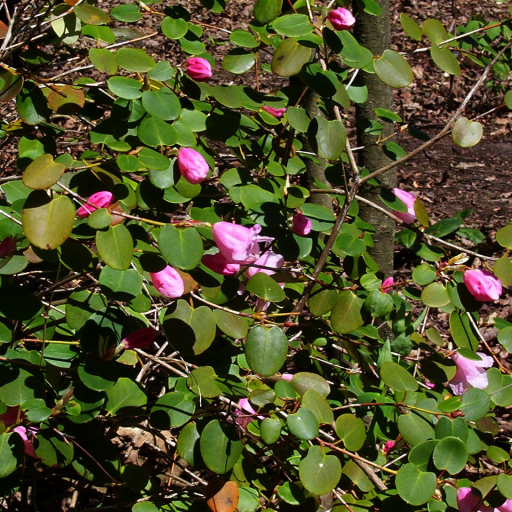
Often called the "Jewel of Sichuan," Rhododendron williamsianum is a dwarf evergreen beloved for its architectural beauty and fairytale-like blooms. Named after the famous Cornish gardener J.C. Williams, this shrub is prized for its perfectly rounded leaves that look like little green coins. It is a slow-growing aristocrat of the garden, offering a sophisticated, mounding shape that requires almost no pruning to maintain its tidy appearance.
🔍 How to Identify
- 🍃 The Foliage: Unlike the long, leathery leaves of common rhododendrons, these are small, nearly circular, and heart-shaped at the base. New growth often emerges in a striking chocolate-bronze tint before turning deep green.
- 🔔 The Blooms: In mid-spring, the plant produces nodding, bell-shaped flowers. They are usually a delicate shell-pink or soft rose, hanging in loose clusters of two or three.
- 🌳 The Silhouette: It naturally forms a dense, spreading dome or "hummock." It rarely grows taller than 4 or 5 feet, making it much more compact than its wilder cousins.
🏡 In Your Garden
- 🌱 Acidic Ambitions: Like most of its kin, this plant is a "calcifuge," meaning it will fail in limey or alkaline soil. It demands rich, acidic peat or leaf mold and plenty of organic matter to keep its shallow roots cool.
- 🛡️ Shelter is Key: While it is cold-hardy, its early-spring flower buds are sensitive to late frosts. Planting it in a spot sheltered from harsh morning sun and biting winds will protect those delicate pink bells from turning brown.
- 💧 Drainage Nuance: It hates "wet feet" but cannot tolerate drying out. The fine, hair-like root system needs constant moisture but will rot quickly if sitting in stagnant water.
⚠️ Safety & Toxicity
- 🚫 High Toxicity: All parts of the Rhododendron williamsianum contain grayanotoxins, which are harmful if ingested.
- 🐾 Pet & Child Safety: Keep this plant away from curious pets and toddlers. Ingestion can lead to salivation, vomiting, and in severe cases, heart arrhythmia. Even the nectar is toxic, leading to the historical "mad honey" phenomenon associated with the Rhododendron family.
✨ Fun Fact
This species was discovered in 1908 by the legendary plant hunter Ernest "Chinese" Wilson. He was so impressed by its beauty that he sent seeds back to England, where it became a foundational parent for dozens of modern "dwarf" rhododendron hybrids found in gardens today.

Detailed Care Instructions
To grow Rhododendron Williamsianum plant, follow these steps:
- Choose the right location: Rhododendron Williamsianum prefers partial shade and well-draining soil. Avoid areas with extreme sunlight or waterlogged soil.
- Prepare the soil: Rhododendrons prefer slightly acidic soil with a pH level between 4.5 and 6.0. If your soil is not acidic, you can amend it by adding peat moss or organic matter to lower the pH.
- Dig a hole: Make a hole that is slightly wider and deeper than the pot the plant is in. Gently loosen the roots of the plant before placing it in the hole.
- Planting: Place the plant in the hole and backfill with soil, gently firming it around the roots. Be careful not to plant the rhododendron too deeply; the root ball should be level with or slightly above the soil surface.
- Watering: Water thoroughly after planting to settle the soil and remove any air pockets. Rhododendrons require regular watering, especially during dry periods. However, be careful not to overwater, as they don't like soggy soil.
- Mulching: Apply a layer of organic mulch, such as wood chips or pine needles, around the base of the plant to help retain moisture, suppress weeds, and maintain a cool root zone.
- Fertilizing: Rhododendrons benefit from regular fertilization. Use a slow-release, acid-loving fertilizer specifically formulated for rhododendrons, following the instructions on the package.
- Pruning: Prune any dead or diseased branches to maintain the plant's health. Pruning should be done after flowering to avoid removing flower buds for the following year.
- Protection: Protect your rhododendron from extreme temperatures, strong winds, and frost. Cover the plant or move containers to a sheltered area if necessary.
- Regular maintenance: Monitor the plant's health regularly, checking for any signs of pests or diseases. Maintain a consistent watering schedule and provide any additional care your specific growing region may require.
Remember that proper care and attention are crucial for the healthy growth of Rhododendron Williamsianum.
To properly water this plant, it is important to consider the soil type and drainage. The soil should be moist but not waterlogged, as excessive water can lead to root rot. It is best to water deeply and slowly, allowing the water to soak into the soil and reach the roots. Depending on the climate and moisture levels, the plant may require watering 1-2 times per week. It is also recommended to mulch around the base of the plant to help retain moisture in the soil.
To fertilize your Rhododendron Williamsianum plant, follow these instructions:
- Choose a well-balanced, slow-release fertilizer specifically formulated for acid-loving plants, such as rhododendrons or azaleas.
- Apply the fertilizer during the early spring before new growth begins. Avoid fertilizing during winter or when the ground is frozen.
- Measure the recommended amount of fertilizer according to the label instructions. Typically, a general guideline is to apply 1 tablespoon of fertilizer per foot of plant height.
- Sprinkle the fertilizer evenly around the drip line or outer edge of the plant canopy. Avoid direct contact with stems or foliage.
- Gently scratch the fertilizer into the top layer of soil using a rake or hand tool, ensuring that it is well incorporated without damaging the plant's shallow roots.
- Water the plant thoroughly after fertilization to help activate and distribute the nutrients within the soil.
- Repeat the fertilization once every spring to promote healthy growth and vibrant blooms. Avoid over-fertilizing, as it can lead to salt build-up and damage the plant.
Remember to always refer to the specific fertilizer product's instructions for accurate dosage and application recommendations.
Rhododendron Williamsianum prefers soils that are acidic and well-draining, with a pH between 4.5 and 6.0. The soil should be rich in organic matter but not too heavy, as the plant does not tolerate waterlogged conditions. A mix of peat moss, coarse sand or perlite, and rich garden soil is recommended for planting this species. It is important to avoid using alkaline soil or adding lime, as it can damage the roots and affect the plant's growth and flowering. Regular fertilization with acidic fertilizers is also recommended to maintain the soil's acidity and provide the necessary nutrients for healthy growth and development.
Propagating Rhododendron Williamsianum involves a few steps to successfully reproduce the plant:
- Prepare the ideal time: The best time to propagate Rhododendron Williamsianum is during late spring or early summer when the plant is actively growing.
- Choose a healthy parent plant: Select a mature and healthy Rhododendron Williamsianum specimen as the parent plant for propagation. Ensure that it is free from any diseases or pests.
- Gather necessary materials: Collect all the required materials before proceeding with propagation. You will need a sharp pair of garden clippers or pruning shears, a sterile knife or scalpel, rooting hormone (optional), a suitable rooting medium (e.g., peat moss, perlite, vermiculite), small pots or trays, and a clear plastic bag or a propagating case.
- Take cuttings: Select a semi-hardwood stem from the parent plant, preferably one that has not yet bloomed. Using clean and sharp garden clippers or pruning shears, remove a 4-6 inch (10-15 cm) long section of the stem, making a clean, diagonal cut just below a leaf node.
- Prepare the cuttings: Remove any leaves from the lower half of the cutting, leaving only a few leaves at the top. If desired, dip the lower end of the cutting in rooting hormone to encourage root development.
- Prepare the rooting medium: Fill small pots or trays with a well-draining rooting medium, such as a mixture of peat moss and perlite or vermiculite. Make sure the medium is moist but not waterlogged.
- Plant the cuttings: Create planting holes in the rooting medium using a pencil or a similar object. Insert the cuttings into the holes, ensuring that the lower part is firmly planted in the medium while keeping the top leaves above the surface.
- Provide optimal conditions: Place the pots or trays in a warm and humid environment with bright indirect light. Enclose the cuttings and containers within a clear plastic bag or a propagating case to maintain high humidity.
- Maintain moisture and humidity: Regularly check the rooting medium to ensure it remains consistently moist but not saturated. If needed, mist the cuttings with water using a spray bottle.
- Monitor growth: Over the next few weeks, keep an eye on the cuttings and monitor their growth. After 6-8 weeks, carefully check for root development by gently tugging on the cuttings. If you feel resistance, the roots have likely formed.
- Transplant the rooted cuttings: Once the cuttings have formed sufficient roots, carefully transplant them into individual pots filled with a well-draining potting mix. Continue to provide optimal conditions, gradually exposing the plants to more light and decreasing the humidity.
By following these steps, you can successfully propagate Rhododendron Williamsianum and grow new plants from a healthy parent specimen.








