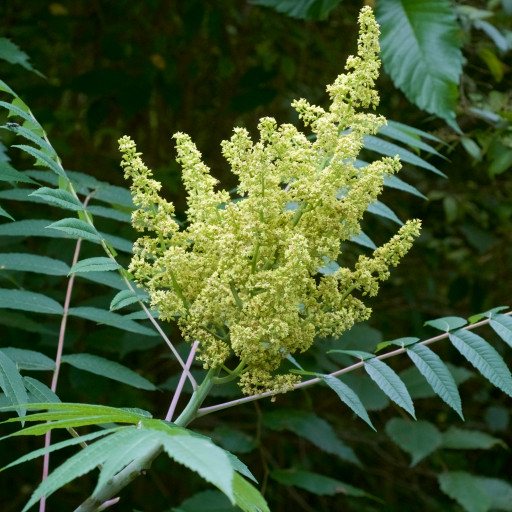
Plant Overview
Often called the "Scarlet Sumac," this vibrant North American native is famous for its spectacular autumn fire. It creates a dramatic landscape with its fern-like leaves and upright, conical red fruit spikes. Historically, Native Americans and pioneers used the tart berries to create a refreshing, vitamin C-rich drink known as "Indian Lemonade."
🔍 How to Identify
- 🌿 The Leaves: Large, compound leaves made up of 11 to 31 serrated leaflets. They look like green ferns in summer but turn a brilliant, glowing crimson the moment the temperature drops in fall.
- 🎋 Smooth Stems: Unlike its cousin, the Staghorn Sumac, this variety has completely smooth, hairless branches often covered in a waxy, whitish "bloom" that can be rubbed off with your thumb.
- 🏮 Crimson Fruit: Large, pyramidal clusters of tiny red berries (drupes) that stand upright at the ends of branches. These clusters stay on the plant long after the leaves have fallen, providing winter interest.
🏡 In Your Garden
- 🌱 Thicket Former: Smooth Sumac spreads via underground rhizomes. This makes it a "champion of the slope"—perfect for stabilizing hillsides or filling in large, barren areas, but it may be too aggressive for a tiny flower bed.
- 🦅 Wildlife Magnet: It is a high-value ecological plant. While the berries are tart, they are a vital "emergency food" for over 300 species of birds (like bluebirds and robins) during late winter when other food sources are exhausted.
⚠️ Safety & Toxicity
- ✅ Safe & Edible: Unlike the infamous "Poison Sumac," the Smooth Sumac is non-toxic to humans, cats, and dogs. The berries are actually used in culinary spices (like Za'atar) and teas.
- 🚫 The "White" Rule: To stay safe, remember the old foragers' rhyme: "Berries white, run in fright; berries red, have no dread." Poison Sumac has white, hanging berries and prefers swampy ground, whereas Smooth Sumac has red, upright berries and loves dry soil.
✨ Fun Fact
Smooth Sumac holds a special botanical record: it is the only tree or shrub species native to all 48 contiguous states of the US! Whether you are in the deserts of the Southwest or the forests of New England, you are likely to spot this crimson traveler.

Detailed Care Instructions
| Color | Yellowish Green |
| Soil Ph | Adaptable |
| Lighting | Full Sun |
| Toxicity | Non-Toxic |
| Soil Type | Average, Well-Drained Soil |
| Bloom Time | June |
| Plant Type | Deciduous Shrub |
| Mature Size | 9 To 15 Ft. Tall And Wide |
| Native Area | Continental Us, Southern Canada |
| Sun Exposure | Full To Part Shade |
| Hardiness Zones | 3-9 |
To grow Rhus Glabra, commonly known as smooth sumac, you can follow these steps:
- Choose a suitable location: Smooth sumac prefers full sun and well-draining soil. It can tolerate a wide range of soil types, including sandy or rocky soils.
- Prepare the soil: If your soil is heavy or clay-like, improve its drainage by adding organic matter such as compost or peat moss. This will help create a loose and fertile soil that retains moisture without becoming waterlogged.
- Planting: Smooth sumac can be propagated by seeds or young saplings. If using seeds, sow them in the spring or fall, around 0.5 to 1 inch deep in the soil. If using saplings, dig a hole slightly larger than the root ball and gently place the plant in the hole. Backfill with soil, firming it gently around the roots.
- Watering: Water the newly planted sumac regularly to keep the soil moist but not overly saturated. After the plant is established, it becomes fairly drought-tolerant and requires less frequent watering.
- Mulching: Apply a layer of organic mulch around the base of the plant to conserve moisture, suppress weed growth, and maintain a cooler soil temperature. Avoid piling the mulch directly against the stem to prevent rot.
- Pruning: Prune smooth sumac in early spring to remove any dead, damaged, or diseased branches. This will aid in shaping the plant and promoting healthy growth.
- Maintenance: Smooth sumac is a relatively low-maintenance plant. However, it can spread via suckers, so you may need to occasionally remove unwanted shoots to prevent the plant from taking over your landscape.
- Fertilizer: Smooth sumac generally doesn't require fertilization. However, if your soil is deficient in nutrients, you can apply a balanced slow-release fertilizer in early spring.
By following these steps and providing adequate care, you can successfully grow Rhus Glabra and enjoy its beautiful foliage and clusters of red berries.

Place in a window with dappled sun or a spot in the middle of a room. Or directly in a window facing west or east.

To water this plant, you should first check the soil moisture level. Stick your finger about an inch deep into the soil to determine if it feels dry or moist. If it feels dry, it's time to water the plant. When watering, make sure to thoroughly saturate the soil until water drains out of the bottom of the pot or onto the ground. It's important to make sure the soil isn't sitting in water, as this can lead to root rot. Watering once or twice a week is typically sufficient, but it's important to adjust based on the weather and humidity levels. In general, this plant prefers well-draining soil and does not tolerate overly wet conditions.
Fertilize the plant with a balanced, slow-release fertilizer in early spring. Apply the fertilizer around the base of the plant and water thoroughly. Avoid applying fertilizer during hot, dry periods as this can damage the plant. Repeat fertilization annually to maintain plant health and vigor.
The ideal soil for this plant should be well-drained, loose, and slightly acidic. It should also be rich in nutrients, such as nitrogen, phosphorus, and potassium, to promote healthy growth and development. It is recommended to mix the soil with organic matter, such as compost or peat moss, to improve soil structure and enhance nutrient retention. Additionally, an appropriate soil drainage system should be put in place to prevent waterlogging or overwatering, which can cause root rot and other plant diseases. Overall, a well-balanced and nutrient-rich soil is crucial to the successful growth of this plant.
Rhus Glabra is a plant that can be propagated through different methods such as seed propagation, stem cuttings, and root cuttings. Seed propagation is the easiest method, but it can take up to 2-3 years for the plants to mature. Stem cuttings can be taken in the summer when the plant is actively growing, and root cuttings are typically taken in the fall when the plants are dormant.
To propagate Rhus Glabra using stem cuttings, first, select a healthy stem from the parent plant and cut a 4-6 inch section just below a node. Remove the leaves from the lower 2 inches of the stem and dip the cut end in rooting hormone powder. Then, plant the stem cutting in a pot filled with moist soil and cover it with a plastic bag to create a humid environment. Keep the pot in a warm and bright location but out of direct sunlight and water the cutting regularly to keep the soil moist.
To propagate Rhus Glabra using root cuttings, dig up the parent plant and select a healthy root that is at least 2 inches long and ¼ inch in diameter. Cut the root into 1-2 inch sections and place them horizontally in a pot filled with moist soil. Cover the pot with plastic to create humidity, and place it in a warm and bright location but out of direct sunlight. Keep the soil moist and wait for the cuttings to produce new shoots.








