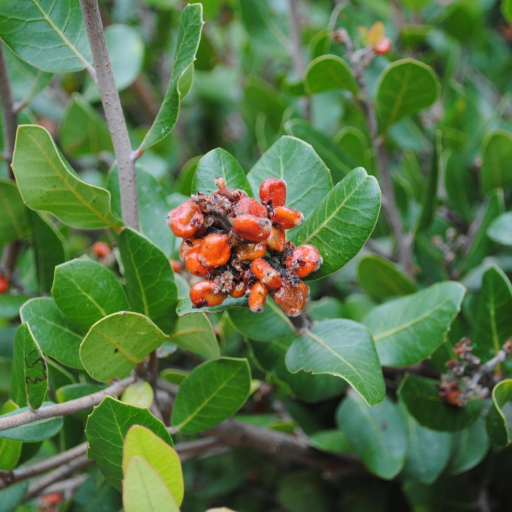
Plant Overview
Known affectionately as the Lemonade Berry, this hardy California native is a staple of coastal sage scrub and chaparral landscapes. It is beloved by gardeners for its deep green, leathery foliage and its incredible ability to act as a fire-resistant privacy screen. Its name comes from the tart, sticky coating on its berries, which has been used for centuries to flavor refreshing drinks.
🔍 How to Identify
- 🍃 Leathery Foliage: The leaves are thick, oval, and waxy with "entire" (smooth) edges, unlike many of its serrated relatives. They are a deep, matte green that provides year-round color.
- 🌸 Cluster Blooms: In late winter and spring, the plant produces dense, tight clusters of small, five-petaled flowers that transition from creamy white to a soft, rosy pink.
- 🔴 Resinous Berries: The most iconic feature is the fruit—small, flattened berries coated in a sticky, reddish-gray "fuzz" that feels tacky to the touch and tastes distinctly sour.
🏡 In Your Garden
- 🧂 Coastal Champion: This plant is a specialist in seaside gardening. It is highly resistant to salt spray and heavy winds, making it the perfect choice for stabilizing bluffs or steep slopes where other plants might wither.
- 💧 Drought Strategy: While it is extremely water-wise, the Lemonade Berry hates "wet feet." It requires well-draining soil; if planted in heavy clay that stays soggy, it is prone to root rot. It’s a "plant it and forget it" species once established.
- 🐦 Wildlife Hub: Because it forms such a dense, mounded thicket, it provides vital nesting sites for birds. In the spring, its nectar-rich flowers are a magnet for local butterflies and bees.
⚠️ Safety & Toxicity
- 🥤 Edibility: The berries are traditionally used to flavor water, but they should be used in moderation. Some people find the concentrated acids can irritate the digestive tract if consumed in large quantities.
- 🧴 Skin Sensitivity: As a member of the Anacardiaceae (Sumac/Cashew) family, it is a distant relative of Poison Ivy. While much less potent, the resinous sap can cause mild skin irritation or a rash in particularly sensitive individuals.
- 🐾 Pet Safety: It is generally considered non-toxic to dogs and cats, though the high tannin content in the leaves might cause a mild stomach upset if chewed.
✨ Fun Fact
🍋 The Original "Gatorade": The tart flavor of the berries comes from malic acid. Indigenous tribes, such as the Kumeyaay and Cahuilla, didn't just drink the "lemonade" for its flavor; they used the cooling brew as a traditional remedy to help break fevers and soothe parched throats during long desert treks.

Detailed Care Instructions
To grow Rhus Integrifolia (Lemonade Berry) plants, you can follow these steps:
- Climate and growing conditions: Lemonade Berry plants thrive in Mediterranean-like climates with mild, wet winters and warm, dry summers. They prefer full sun or partial shade and well-drained soil.
- Propagation: Lemonade Berry can be propagated from seeds or cuttings. If starting from seeds, soak them in water overnight before planting. Sow the seeds in a pot filled with well-draining soil and place them in a warm, sunny location. Keep the soil consistently moist until germination occurs. If using cuttings, select a healthy stem and remove the leaves from the lower half. Dip the cut end in rooting hormone and plant it in a well-draining potting mix. Keep the soil moist and place the cutting in a warm, protected area.
- Planting: When the seedlings or cuttings have developed a strong root system and are about 6-12 inches tall, transplant them into the desired location. Ensure the planting hole is large enough to accommodate the root ball and backfill with soil, firming gently around the plant. Leave space of about 6-8 feet between plants to allow for their mature size.
- Watering: Lemonade Berry plants are relatively drought-tolerant once established. However, during the first year after planting, water regularly (about 1-2 inches per week) to assist with root establishment. Afterward, water during extended dry periods to maintain the plant's health.
- Mulching and weed control: Apply a layer of organic mulch around the plants to help retain moisture, suppress weed growth, and regulate soil temperature. Maintain a weed-free area around the plants to minimize competition for water and nutrients.
- Pruning: Pruning is generally not required for Lemonade Berry plants. However, if you wish to shape or control their growth, it's best to prune in late winter or early spring before new growth begins. Remove any dead, damaged, or crossing branches. Avoid heavy pruning as it may negatively impact the plant's health and natural form.
- Fertilization: Lemonade Berry plants usually do not require much fertilization. However, you can apply a balanced, slow-release fertilizer in early spring to provide some nutrients.
- Pest and disease control: Lemonade Berry is generally resistant to pests and diseases. However, occasional issues like aphids or powdery mildew may occur. Promptly treat any pest or disease problems as needed.
By following these guidelines, you should be able to successfully grow Rhus Integrifolia (Lemonade Berry) plants and enjoy their attractive foliage and berries.

Place in a bright room that is sun drenched almost all day. Or directly in a south-facing window.

To properly water this plant, you will want to start by examining the soil to ensure that it is dry before watering. When you are ready to water it, you will want to use a watering can or hose to slowly and evenly water the soil around the plant's roots. Make sure that you do not allow water to pool around the plant, as this can cause rot and other issues. Additionally, it is important to avoid overwatering this plant, as it can be sensitive to too much moisture. You may need to adjust your watering schedule depending on the climate and humidity levels in your area.
To fertilize the plant, apply a balanced fertilizer in early spring before the foliage emerges, and again in late fall. Use a slow-release granular fertilizer and apply according to package instructions. It is important not to over-fertilize, as it can lead to excessive growth and weakened structure. Finally, always water the plant thoroughly after applying fertilizer.
Rhus Integrifolia prefers a well-draining, loamy soil with a pH range of 6.0 to 7.2. The soil should have good fertility and should be rich in organic matter. It is important to avoid soils that are heavy or compacted, as these can cause drainage problems and inhibit root growth. Sandy soils can also be used, but they may require more frequent watering and fertilization. It is recommended that the soil be amended with compost or other organic matter before planting. Additionally, it is important to ensure that the soil is kept consistently moist, but not waterlogged, in order to promote healthy growth and development.
To propagate this plant, first select a healthy specimen with strong branches and vibrant leaves. Identify a stem with at least two nodes (where leaves emerge) and make a clean cut with sterilized pruning shears just below the lowest node. Remove all leaves except the uppermost ones, leaving the stem with a few leaves to supply energy.
Place the stem cutting into a container with well-draining soil mix. The soil should be moist but not wet to avoid rotting the cutting. Cover the container with a plastic bag or plastic wrap to create humidity. Place the container in a bright but not direct sunlight, if possible, maintain room temperature around 70-75°F (21-24°C). Avoid exposure to drafts or extreme temperature changes.
Mist the cutting with water or use a drip irrigation system to keep the soil moist. Check the cutting frequently, but avoid removing the plastic cover unless the soil appears dry or signs of fungus or mold appear. In about 4-6 weeks, the cutting will develop roots and begin to grow new leaves. At this point, it can be transplanted into a larger container or outdoors in a suitable location.
Common pests of the lemonade sumac include Scale insect, mealybugs, spider mites, thrips. Make a habit of checking your lemonade sumac frequently for pests so that any infestations can be caught and managed early.








