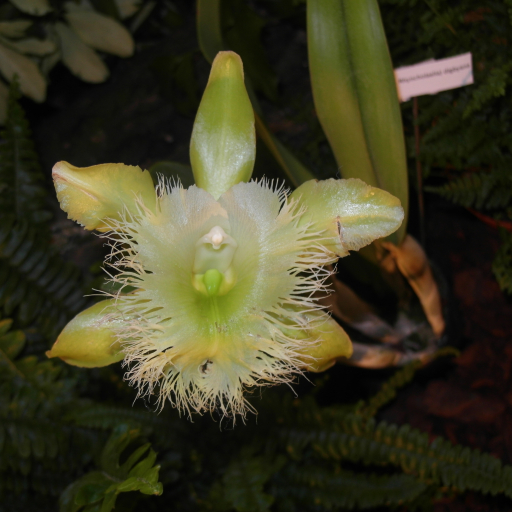
Plant Overview
Often called the "Fringe-lipped Orchid," Rhyncholaelia digbyana is a showstopper that looks like it stepped out of a Victorian lace shop. Native to the dry forests of Central America, this orchid is legendary among collectors for its citrus-vanilla scent and its prestigious status as the national flower of Honduras. It is a rugged survivor that trades the typical bright colors of orchids for a sophisticated, ghostly green elegance.
🔍 How to Identify
- 🌸 The "Frilly" Lip: The most iconic feature is the massive, deeply fringed labellum (lip) that looks like delicate green lace or sea foam surrounding the center of the flower.
- 🍃 Waxy Foliage: Its leaves are stiff, leathery, and have a unique silvery-blue or "glaucous" coating, which acts as a natural sunscreen against harsh tropical rays.
- 📏 Sturdy Pseudobulbs: The plant grows from short, thick, club-shaped stems that store water, allowing it to withstand periods of drought in the wild.
🏡 In Your Garden
- ☀️ Light Lover: This orchid is a sun-worshiper. If the leaves aren't a pale, lime-green color, it likely isn't getting enough light to produce those spectacular blooms. In fact, it can handle much more brightness than your average Phalaenopsis.
- 🌬️ The "Dry Out" Rule: Because it grows as an epiphyte on trees, it hates "wet feet." It is happiest when mounted on a piece of cork or kept in a wooden slat basket where the roots can breathe and dry completely between waterings.
- 🌙 Midnight Perfume: Don't expect a scent during the day! This plant is "vespertine," meaning it only releases its powerful, lemony fragrance at night to attract the specific moths that pollinate it.
⚠️ Safety & Toxicity
- 🐾 Pet Friendly: Rhyncholaelia digbyana is generally considered non-toxic to cats, dogs, and horses, making it a safe choice for indoor enthusiasts with curious pets.
- 🚫 Root Sensitivity: While not chemically toxic, the plant is "sensitive" to movement. It has a notorious "taproot-like" temperament—if you repot it or disturb the roots too often, the plant may go into a sulk and refuse to bloom for a year or more.
✨ Fun Fact
This orchid is the "secret ingredient" in orchid breeding history! It has been used as a parent in thousands of hybrids (specifically the "B" in "Blc." hybrids) to pass down that massive, ruffled, lace-like lip to its offspring.

Detailed Care Instructions
To grow Rhyncholaelia Digbyana, commonly known as the golden or yellow lady slipper orchid, you need to provide the right growing conditions and care. Here are some steps to help you grow this plant successfully:
- Light: Rhyncholaelia Digbyana thrives in bright, indirect light. Place your orchid near a south or east-facing window where it can receive bright, filtered light. Avoid direct sunlight, as it can scorch the leaves.
- Temperature and Humidity: These orchids prefer moderate temperatures between 65°F to 75°F (18°C to 24°C) during the day and slightly cooler temperatures at night. Maintain a relative humidity of around 50-70%. You can increase humidity levels by placing the orchid on a tray filled with water and pebbles or using a humidifier.
- Watering: Water your orchid thoroughly when the top inch of the potting medium feels dry. Use room temperature water and ensure that excess water drains out of the pot. It is important not to let your plant sit in standing water, as this can lead to root rot. Reduce watering in the winter when the plant enters its dormant period.
- Potting Medium: Use a well-draining orchid-specific potting mix, such as a combination of bark, sphagnum moss, and perlite. Repot your orchid every 1-2 years or when the potting medium breaks down.
- Fertilizer: Feed your Rhyncholaelia Digbyana with a balanced orchid fertilizer diluted to half strength every 2-3 weeks during the growing season. Reduce or stop fertilizing during the dormant period.
- Air Circulation: Proper air circulation is essential for preventing diseases and promoting healthy growth. Place a small fan nearby to ensure air movement around the plant.
- Rest Period: During the winter months, Rhyncholaelia Digbyana goes through a rest period where it needs cooler temperatures and less water. Reduce watering and withhold fertilizer during this time.
- Reproduction: Propagating Rhyncholaelia Digbyana can be done through division. Wait until the plant has grown large enough, and then divide it into smaller sections, ensuring each division has enough roots to sustain itself.
By following these steps, you can provide the optimum growing conditions for Rhyncholaelia Digbyana and enjoy its beautiful blooms. Remember that cultivating orchids requires patience and attention to detail.

Place in a window with dappled sun or a spot in the middle of a room. Or directly in a window facing west or east.

To correctly water this plant, it is important to consider its natural habitat and growth habits. This plant typically grows in humid environments with plenty of rainfall, meaning it requires consistent moisture.
When watering, use room temperature and clean water to avoid shocking the roots with sudden temperature changes or exposure to chemicals. Water the plant thoroughly, allowing the water to run out of the drainage holes in the pot. Be sure to wait until the soil is fairly dry before watering again, as this plant is susceptible to root rot if left sitting in wet soil for extended periods.
In addition to regular watering, it is also beneficial to mist this plant frequently to mimic its natural environment. This helps to keep the overall humidity level high and ensures that the plant doesn't dry out.
Overall, the key to successfully watering this plant is to provide consistent moisture without allowing it to sit in overly wet soil.
To fertilize the plant, use a balanced fertilizer with equal amounts of nitrogen, phosphorus, and potassium. Dilute the fertilizer to half strength and apply it every two weeks during the growing season. Avoid fertilizing during the plant's dormant period. Always water the plant before applying the fertilizer to prevent root burn.
The ideal soil for the plant commonly known as Rhyncholaelia Digbyana should be well-draining and porous. It should consist of a mix of organic matter such as peat moss or coconut coir, and inorganic materials such as perlite or vermiculite. The pH level of the soil should be slightly acidic, between 5.5 and 6.5. Additionally, the plant prefers a soil mix that is rich in nutrients, so adding fertilizer to the soil is recommended. It is important that the soil does not become waterlogged, as this can lead to root rot and damage to the plant. Frequent repotting is also recommended to ensure that the plant has ample space to grow and access to fresh nutrients in the soil.
To propagate this orchid species, it is important to start with a healthy, mature plant. The first step is to select a few healthy pseudobulbs with at least one leaf and some aerial roots. Carefully remove these from the parent plant, being sure not to damage them.
Next, prepare a pot with a well-draining orchid mix, such as sphagnum moss or bark chips. Place the pseudobulbs on the surface of the mix, making sure the roots are in contact with the mix.
To encourage the growth of new roots and shoots, provide indirect sunlight and maintain a high level of humidity around the plant. This can be achieved by covering the pot with a plastic bag or placing it in a humid environment, such as a terrarium.
It is important to monitor the plant and adjust watering as necessary. Do not allow the mix to dry out completely, but also be sure not to overwater as this can lead to rot.
With proper care and patience, the pseudobulbs will eventually develop new growth and establish themselves as individual plants.
Common pests of the digby's beaked laelia include Scale insect, mealybugs, spider mites, thrips. Make a habit of checking your digby's beaked laelia frequently for pests so that any infestations can be caught and managed early.








