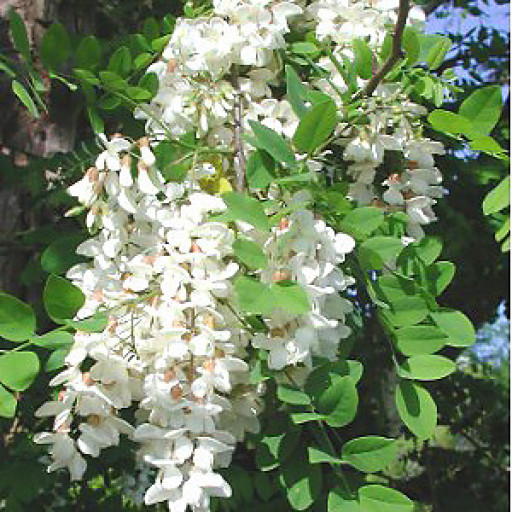
Plant Overview
Known as the "False Acacia" or "Black Locust," the Robinia is a fast-growing tree that balances delicate, lace-like foliage with a surprisingly tough-as-nails personality. Originally from the Appalachian Mountains of North America, it has traveled the globe, beloved by beekeepers for its fragrant, nectar-rich flowers that smell like a mix of honey and orange blossoms. While it looks soft and ornamental, it is a pioneer species capable of surviving in the harshest soils.
🔍 How to Identify
- 🍃 Lacy Leaves: It features pinnately compound leaves—small, oval leaflets arranged in pairs along a central stem, giving the canopy a soft, airy appearance that filters sunlight beautifully.
- 🌸 Pea-like Blooms: In late spring, the tree is draped in heavy, drooping clusters (racemes) of white or pale pink flowers that look remarkably like sweet peas.
- ⚔️ Spiny Protection: Don't let the flowers fool you; young branches and saplings usually sport sharp, paired thorns at the base of each leaf stalk.
- 🪵 Deeply Furrowed Bark: As the tree matures, its bark becomes dark brown and develops deep, crisscrossing ridges that look like thick braided rope.
🏡 In Your Garden
- 🌱 The Soil Builder: Like other members of the pea family, Robinia is a nitrogen-fixer. It hosts special bacteria in its roots that turn atmospheric nitrogen into "food" for the soil, making it a great choice for reclaiming poor or rocky land.
- 🏃 The Great Wanderer: Gardeners should be cautious of its "suckering" habit. It spreads via underground runners and can quickly turn from a single specimen into a thicket if the roots are disturbed or if it isn't pruned regularly.
- 🌬️ Brittle Branches: Because it grows so fast, the wood can be brittle. It’s best to plant it away from the house or power lines, as heavy winds or snow can cause branches to snap.
⚠️ Safety & Toxicity
- 🚫 Toxic Parts: While the fragrant flowers are technically edible (often used in traditional European fritters), the bark, seeds, and leaves are toxic to both humans and livestock.
- 🐴 Equine Warning: Robinia is particularly dangerous to horses. Ingesting even small amounts of the bark or wilted leaves can lead to severe digestive distress and heart palpitations.
- 🧤 Thorny Handling: Always wear thick gloves when pruning young Robinia to avoid painful punctures from its hidden spines.
✨ Fun Fact
[🚢] The Shipbuilder’s Secret: Robinia wood is one of the hardest and most rot-resistant timbers in the world. It was famously used to make "trunnels" (wooden nails) for the hulls of the USS Constitution. These wooden nails were so strong they often outlasted the iron bolts used in other ships!

Detailed Care Instructions
To grow a Robinia plant, also known as black locust, you can follow these steps:
- Choose a suitable location: Robinia plants thrive in full sun and well-drained soil. Select an area in your garden that receives at least 6-8 hours of direct sunlight each day.
- Prepare the soil: Robinia plants prefer slightly acidic to neutral soil with a pH of 6.0-7.0. Make sure the soil is well-draining and amend it with organic matter such as compost or well-rotted manure. This will improve the soil structure and provide essential nutrients.
- Planting: Dig a hole that is twice the width and depth of the root ball of the plant. Place the plant into the hole, ensuring it is at the same level as it was growing previously. Backfill the hole with soil and gently firm it around the base of the plant.
- Watering: Water the plant thoroughly after planting to settle the soil. Keep the soil moist but not waterlogged during the first year of growth. Once established, Robinia plants are quite drought-tolerant and require less frequent watering.
- Pruning: Prune the plant in late winter or early spring to remove any dead, damaged, or diseased branches. You can also shape the plant by trimming it lightly. This encourages better airflow and helps maintain a healthy plant structure.
- Fertilizing: Robinia plants usually do not require much fertilization. However, you can apply a balanced slow-release fertilizer in early spring to provide essential nutrients. Follow the package instructions for application rates.
- Mulching: Apply a layer of organic mulch around the base of the plant to help conserve moisture, suppress weeds, and regulate soil temperature. Leave a small gap between the mulch and the stem to prevent rotting.
- Pest and disease control: Robinia plants are generally resistant to pests and diseases. However, they can occasionally be affected by aphids or mimosa webworms. Monitor the plant regularly and take appropriate measures if any issues arise, such as using insecticidal soap spray or removing affected parts.
- Regular maintenance: Remove any suckers or unwanted shoots that may grow around the base of the plant. These plants have a tendency to spread through suckering, so it's important to keep them in check.
By following these steps and providing proper care and maintenance, your Robinia plant should grow well and provide you with beautiful foliage and fragrant flowers.

Place in a bright room that is sun drenched almost all day. Or directly in a south-facing window.

To properly water this plant, it is important to understand its watering needs. This plant prefers to be grown in well-draining soil, which allows water to flow through easily and prevents waterlogging. When watering, it is best to thoroughly saturate the soil until water drains out from the bottom of the container or soil. This ensures that the roots are receiving enough water.
It is important to not over-water the plant as this can lead to root rot and fungal diseases. It is recommended to allow the soil to dry out slightly between waterings. Additionally, it is important to avoid getting water on the leaves and foliage of the plant as this can increase the risk of fungal diseases.
During hot and dry weather, this plant may require more frequent watering. It is also important to note that if the plant is grown outdoors, it may receive water from rainfall and therefore require less manual watering.
Overall, it is important to maintain a consistent watering schedule and to monitor the soil moisture levels to ensure proper hydration for this plant.
To fertilize this plant, use a slow-release granular fertilizer in early spring, just before new growth appears. Avoid applying fertilizer during the summer or fall as it can stimulate new growth that may not have time to mature before winter. Apply the fertilizer around the base of the plant, following the package instructions for dosage. Water thoroughly after fertilizing.
When planting Robinia, it is recommended to use a well-draining soil that is rich in nutrients. The soil should have a pH level between 6.0 and 8.0. It is important to avoid heavy, clay soils as Robinia prefers a lighter soil texture. Adding organic matter to the soil can help improve its structure and increase its fertility. It is also recommended to mulch around the base of the plant to help retain moisture and suppress weed growth. Avoid over-fertilizing as this can lead to excessive growth and reduced flowering.
To propagate this plant, you will need to gather cuttings from the parent plant. It is best to take these cuttings in the spring or early summer. Select a healthy stem that is not too woody and has several sets of leaves. Cut the stem at a 45-degree angle, leaving at least 6 inches of stem.
Remove the lower sets of leaves and any flowers or buds. Dip the cut end of the stem in rooting hormone and plant it in a pot filled with a well-draining potting mix. Water the cutting well and cover it with a clear plastic bag to create a greenhouse-like environment.
Place the pot in a location with bright, indirect light and keep the soil moist but not waterlogged. After several weeks, the cutting should start to produce new growth, indicating that it has rooted successfully. When the new growth is about 2 inches long, you can transplant it into a larger pot or outside in the garden, if the weather is warm enough.







