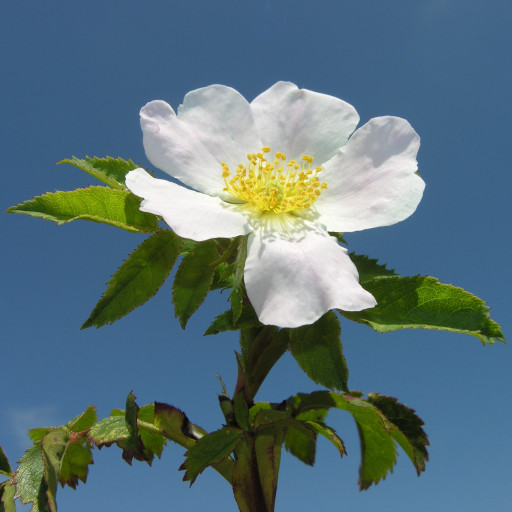
Plant Overview
Known as the Small-leaved Sweet-briar, Rosa agrestis is a subtle beauty of the wild rose family. While its garden cousins compete for the largest blooms, this species wins hearts with its rustic charm and its ability to thrive in the toughest limestone soils. In European folklore, wild roses like this one were often planted near boundaries to act as both a physical barrier and a symbolic protector of the home.
🔍 How to Identify
- 🌿 The Foliage: The leaves are small, narrow, and pointed. If you flip them over, you’ll find tiny resinous glands that release a faint, refreshing scent of green apples when crushed.
- 🌸 The Flowers: It produces modest, five-petaled flowers that are usually white or a very pale, ethereal pink. They lack the heavy scent of hybrid roses but offer a delicate, airy fragrance.
- 🍷 The Fruit: In autumn, the plant produces smooth, oval-shaped red "hips." These bright fruits persist into winter, providing a splash of color against the dormant landscape.
- ⚔️ The Prickles: Its stems are armed with stout, hooked thorns that are curved like a cat’s claw, designed for "climbing" or anchoring onto neighboring shrubs.
🏡 In Your Garden
- 🌱 Alkaline Specialist: Unlike many garden plants that crave acidic soil, this rose is a specialist for chalky, limestone, or calcareous ground. It is the perfect choice for "difficult" rocky patches where other roses might turn yellow.
- 🐦 Wildlife Magnet: Because it forms dense, thorny thickets, it is a five-star hotel for nesting birds. The flowers provide nectar for early-season pollinators, and the hips are a vital food source for birds during the winter frost.
⚠️ Safety & Toxicity
- 🛡️ Status: Non-toxic but physically defensive.
- 🧤 Details: While the plant isn't poisonous to pets or humans, the "stipular" thorns are incredibly sharp and can easily pierce garden gloves. Always wear heavy-duty protection when pruning. The hairs inside the rose hips can also be a skin and throat irritant if handled or eaten raw.
✨ Fun Fact
The specific epithet agrestis comes from the Latin word for "wild" or "belonging to the fields." It shares the same root as the word "agrarian," perfectly describing its preference for roaming free in rural hedgerows rather than being confined to a manicured flower bed.

Detailed Care Instructions
To grow Rosa Agrestis, also known as wild rose, you can follow these steps:
- Choose the right location: Wild roses prefer a sunny spot with well-draining soil. Ensure the location has at least 6 hours of direct sunlight daily.
- Prepare the soil: Wild roses can tolerate a range of soil conditions but prefer slightly acidic to neutral soil. Improve the soil by adding compost or well-rotted manure before planting.
- Propagation: Wild roses can be propagated from seeds or cuttings. If you have access to wild rose seeds, sow them in a seed tray or individual pots filled with well-draining soil. Keep the soil moist until the seeds germinate. Alternatively, take semi-hardwood cuttings from an existing wild rose plant and plant them in potting soil or directly in the ground.
- Planting: Choose a cool time of the year, preferably spring or fall, to plant your wild rose. Dig a hole slightly larger than the root ball of the plant and place the root ball in the hole. Backfill the hole with soil, firm it gently, and water well.
- Watering: Keep the soil evenly moist but not waterlogged during the growing season. Water deeply once a week or whenever the top inch of soil feels dry. Reduce watering during the dormant winter period.
- Mulching: Apply a layer of organic mulch around the base of the plant, such as wood chips or straw. Mulch helps retain moisture, suppresses weeds, and regulates soil temperature.
- Pruning: Wild roses generally require minimal pruning. However, you can remove dead, diseased, or damaged branches at any time. Light shaping or selective pruning can be done in late winter or early spring.
- Fertilizing: Wild roses generally do not require heavy feeding. However, you can apply a balanced rose fertilizer in early spring to promote healthy growth. Follow the package instructions for the appropriate amount.
- Pest and disease control: Wild roses are generally more resistant to pests and diseases compared to hybrid roses. However, keep an eye out for common rose pests such as aphids or rose beetles. Treat any infestations using organic pest control methods.
- Enjoy the flowers: Wild roses usually bloom in early to mid-summer. They produce single, pink or white flowers with a delightful fragrance. Enjoy the beauty and fragrance of your Rosa Agrestis plant throughout the blooming season.
Remember to grow wild roses responsibly, as they can become invasive in some areas.

Place in a bright room that is sun drenched almost all day. Or directly in a south-facing window.

To properly water this plant, first ensure that the soil is dry to the touch before watering. When watering, use a watering can or hose with a gentle flow and water around the base of the plant until the soil is moist but not waterlogged. Avoid getting water on the leaves or blooms as this can lead to disease. Water early in the morning or late in the afternoon to avoid evaporation. It is important to also maintain good drainage to prevent the soil from becoming waterlogged.
To fertilize this plant, begin by selecting an all-purpose fertilizer that is high in phosphorous. Dilute the fertilizer according to the instructions on the packaging, and apply it directly to the soil once every month during the growing season. Be careful not to over-fertilize, as this can damage the plant or cause excessive foliage growth at the expense of flowers. Additionally, make sure the plant has adequate moisture, as dry conditions can hinder its ability to absorb nutrients. It is also important to prune the plant regularly to promote healthy growth and flowering.
Rosa Agrestis plants prefer well-draining soil that is rich in organic matter. A sandy loam or loamy soil with a pH level between 6.0 and 6.5 is ideal for these plants. It is important to ensure that the soil is not too compacted, as good drainage is essential for the healthy growth of Rosa Agrestis plants. Adding organic matter, such as compost or well-rotted manure, to the soil can help improve its fertility and structure. Additionally, it is recommended to mulch around the base of the plant to help retain moisture and suppress weeds.
- Select a healthy and mature Rosa Agrestis plant.
- Identify a stem that is at least 6 inches long and has several nodes.
- Using a sharp and clean pair of garden pruners, make a diagonal cut just below a node on the stem.
- Remove any leaves or buds from the lower stem to expose at least one node.
- Dip the cut end of the stem in rooting hormone powder to improve the chances of successful rooting.
- Plant the stem in a well-draining potting mix and water it thoroughly.
- Cover the stem and pot with a plastic bag or dome to maintain humidity and create a greenhouse effect.
- Place the pot in indirect or filtered sunlight.
- Check the soil moisture regularly and water as needed to keep the soil moist but not waterlogged.
- In around 4-6 weeks, check for signs of new growth and roots. Once the plant has established roots and new growth is visible, it can be transplanted to a larger pot or directly into the garden.








