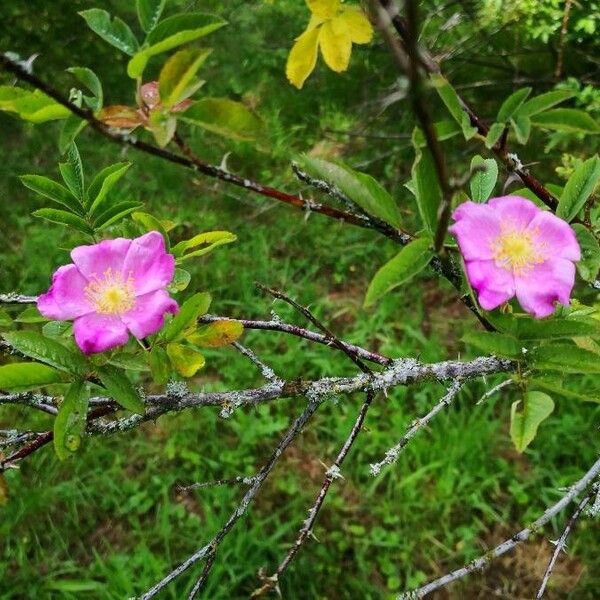
Plant Overview
The Dahurian Rose is a resilient beauty that thrives where other roses falter, originating from the harsh climates of East Asia, Mongolia, and Siberia. Often called the "Siberian Rose," it is prized for its deep magenta blooms and its incredible ability to survive temperatures that would freeze most other garden plants solid. In the wild, it forms dense, protective thickets that serve as a vital sanctuary for birds and small mammals during brutal winters.
🔍 How to Identify
- 🍃 Leaf Structure: The foliage consists of 7 to 9 small, oval leaflets with sharply toothed edges and a slightly "quilted" texture on the surface.
- 🌸 The Bloom: It produces solitary, fragrant flowers with five broad petals that range from deep purplish-red to a soft magenta, featuring a cluster of golden stamens at the center.
- 🔴 The Hips: In autumn, the plant produces smooth, spherical, bright red hips that are noticeably smaller and rounder than those of the common Rosa rugosa.
🏡 In Your Garden
- ❄️ Extreme Hardiness: This is a "set it and forget it" plant for cold climates; it requires a true winter dormancy and actually struggles in tropical or subtropical regions that don't get a hard frost.
- 🦋 Pollinator Paradise: Because it is a "wild-type" rose with a single row of petals, bees and butterflies can easily access the pollen, making it far more ecologically valuable than modern "double-petal" hybrid roses.
⚠️ Safety & Toxicity
- ✅ Non-Toxic: Rosa davurica is generally considered safe for humans, cats, and dogs.
- 🧤 Prickle Protection: While not toxic, the stems are armed with straight, sharp prickles. Always wear thick gardening gloves when pruning to avoid "rose gardener's disease" (sporotrichosis), a rare fungal infection that can enter through thorn scratches.
✨ Fun Fact
✨ Siberian Superfood: The hips of the Dahurian Rose are exceptionally high in Vitamin C—containing significantly more per gram than citrus fruits. Historically, they were a primary source of vitamins for indigenous peoples in Siberia to prevent scurvy during the long, dark winters.

Detailed Care Instructions
To grow Rosa Davurica plants, follow these steps:
- Choose a suitable location: Rosa Davurica plants prefer full sun to partial shade. Select a location with well-draining soil.
- Prepare the soil: Before planting, amend the soil with organic matter like compost or well-rotted manure to improve fertility and drainage.
- Plant the rose: Dig a hole slightly larger than the rootball of the plant. Place the rootball in the hole, ensuring that the bud union (swollen area where the rose was grafted onto the rootstock) is at or slightly above soil level. Backfill the hole with soil, gently firming it around the plant.
- Water thoroughly: After planting, water the rose deeply to help settle the soil and ensure good root-to-soil contact. Once established, water regularly, aiming for about 1 inch of water per week.
- Mulch: Apply a layer of organic mulch around the base of the plant to help retain moisture, suppress weeds, and regulate soil temperature.
- Prune: Prune your Rosa Davurica plant in early spring or late winter. Remove any dead, diseased, or damaged wood, and shape the plant as desired. Pruning helps promote healthy growth and abundant blooms.
- Fertilize: Apply a balanced, slow-release fertilizer in the spring and summer to promote healthy growth and flowering. Follow the manufacturer's instructions for application rates.
- Monitor for pests and diseases: Keep an eye out for common rose pests like aphids, spider mites, or rose sawflies. Treat any infestations promptly using organic or chemical controls.
- Provide support: Depending on the growth habit of the specific Rosa Davurica variety, you may need to provide support like trellises or stakes to prevent the plant from sprawling or falling over.
- Enjoy the blooms: Rosa Davurica plants produce beautiful, fragrant flowers. Enjoy their blooms throughout the growing season and remember to deadhead spent flowers to encourage further flowering.
By following these steps, you can successfully grow and enjoy your Rosa Davurica plant.

Place in a bright room that is sun drenched almost all day. Or directly in a south-facing window.

To water the plant that belongs to the species Rosa davurica, you should first check the moisture levels of the soil. Insert your finger or a moisture meter into the soil to determine if it is dry or moist. If the soil feels dry to the touch, it is time to water the plant.
When watering, aim to soak the soil thoroughly as this will encourage the roots to grow deeper. Avoid watering the foliage or flowers of the plant as this can promote fungal growth and increase the risk of disease.
The frequency of watering will depend on various factors such as the size of the pot or garden bed, weather conditions, and the type of soil. As a general rule of thumb, potted plants should ideally be watered every 2 to 3 days, while garden beds can be watered less frequently (once every 5 to 7 days).
It is recommended to water early in the morning or late in the evening when the temperature is cooler and the sun is less intense. This will reduce the likelihood of water evaporation and ensure that the plant is hydrated for longer.
Overall, proper watering technique is crucial for the health and growth of the Rosa davurica plant. By checking the soil moisture regularly and watering thoroughly and at the right time, you can help ensure that the plant thrives and produces beautiful blooms.
To fertilize this particular plant, you should apply a balanced fertilizer with equal parts nitrogen, phosphorus, and potassium during the growing season. Follow the recommended dosage on the label and avoid over-fertilizing, which can cause damage to the roots. Additionally, it's beneficial to apply a layer of organic compost or mulch around the base of the plant to improve soil health and nutrient retention. Water the plant thoroughly after fertilization to ensure proper uptake of nutrients.
Rosa Davurica plant will thrive in well-draining soil that is rich in nutrients. The soil pH should be slightly acidic to neutral, ranging from 6.0 to 7.5. Sandy loam or loamy soil would be ideal for this plant, as it would allow for adequate drainage while retaining moisture. The soil should also be loose and aerated, allowing for the roots to spread and uptake nutrients efficiently. Additionally, the plant prefers soil that is fertile and high in organic matter. You can amend the soil with compost or well-rotted manure to help improve the soil fertility. It is essential to avoid using heavy clay soil, as it can retain too much water and lead to root rot. Finally, ensure that the soil provides sufficient nutrients such as nitrogen, phosphorus, and potassium, to promote healthy growth and blooming of Rosa Davurica plant.
To propagate this plant, you'll need to gather materials such as a sharp and sterile cutting tool, rooting hormone powder, a small pot with well-draining soil, and a warm and humid spot.
- Select a healthy and disease-free stem from the parent plant. Make sure it has at least one or two nodes (areas where leaves emerge).
- Using the cutting tool, make a clean cut at a 45-degree angle just below a node and remove any leaves along the lower half of the stem.
- Once you have your cutting, dip the bottom end of the stem into the rooting hormone powder, ensuring that it is well-coated.
- Plant your cutting into a pot filled with moist soil.
- Place the pot in a warm, bright location, avoiding direct sunlight, and keep the soil consistently moist.
- After a few weeks, check for new growth and tiny roots appearing from the stem base.
- Once the new plant develops a few leaves, you can transplant it to a larger container or outdoors.
With patience and care, you can successfully propagate your Rosa Davurica plant!








