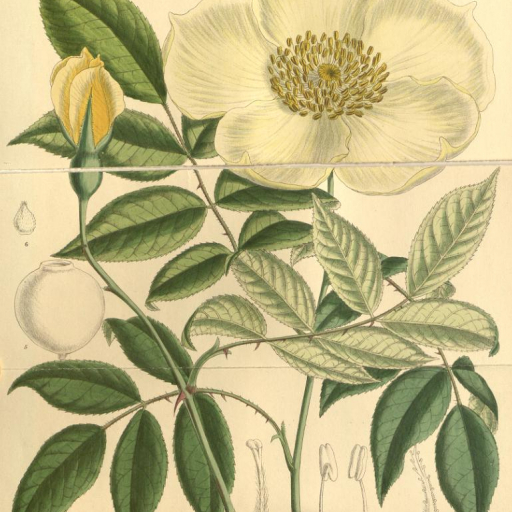
Plant Overview
Often called the "Giant Rose" or the "Manipur Rose," Rosa gigantea is the undisputed titan of the rose family. Hailing from the misty foothills of the Himalayas and the forests of Southwest China, this isn't your average backyard bush; it is a vigorous, tree-climbing marvel. It holds a legendary status in botany as one of the primary ancestors of the modern "Tea Rose," passing down its signature fragrance to the hybrids we see today.
🔍 How to Identify
- 🌸 Massive Blooms: The flowers are exceptionally large for a wild rose, featuring five elegant petals that range from creamy white to a soft, pale lemon yellow.
- 🍃 Lustrous Foliage: Its leaves are thick, leathery, and shiny. In warmer climates, the plant remains evergreen, providing a lush green canopy year-round.
- 🧗 Scrambling Canes: Unlike stiff garden roses, this species produces long, flexible canes armed with thick, hooked prickles that allow it to "hitchhike" up trees to heights of 20 meters or more.
🏡 In Your Garden
- 🏗️ Needs Room to Roam: This is not a plant for a small patio. It requires a massive amount of vertical space and a very sturdy structure—like a mature tree or a heavy-duty pergola—to support its weight.
- ☀️ Warmth and Shelter: Coming from subtropical mountain regions, it is less frost-hardy than most modern roses. It thrives in sunny, sheltered spots and prefers well-drained soil that doesn't stay soggy during the winter.
⚠️ Safety & Toxicity
- 🛡️ Physical Hazard: While Rosa gigantea is not chemically toxic, its "giant" name applies to its thorns too. The prickles are hooked and very strong, capable of causing deep scratches if handled without heavy-duty gloves.
- 🐾 Pet & Child Friendly: The plant is generally considered non-toxic to cats, dogs, and humans if accidentally ingested, though the sharp thorns are a significant physical risk for curious pets or playing children.
✨ Fun Fact
Most of the "Tea Roses" sold in florist shops today owe their distinct, tea-like scent to Rosa gigantea. When European explorers first encountered it, they noted the flowers smelled exactly like a freshly opened crate of high-quality Chinese tea!

Detailed Care Instructions
To grow Rosa Gigantea, also known as the tea rose, you can follow these steps:
- Choose the right location: Rosa Gigantea thrives in full sun, so select a spot in your garden that receives at least 6-8 hours of direct sunlight daily. The plant also prefers well-draining soil.
- Prepare the soil: Before planting, amend the soil with organic matter like compost or aged manure to improve drainage and fertility. Remove any weeds or grass from the planting area.
- Planting: Dig a hole that is slightly larger and deeper than the root ball of the plant. Place the root ball in the hole and backfill with soil, ensuring that the bud union (the swollen area where the rose was grafted onto rootstock) is level with or slightly above the soil surface.
- Watering: After planting, water the rose thoroughly. Throughout the growing season, water deeply once or twice a week if rainfall is insufficient. Avoid overwatering, as it can lead to root rot.
- Mulching: Apply a layer of organic mulch around the base of the plant to conserve soil moisture, control weeds, and regulate soil temperature. Keep the mulch a few inches away from the stem to prevent rot.
- Fertilizing: Feed the rose with a balanced rose fertilizer according to the package instructions. Start fertilizing in early spring and continue every 4-6 weeks during the growing season. Water the plant before and after applying fertilizer to prevent burning the roots.
- Pruning: Prune Rosa Gigantea in late winter or early spring to remove dead, damaged, or crossing branches. Additionally, trim the plant to maintain its desired shape and promote better air circulation.
- Pest and disease control: Monitor your rose plant regularly for common pests like aphids, spider mites, or black spot disease. Treat any issues promptly using appropriate organic or chemical controls if necessary.
- Winter care: In colder regions, provide protection in winter by covering the base of the plant with a thick layer of mulch or applying a protective rose cone. This helps insulate the plant and shield it from extreme cold temperatures.
By following these guidelines, you can successfully grow and care for Rosa Gigantea and enjoy its beautiful tea rose blooms.
To properly water this plant, it is important to observe the soil moisture level. The soil should be moist but not waterlogged. Water the plant thoroughly and deeply, allowing the water to penetrate the soil and reach the roots. Avoid getting water on the foliage as this can lead to fungal diseases. Water less frequently during cooler temperatures or if the plant is in a dormant stage. Use a well-draining soil mix that allows for proper drainage and aeration. Avoid allowing the soil to dry out completely between watering, as this can stress the plant and reduce its overall health.
- Choose a balanced fertilizer, with equal amounts of nitrogen, phosphorus, and potassium.
- Apply the fertilizer in the spring, just as the plant is starting to grow.
- Measure out the appropriate amount of fertilizer, based on the size of the plant.
- Scatter the fertilizer evenly around the base of the plant, ensuring that it is not touching the stems or leaves.
- Gently work the fertilizer into the soil with a hand trowel or fork.
- Water the plant thoroughly, to help the fertilizer reach the roots.
- Repeat the process every three months during the growing season, to ensure that the Rosea Gigantea receives the nutrients it needs to thrive.
The ideal soil for Rosa Gigantea plant is a well-draining, loamy soil with a pH level between 5.5 to 7.0. The soil should be rich in nutrients and have good aeration and water retention properties. It should be able to retain moisture without becoming waterlogged, as stagnant water can cause root rot in the Rosa Gigantea plant. Adding organic matter such as compost, aged manure, or leaf mold to the soil can help improve its quality and fertility. It is important to ensure that the soil is free from pests and diseases that can harm the Rosa Gigantea plant. Regularly testing the soil's pH level and nutrient content can help ensure optimal growing conditions for the Rosa Gigantea plant.
- Tools and materials needed: A sharp, sterilized pruning shears, a rooting hormone powder, a pot, a well-draining soil mix, and water.
- Choose a healthy, mature stem of the Rosa Gigantea plant to propagate. Make sure that the stem is at least 6 inches long and has at least 3 leaf nodes.
- Cut the stem at a 45-degree angle, using sterilized pruning shears, just below a node. Remove any leaves that are within 3 inches from the bottom of the stem.
- Dip the cut end of the stem into a rooting hormone powder to stimulate root growth.
- Fill a pot with well-draining soil mix and make a small hole in the soil using a pencil or your finger.
- Insert the cut end of the stem into the hole and press lightly around the soil to make sure the cutting is secure.
- Water the cutting thoroughly to settle the soil around the stem.
- Cover the planted cutting with a plastic bag or a glass jar to create a mini greenhouse.
- Place the pot in a warm, bright spot with indirect light.
- Check the cutting every few days to ensure that the soil is moist. Mist the cutting if the soil feels dry.
- After 4-6 weeks, check for roots by gently tugging on the stem. If there is resistance, roots have formed, and you can remove the plastic bag or glass jar.
- Once the cutting has developed a good root system, you can transplant it to a larger pot or a permanent location in your garden.








