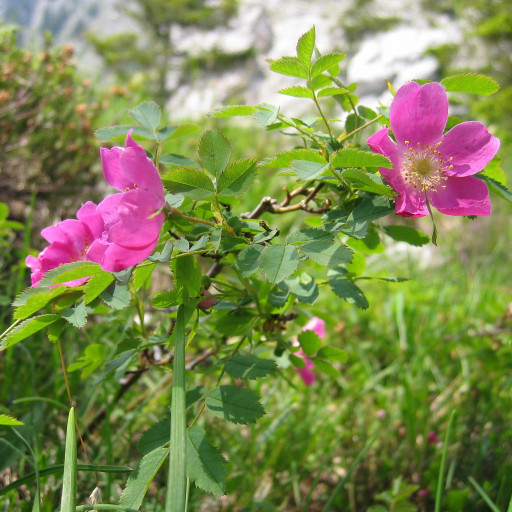
Plant Overview
Often called the Alpine Rose, this mountain gem brings a touch of wild elegance from the high-altitude peaks of Central and Southern Europe. Unlike its heavily manicured garden cousins, this hardy shrub thrives where the air is thin and the winters are long, offering a flush of deep magenta blooms that signal the arrival of the alpine summer. It is famously "well-behaved" compared to other wild roses, often lacking the aggressive, tearing thorns that define the genus.
🔍 How to Identify
- 🌸 The Blooms: Five-petaled, deep pink to purplish-red flowers with a bright cluster of golden stamens at the center. They typically bloom in early summer.
- 🍃 The Foliage: Feathery, compound leaves usually made up of 7 to 11 small, tooth-edged leaflets. In autumn, the foliage transitions into a soft, golden yellow.
- 🔴 The "Hips": One of its most distinct traits is the fruit—bright red, bottle-shaped "hips" that hang gracefully downward (pendulous) as they ripen.
- 🌿 The Stems: Smooth, reddish-brown bark. While many roses are armored with prickles, Rosa pendulina is largely thornless, especially on its upper branches.
🏡 In Your Garden
- ⛰️ Climate Preferences: Because it originates in the mountains, it is incredibly frost-hardy. It prefers regions with cooler summer nights and may struggle in heavy, sweltering tropical humidity.
- 🌥️ Shade Tolerance: While most roses are "sun-worshippers," the Alpine Rose is surprisingly tolerant of partial shade, making it perfect for woodland edges or north-facing garden spots.
- 🧤 Ease of Care: It is naturally resistant to many common rose diseases like black spot and mildew. Because it doesn't have the "hooked" thorns of most briars, it is much easier to prune without protective armor.
⚠️ Safety & Toxicity
- ✅ Non-Toxic: The plant is generally considered safe and non-toxic for humans, dogs, and cats.
- 👄 Irritating Seeds: While the rose hips are edible and high in Vitamin C, the seeds inside are covered in tiny, stiff hairs. These can cause "itching powder" irritation in the throat or skin if they aren't filtered out before consumption.
✨ Fun Fact
The species name pendulina comes from the Latin word for "hanging." This refers to the plant's unique habit of bowing its heavy, elongated fruit toward the ground, a visual trait that distinguishes it from almost all other wild roses whose hips point toward the sky.

Detailed Care Instructions
| Color | Rich Pink Flowers With Bright Yellow Centers |
| Soil Ph | 5.6 To 6.5 |
| Humidity | Normal |
| Lighting | Full Sun |
| Toxicity | Non-Toxic |
| Soil Type | Rich, Well-Draining Soil |
| Bloom Time | Late Spring To Early Summer |
| Difficulty | Medium |
| Plant Type | Deciduous Shrub |
| Hibernation | Cold Period |
| Mature Size | 1.5-6 Ft. |
| Native Area | Eastern Russia, Korea, Japan, And Northern China |
| Sun Exposure | Full Sun To Partial Shade |
| Hardiness Zones | 3 To 9 |
To successfully grow Rosa Pendulina plants, also known as Rosa pendulina or the Alpine rose, follow these steps:
- Location: Choose a suitable location for planting the Rosa Pendulina plant. It thrives in full sun or partial shade. Ensure that the soil is well-draining with good organic matter, as these plants prefer slightly acidic to neutral soil pH.
- Planting: Dig a hole that is slightly wider and deeper than the plant's root ball. Gently remove the plant from its container and place it in the hole. Fill the hole with soil, firming it gently around the roots. Water the plant thoroughly after planting.
- Watering: Keep the Rosa Pendulina plant well-hydrated, especially during hot and dry periods. Water deeply, but avoid overwatering, which can cause root rot. Allow the top inch of soil to dry out between waterings.
- Fertilization: Apply a balanced slow-release fertilizer once a year in spring or early summer. Alternatively, use organic compost or well-rotted manure as a natural fertilizer around the base of the plant.
- Pruning: Prune the Rosa Pendulina plant in late winter or early spring to remove any dead or damaged wood. You can also trim back overgrown or unruly branches to maintain shape and encourage bushier growth.
- Mulching: Apply a layer of organic mulch around the base of the plant, such as wood chips or shredded bark. Mulching helps retain soil moisture, suppress weeds, and regulate soil temperature.
- Pests and Diseases: Monitor the plant regularly for any signs of pests or diseases, such as aphids or powdery mildew. Treat these issues promptly with appropriate organic or chemical remedies.
- Support: As the Rosa Pendulina plant grows, it may benefit from support, such as stakes or trellises, especially if it tends to lean or trail. Use soft ties to loosely secure the stems to prevent damage.
- Winter Care: In colder climates, protect the Rosa Pendulina plant from harsh winter conditions by mulching the base heavily with straw or leaves. This insulates the roots and helps prevent frost damage.
- Propagation: Rosa Pendulina can be propagated through softwood cuttings or by collecting seeds. Softwood cuttings should be taken in late spring or early summer and rooted in a suitable growing medium. Seeds can be sown in containers or directly in the ground in early spring.
Remember to regularly monitor the plant's health, provide adequate care, and enjoy the beautiful blooms of the Rosa Pendulina plant throughout the growing season.

Place in a bright room that is sun drenched almost all day. Or directly in a south-facing window.

To water this plant, you should first ensure that the soil is dry to a depth of about an inch before watering. This can be checked by inserting your finger or a moisture meter into the soil. When watering, use a watering can or hose attachment with a fine spray nozzle to moisten the soil evenly, taking care not to wet the leaves excessively. Water should be applied at the base of the plant and allowed to soak into the soil. Avoid overwatering as this can lead to root rot and other problems. During hot and dry weather, this plant may require more frequent watering.
To fertilize this plant, apply a balanced fertilizer with equal amounts of nitrogen, phosphorus, and potassium in the soil around the base of the plant. Make sure to follow the recommended dosage instructions on the package and water thoroughly after application. Fertilize once in the early spring and another time in the late summer or early fall for optimal growth and blooms. Avoid over-fertilizing as it can cause damage to the plant.
Rosa Pendulina plants thrive in well-draining, loamy soil that is slightly acidic with a pH level of around 6.0 to 6.5. A soil mix that is rich in organic matter, such as compost or peat moss, can help provide nutrients and improve the soil structure for optimal growth. Adding perlite or sand to the soil mixture can also improve drainage and prevent waterlogging, which can lead to root rot. It is important to avoid heavy clay soils, as they can retain too much water and suffocate the plant's roots. Additionally, regular mulching around the base of the plant can help retain moisture and regulate soil temperature.
To propagate this plant, take a stem cutting from a healthy parent plant, making sure to use a sharp and clean pair of scissors or pruning shears. Choose a stem that is at least six inches long and has at least two nodes (where the leaves emerge) along its length.
Remove any flowers or buds from the stem, then make a clean cut below a node at the base of the stem. Remove the leaves from the bottom half of the stem, leaving only one or two leaves at the top.
Dip the cut end of the stem into rooting hormone powder, then plant the stem into a pot filled with well-draining potting mix. Water the newly planted stem, then cover the pot with a plastic bag or dome to create a humid environment.
Place the pot in bright, indirect light and keep the soil moist but not waterlogged. After a few weeks, gently tug on the stem to see if it has rooted. If it resists, then roots have formed and the plastic covering can be removed.
Monitor the plant for the next several weeks, making sure the soil stays moist and the plant does not become too dry or too wet. Once the new plant has established roots and is growing well, it can be transplanted into a larger pot or into the garden.
Common pests of the mountain rose include Spider mites, aphids, larvae. Make a habit of checking your mountain rose frequently for pests so that any infestations can be caught and managed early.








