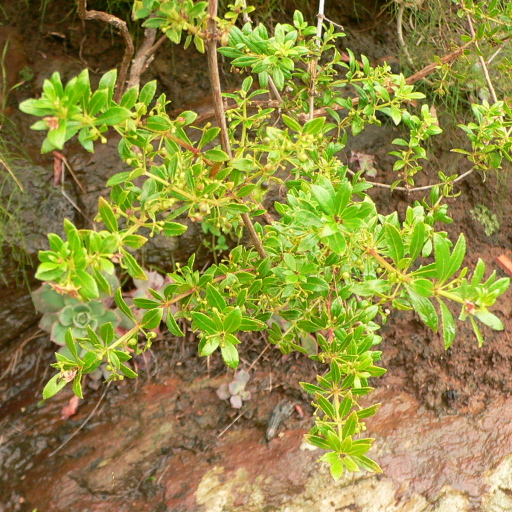
Plant Overview
Hailing from the sun-drenched cliffs of the Canary Islands, Madeira, and Cape Verde, Rubia fruticosa—commonly known as the Canary Madder—is a rugged, scrambling survivor. Unlike its more famous relative used for red dyes, this wild shrub is built for the Macaronesian scrubland, weaving itself through other vegetation like a living, prickly lace. It is a plant of endurance, perfectly adapted to salty coastal winds and rocky terrains where few others thrive.
🔍 How to Identify
- 🌿 Whorled Foliage: The leaves are stiff, lance-shaped, and usually grow in star-like circles (whorls) of four to six along the stem.
- 🪝 Hooked Texture: If you touch the stems or leaf edges, they feel "sticky" or rough; this is due to tiny, backward-curving prickles that help the plant climb upward.
- 🌼 Subtle Blooms: It produces clusters of tiny, star-shaped flowers that are pale yellow or greenish-white, appearing mostly in late winter and spring.
- 🌑 Fleshy Berries: After flowering, it develops small, pea-sized globose fruits that turn from a translucent green to a deep, polished black when ripe.
🏡 In Your Garden
- 🧗 The Natural Scrambler: Because of its hooked prickles, this plant doesn't need ties to climb; it simply "hooks" onto neighbors. In a garden setting, it works best as a "filler" in wild, xeriscaped corners where it can sprawl over rocks or old fences.
- ☀️ Coastal Resilience: It is incredibly salt-tolerant and drought-resistant once established. It thrives in well-draining, even poor quality soil, but it absolutely demands bright sunlight to maintain its bushy habit.
- ✂️ Growth Management: Left to its own devices, it can become a bit tangled and messy. Occasional thinning helps maintain its shape and prevents it from smothering smaller, more delicate plants.
⚠️ Safety & Toxicity
- 🟢 Generally Mild: Rubia fruticosa is not considered highly toxic, but it is not edible for humans or pets.
- 🐾 Physical Irritation: The primary "danger" is mechanical. The tiny hooks on the stems can cause mild skin irritation or scratches if handled without gloves, and the berries may cause digestive upset if ingested by curious pets.
- 🧤 Hand Protection: Always wear garden gloves when pruning or moving this plant to avoid the "sandpaper" effect of its stems.
✨ Fun Fact
The genus name Rubia comes from the Latin word "ruber," meaning red. While Rubia fruticosa isn't the primary source of commercial dye, its roots contain the same chemical compounds (alizarin) that have been used since ancient Egyptian times to create vibrant red pigments for textiles!

Detailed Care Instructions
To grow Rubia Fruticosa, also known as wild madder, follow these steps:
- Find a suitable location: Rubia Fruticosa thrives in full sun to partial shade. Choose a location with well-draining soil.
- Obtain seeds or seedlings: You can either purchase Rubia Fruticosa seeds online or from a reputable local nursery. Alternatively, you can also collect seeds from existing plants or ask for seedlings from fellow gardeners.
- Prepare the soil: Rubia Fruticosa prefers fertile and humus-rich soil. Add organic matter, such as compost or well-rotted manure, to improve soil quality and drainage.
- Sow the seeds or plant the seedlings: If using seeds, sow them directly into the prepared soil according to the recommended depth on the seed packet. If using seedlings, dig a hole slightly larger than the root ball and place the seedling, then cover the roots with soil.
- Water regularly: Keep the soil consistently moist but not waterlogged. Water the plant deeply once or twice a week, depending on the weather and soil conditions.
- Mulch: Apply a layer of organic mulch, such as straw or wood chips, around the base of the plant to help retain moisture, suppress weed growth, and maintain a stable soil temperature.
- Prune regularly: Trim back the plant periodically to promote bushy growth and control its size. Pruning can be done in early spring or autumn.
- Support climbing varieties: If you have Rubia Fruticosa cultivars that climb, provide a trellis or support structure for them to grow on. This will encourage healthy growth and prevent damage to the plant.
- Fertilize: Feed the plant with a balanced slow-release fertilizer in spring and midsummer, following the manufacturer's instructions.
- Monitor pests and diseases: Keep an eye out for common pests like aphids or spider mites. Treat any infestations promptly using organic methods or insecticidal soaps. Watch for signs of diseases such as powdery mildew, and take appropriate measures if necessary.
- Harvesting: Rubia Fruticosa produces red berries that can be harvested in late summer or autumn. Wait until the berries are fully ripe before picking, as unripe berries may not have viable seeds.
By following these steps, you should be able to successfully grow and maintain your Rubia Fruticosa plant.
Rubia Fruticosa is a plant that requires regular watering to thrive. When watering this plant, you should aim to keep the soil moist but not overly saturated. It is important to avoid letting the soil dry out completely, as this can cause damage to the plant's root system.
To water this plant, you can use a watering can or a hose with a gentle nozzle. You should aim to water the soil around the base of the plant, rather than the leaves or flowers, to direct the water where it is needed most.
One way to ensure that you are providing the right amount of water to your Rubia Fruticosa plant is to check the soil moisture level regularly. You can do this by sticking your finger in the soil near the base of the plant. If the soil feels dry to the touch, it is time to water. If the soil is still moist, you can wait a day or two before checking again.
Another important factor to consider when watering this plant is the climate and growing conditions. In hot, dry weather, you may need to water more frequently to keep the soil from drying out. On the other hand, in cool and damp conditions, watering less frequently may be necessary to prevent the soil from becoming waterlogged.
Overall, watering Rubia Fruticosa requires attention and consistency to ensure that the plant remains healthy and vigorous. With proper care and attention, this plant can provide beauty and enjoyment for years to come.
To fertilize this type of plant, it is recommended to use a balanced, slow-release fertilizer. Apply the fertilizer around the base of the plant at the start of the growing season and then again about halfway through the season. Be sure to water the plant thoroughly after fertilizing to help the nutrients penetrate the soil. Avoid fertilizing during periods of drought or extreme heat.
Rubia Fruticosa is a shrub plant that requires soil that is well-draining and has a pH level between 6.5 and 7.5. The soil should be fertile with a good amount of organic matter, such as compost or aged manure, added to it. The plant prefers soils that are sandy or loamy, but it can also grow in clay soils as long as they are not too heavy or compacted. Additionally, it is recommended to mix perlite or gravel into the soil to improve drainage. It's important to avoid using soils that are too dense or retain too much moisture, as this can lead to root rot and other plant diseases. Overall, the soil should provide good aeration and drainage while still maintaining enough moisture to support the plant's growth.
Rubia Fruticosa is a plant that can be propagated through stem-cuttings. You will need to take a healthy, young stem from the mother plant, and cut it at an angle just below a node. Remove any leaves from the lower half of the stem, leaving only the top leaves intact.
Prepare a pot with a well-draining potting mix, and make a hole suitable for planting the stem-cutting. Dip the lower end of the stem in rooting hormone powder, and carefully plant it in the hole.
Water the cutting well and keep it in a bright, shaded area with high humidity. Be sure to keep the soil moist, but not waterlogged, and mist the cutting daily to maintain high humidity.
After a few weeks, you should start seeing new growth from the top of the cutting as well as roots growing from the bottom. Once the roots have formed well, the cutting can be transplanted into a larger pot or directly into the garden.








