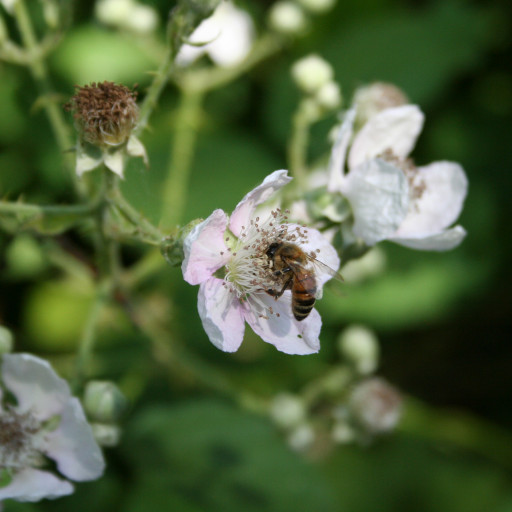
Plant Overview
Known as the "King of the Berries" to some and a "Thorny Terror" to others, the Himalayan Blackberry (Rubus armeniacus) is a powerhouse of the plant world. Despite its name, this vigorous shrub actually hails from Armenia and Northern Iran, brought to the West for its massive, sweet fruit. It is famous for creating impenetrable, arching thickets that can swallow fences and even small sheds if left unchecked.
🔍 How to Identify
- 🌿 The Canes: Unlike many wild berries, the stems (canes) are exceptionally thick, deeply ridged (pentagonal in cross-section), and armed with large, hooked prickles that act like velcro.
- 🍃 The Leaves: Look for palmately compound leaves, usually in sets of five on first-year canes. They are dark green on top with a distinct, silvery-white fuzzy underside.
- 🌸 Flowers & Fruit: It produces clusters of white-to-pale-pink flowers with five petals. These transition into large, glossy black aggregate fruits that are much bigger and sweeter than those of native blackberry species.
🏡 In Your Garden
- 🌱 The Great Escape: This plant doesn’t just grow; it conquers. It uses a "walking" habit where the tips of its long canes arch over and root themselves the moment they touch the soil, creating a brand-new plant.
- ✂️ Control and Management: If you have this in your yard, it requires aggressive pruning. Because it thrives in disturbed soil and is highly drought-tolerant once established, it is often classified as a noxious weed. However, if managed, it provides an incredible summer harvest.
⚠️ Safety & Toxicity
- 🛡️ Physical Hazard: The primary danger is physical. The thorns are large, sharp, and curved; they can easily pierce garden gloves and cause deep scratches. Always wear heavy-duty sleeves when handling.
- 🍇 Edibility: The berries are safe and delicious for humans and pets. However, be cautious of plants growing near roadsides or industrial areas, as they may have been sprayed with herbicides or absorbed heavy metals.
✨ Fun Fact
The famous American botanist Luther Burbank introduced this species to North America in 1885. He mistakenly believed the seeds came from the Himalayas, giving the plant its confusing common name that has stuck for over a century!

Detailed Care Instructions
To grow Rubus armeniacus, also known as Himalayan blackberry, you'll need to follow these steps:
- Choose a suitable location: Himalayan blackberries prefer full sun but can tolerate some shade. Ensure the soil is well-draining and fertile.
- Prepare the soil: Before planting, remove any weeds or grass from the area. Loosen the soil with a garden fork or tiller and amend it with organic matter, such as compost or well-rotted manure.
- Planting: Dig a hole twice as wide and deep as the plant's root ball. Place the plant in the hole, ensuring it is at the same depth as it was in the container. Backfill the hole with soil and lightly tamp it down. Space the plants about 3-5 feet apart.
- Watering: After planting, water thoroughly to settle the soil around the roots. Keep the soil evenly moist throughout the growing season, especially during dry periods. Avoid overwatering, as excessive moisture can lead to root rot.
- Mulching: Apply a layer of organic mulch around the plants to help retain moisture, suppress weeds, and maintain a more consistent soil temperature.
- Pruning: Prune your Rubus armeniacus plants during the dormant season, which is typically late winter to early spring. Remove any dead, damaged, or diseased canes and thin out overcrowded growth. This will help promote vigor and disease resistance.
- Support: Depending on the variety and growth habit, you may need to provide trellises or stakes for support. Some Himalayan blackberry varieties can grow quite vigorously, so it's best to provide support to prevent the canes from sprawling on the ground.
- Fertilization: It's generally unnecessary to fertilize Himalayan blackberries if the soil is already rich in organic matter. However, if you notice weak growth or yellowing leaves, you can apply a balanced fertilizer in early spring.
- Harvesting: Himalayan blackberries typically produce fruit in late summer. Harvest the ripe berries by gently picking them off the canes. Be careful of the thorns, as they can be sharp.
- Maintenance: Continue to monitor the plants for pests and diseases. Common pests that affect Rubus armeniacus include aphids, spider mites, and blackberry psyllids. If necessary, apply appropriate organic insecticides or seek help from a local garden center.
By following these steps, you can successfully grow Rubus armeniacus plants and enjoy the delicious harvest of blackberries.

Place in a bright room that is sun drenched almost all day. Or directly in a south-facing window.

Watering the Rubus armeniacus plant requires some special attention. This plant needs regular watering to maintain healthy growth and fruit production. The best way to water this plant is by providing it with deep, slow watering. This means that the water should be applied slowly and allowed to penetrate deep into the soil.
To water this plant, first, check the soil moisture level by inserting a finger into the soil. If the soil is dry to a depth of 2-3 inches, it's time to water the plant. Use a watering can or hose with a low-pressure nozzle to deliver water to the plant's base. Avoid getting water on the leaves or flowers.
Water the plant until the soil is moist but not waterlogged. Watering too much or too often can lead to root rot and other problems for the plant. Frequency of watering will depend on the climate and soil type. In general, Rubus armeniacus plants should be watered every 7-10 days, depending on the conditions.
In addition to regular watering, mulching around the plant can help retain moisture in the soil. It is also important to make sure that the plant is receiving adequate sunlight and nutrients to ensure healthy growth.
To fertilize this plant, apply a balanced fertilizer with equal amounts of nitrogen, phosphorus, and potassium. Apply the fertilizer in spring and again in late summer or early fall. Avoid fertilizing during the winter months. Water the plant thoroughly after fertilizing.
The optimal soil type for Rubus armeniacus is loamy soil, which is well-draining and high in organic matter. The pH level should be between 6.0 to 7.5, with a slightly acidic to neutral soil preference. The plant prefers soil that is moist but not waterlogged, and it does well in soils that retain moisture but do not become overly saturated. Heavy clay soils may be too dense and compact for this plant. A soil that is rich in nutrients will contribute to healthy growth and a higher yield of fruit. It is recommended to amend the soil with compost or other organic matter before planting to improve soil structure, water retention and nutrient content.
Rubus Armeniacus is a plant species from the Rosaceae family and is typically propagated through vegetative means, including stem cutting and layering.
To propagate through stem cutting, first, identify a healthy and mature plant from which you want to take a cutting. Then, using a sharp and sterilized cutting tool, cut a stem that is 4-6 inches long. Remove any leaves from the bottom half of the stem, leaving 2-3 pairs of leaves at the top.
Next, dip the cut end of the stem into a rooting hormone powder to stimulate root growth. Plant the stem cutting into a pot with well-draining and nutrient-rich soil, and water it thoroughly.
To propagate through layering, identify a healthy and mature plant and bend a flexible stem down to the ground. Gently scrape away the bark on the underside of the stem, exposing the green cambium layer. Secure the stem to the ground with a U-shaped wire or a rock. Cover the scraped area with soil, and water it.
Over time, roots will form at the scraped area of the stem, and a new plant will emerge. Once the new plant has taken root, cut it from the parent plant and transplant it to a new location.
Both of these propagation methods can be successful with Rubus Armeniacus plants, and with optimal growing conditions, the new plants can mature and produce fruit within a few years.








