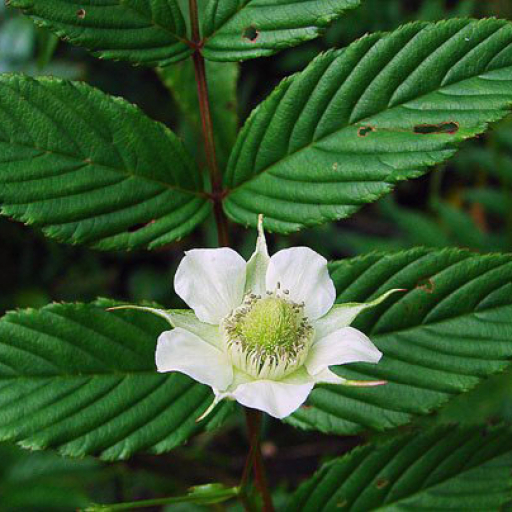
Plant Overview
Known as the Mountain Raspberry or Ash-leaf Raspberry, this wild berry is a hidden gem of the Southeast Asian highlands. It earns its scientific name, fraxinifolius, from its unique foliage, which looks more like the leaves of an Ash tree than a typical thorny bramble. While it belongs to the same family as your favorite supermarket raspberries, this variety is a rugged explorer, often found clinging to the misty, volcanic slopes of the Philippines and Indonesia.
🔍 How to Identify
- 🍃 The Leaves: Unlike the rounded leaves of common berries, these are "pinnate," meaning they grow in sets of 3 to 11 pointed leaflets along a single stalk, mimicking a tree branch.
- 🌸 The Bloom: It produces clusters of delicate white flowers with five papery petals and a fuzzy, golden-green center.
- 🍓 The Berry: A bright red, hollow aggregate fruit that sits perched on a persistent green base. It is typically longer and more conical than a standard raspberry.
🏡 In Your Garden
- ⛰️ Highland Heritage: This plant is a "cool-weather" tropical. It thrives in the humid, breezy air of high altitudes and may struggle in stagnant, lowland heat. It loves volcanic, well-draining soil that stays consistently moist.
- 🛡️ Prickly Protection: It is a vigorous, scrambling shrub that uses small, hooked thorns to climb over other vegetation. If planting at home, give it a trellis and keep it away from walkways to avoid "snagging" guests.
⚠️ Safety & Toxicity
- 😋 Status: Non-toxic and edible.
- 🐶 Details: The berries are safe for human and pet consumption and are packed with Vitamin C. However, the stems are heavily armed with sharp prickles; curious dogs or toddlers should be kept at a distance to prevent scratches or skin irritation.
✨ Fun Fact
In the Philippines, where the plant is locally known as Sampinit, the berries are a prized wild delicacy. Because they are delicate and difficult to transport from the mountains, they are rarely seen in major cities, making them a "holy grail" for local foragers.

Detailed Care Instructions
To grow Rubus Fraxinifolius (Ashy Himalaya Blackberry) plants, you can follow these steps:
- Obtaining Seeds or Seedlings: You can collect seeds from a mature Rubus Fraxinifolius plant or purchase seeds or seedlings from a reputable nursery.
- Choosing the Right Location: Rubus Fraxinifolius prefers well-draining soil and a sunny location but can tolerate partial shade. Ensure the area has enough space for the plant to spread.
- Soil Preparation: Prepare the soil by removing any weeds or grass from the planting area. Rubus Fraxinifolius thrives in well-drained loamy soil. Consider adding organic matter like compost to enhance soil fertility and drainage.
- Planting: If using seeds, sow them in prepared soil, ensuring they are just covered with a thin layer of soil. If using seedlings, dig a hole slightly larger than the root ball and place the seedling in it, ensuring the top of the root ball is level with the soil surface.
- Watering: Water the newly planted seeds or seedlings thoroughly. Keep the soil evenly moist but not waterlogged. After the plant establishes, it generally requires about 1 inch of water per week.
- Mulching: Apply a layer of organic mulch around the base of the plant to conserve soil moisture and suppress weed growth.
- Pruning: Rubus Fraxinifolius can form thickets if left unattended. Regular pruning is essential to maintain the plant's shape and keep it under control. Prune the plant in late winter or early spring by cutting out any dead or damaged canes.
- Support: Depending on the growth habit of the Rubus Fraxinifolius variety you are growing, you may need to provide support like trellises or stakes to keep the plant upright.
- Disease and Pest Management: Monitor the plant for any signs of pests or diseases, such as aphids or powdery mildew. Use appropriate organic control methods if necessary.
- Harvesting: Rubus Fraxinifolius produces edible berries. Harvest the ripe berries by gently plucking them from the plant. Be careful of the plant's thorns, which can be sharp.
Remember to research the specific cultivar of Rubus Fraxinifolius you are growing, as the care requirements may vary slightly.

Place in a window with dappled sun or a spot in the middle of a room. Or directly in a window facing west or east.

To water this plant, it is important to consider the soil and environmental conditions. Begin by assessing the moisture level in the soil; the top layer should feel dry to the touch before watering. Water the plant gently at the base to avoid wetting the foliage. Use a watering can or hose with a low-pressure setting to avoid flooding the soil. Avoid overwatering as this can lead to root rot. A general rule of thumb is to water deeply and infrequently, rather than a little and often. Lastly, monitor the plant regularly and adjust the watering frequency depending on its response to the watering schedule and any changes in environmental conditions.
To fertilize this plant, you should apply a balanced fertilizer with equal parts nitrogen, phosphorus, and potassium. Use a slow-release fertilizer in the early spring and again in midsummer. Be careful not to overfertilize as this can lead to excessive growth and reduced fruiting. Apply the fertilizer to the base of the plant, avoiding the foliage and stems, and water deeply after application. Additionally, organic fertilizers such as compost or well-aged manure can also be used to promote healthy growth.
The recommended soil for Rubus Fraxinifolius is a well-draining soil mixture that is rich in organic matter. The soil pH should ideally be slightly acidic to neutral, with a range between 5.5 to 7.0. The plant prefers a soil that is moist but not waterlogged, and it does well in soils that have a good balance of nutrients.
It is important to avoid soil that is too compacted or heavy, as this can impede the growth of the plant's root system. Adding sand or perlite to the soil mixture can help to improve drainage and prevent waterlogging.
When planting Rubus Fraxinifolius, it is important to ensure that the soil is well prepared before planting. This may involve digging a hole that is large enough to accommodate the plant's root system, mixing in compost or other organic matter, and creating a soil mound or berm around the base of the plant to help retain moisture.
Overall, Rubus Fraxinifolius requires a soil that is well-draining, rich in organic matter, and moist but not waterlogged. It is important to ensure that the soil is prepared properly before planting, to promote healthy growth and development of the plant.
To propagate this plant, first select a healthy stem cutting from an established plant. Then, remove any leaves from the bottom half of the cutting and dip it into rooting hormone. Next, plant the cutting into a pot filled with moist, well-draining soil. Keep the soil consistently moist and provide bright, indirect light to encourage root growth. Once roots have formed and new growth appears, the plant can be transferred to a larger container or transplanted into a garden bed.








