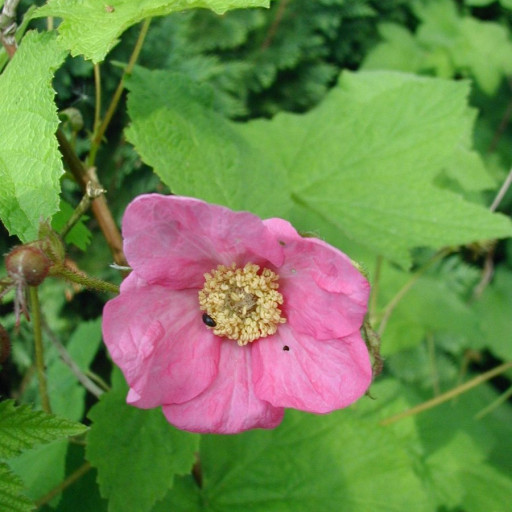
Plant Overview
Commonly known as the Purple-flowering Raspberry or Thimbleberry, this North American native is the elegant, "gentle" cousin of the common garden bramble. Unlike the prickly raspberries that catch on your clothes, this plant is famous for its thornless, velvety stems and stunning, rose-like magenta blossoms. It’s a favorite for woodland gardeners who want the wild look of a thicket without the painful scratches of traditional berries.
🔍 How to Identify
- 🍃 The Foliage: Look for massive, star-shaped leaves that can grow up to 10 inches wide. They look strikingly similar to maple leaves, giving the plant a lush, tropical appearance in the shade.
- 🌸 The Blooms: The flowers are a deep rose-purple, featuring five delicate, crinkled petals. They are significantly larger and more ornamental than the tiny white flowers found on most edible raspberry bushes.
- 🪵 The Stems: A key identifier is the "shaggy" bark on older canes and the absence of thorns. Instead of prickles, the stems are covered in fine, glandular hairs that can feel slightly sticky to the touch.
🏡 In Your Garden
- ⛅ The Shade Specialist: While most fruit-bearing plants demand full sun, Rubus odoratus is a true forest-dweller. It thrives in the dappled light under tall trees, making it a perfect solution for those "difficult" shady corners of your yard.
- 👐 Space to Spread: This plant is a "spreader." It uses underground runners to form dense, privacy-providing thickets. It’s best used in naturalized areas or large borders where it has permission to wander; in a tiny, manicured bed, it might feel a bit too ambitious.
⚠️ Safety & Toxicity
- ✅ Safe & Edible: This plant is non-toxic to humans, dogs, and cats.
- 🍓 The Fruit Factor: The berries are technically edible, resembling flat, fuzzy red raspberries. However, they are often dry and seedy. While birds and chipmunks absolutely love them, humans usually find the flowers much more rewarding than the fruit.
✨ Fun Fact
The Latin name odoratus translates to "fragrant," but the scent doesn't just come from the flowers. If you gently rub the flower stalks or the young, fuzzy stems, they release a sticky resin that smells uniquely sweet and spicy!

Detailed Care Instructions
| Humidity | Normal |
| Lighting | Full Sun |
| Difficulty | Medium |
| Hibernation | Cold Period |
| Temperature | 20°C - 30°C |
| Hardiness Zones | 4 - 8 |
To grow Rubus odoratus, also known as the purple-flowering raspberry, you can follow these steps:
- Choose a suitable location: Select a spot with well-draining soil that receives partial shade to full sun. It is important to consider the plant's size, as it can reach a height of 2-6 feet (0.6-1.8 meters), and provide a trellis or support if desired.
- Prepare the soil: Ensure the soil is well-draining and rich in organic matter. Loosen the soil by removing weeds and dead plant material, and add compost or aged manure to enhance fertility and moisture retention.
- Planting: Dig a hole that is about twice the size of the plant's root ball and place the plant in the hole. Cover the roots with soil, gently firm it, and water thoroughly. Space multiple plants around 3-4 feet (0.9-1.2 meters) apart to allow them room to grow.
- Watering: Water the plant deeply and regularly, especially during dry periods. Aim to keep the soil consistently moist but not waterlogged to prevent root rot.
- Mulching: Apply a layer of mulch around the base of the plant, such as straw or wood chips, to help retain moisture, control weeds, and maintain a more stable soil temperature.
- Pruning: In the early spring, before new growth emerges, prune Rubus odoratus to remove any damaged or weak branches. This promotes air circulation and overall health of the plant.
- Fertilizing: Apply a balanced, slow-release fertilizer in early spring to support growth and blooming. Follow the package instructions for appropriate dosage.
- Propagation: The purple-flowering raspberry can be propagated through division or by taking stem cuttings during early summer or by layering. Division involves separating the plant into smaller sections and replanting them. Stem cuttings can be rooted in a well-draining medium. Layering involves bending a low-lying stem to the soil, securing it, and allowing it to root before separating it from the parent plant.
- Pest and disease control: Monitor the plant for common pests like aphids, spider mites, or raspberry cane borers. Use appropriate organic or chemical treatments if necessary. Also, keep an eye out for diseases such as root rot, raspberry mosaic virus, or powdery mildew. Taking preventive measures like maintaining good air circulation, proper watering, and promptly addressing any issues can help keep the plant healthy.
- Harvesting: Depending on the variety, Rubus odoratus may produce edible fruits, although they can be smaller and less flavorful than traditional raspberries. Harvest the mature fruits when they are plump and easily detach from the plant.

Place in a window with dappled sun or a spot in the middle of a room. Or directly in a window facing west or east.

To water this plant, it is important to consider the soil moisture level. Before watering, you should check the soil moisture by feeling it with your finger or using a moisture meter. If the soil is dry to a depth of 1-2 inches, then it needs watering.
The best way to water this plant is deeply and evenly. It is important to avoid getting water on the leaves, as this can lead to fungal diseases. The water should be directed towards the base of the plant.
You can either water this plant by using a watering can or a hose with a gentle stream. It is important to water slowly and make sure that the water is penetrating the soil. Once the soil is moist to a depth of at least 6 inches, stop watering.
During hot and dry weather, you may need to water this plant more frequently. However, it is important not to overwater, as this can lead to root rot. It is better to water deeply and less frequently than to water shallowly and frequently.
To fertilize this plant, use a balanced fertilizer with equal amounts of nitrogen, phosphorus, and potassium. Apply the fertilizer in early spring before new growth appears and again in early summer after the first flush of blooms. Use caution not to over-fertilize, as high levels of nutrients can burn the plant's roots and cause damage. Water the plant thoroughly after fertilizing to help distribute the nutrients.
Rubus Odoratus prefers a well-drained soil that is rich in organic matter. A soil pH between 5.5 and 7 is best, with a slightly acidic pH being preferred. The plant also benefits from soil that is consistently moist but not waterlogged. A good option is to use a mix of compost, peat, and sand to provide the desired soil structure and nutrient levels. It is important to avoid using heavy, clayey soils that may lead to waterlogging and root rot. Additionally, regular fertilization with a balanced fertilizer can help maintain the plant's health and vigor.
Rubus Odoratus plant can be propagated through both vegetative and sexual methods. One way to propagate it vegetatively is through stem cuttings. Here are the steps:
- Choose healthy stems that are at least 6 inches long with no flowers or buds.
- Make a clean cut at about a 45-degree angle just below a node.
- Remove the leaves from the bottom half of the stem.
- Dip the cut end into rooting hormone powder.
- Plant the stem cutting into a pot filled with a well-draining soil mix, making sure it's buried at least an inch deep.
- Water the cutting thoroughly and cover with a plastic bag to create a humid environment.
- Place the pot in a warm, bright area, but away from direct sunlight.
- Keep the soil moist until the cutting establishes roots in about 3-4 weeks.
Another way to propagate Rubus Odoratus plant is through seed. Here are the steps:
- Collect ripe berries from the plant.
- Mash the berries in a container and add some water.
- Let the mixture sit for a few days until the seeds sink to the bottom.
- Drain the liquid and rinse the seeds with water.
- Plant the seeds in a pot filled with a well-draining soil mix, making sure they're covered with a thin layer of soil.
- Water the seeds and place the pot in a warm, bright area, but away from direct sunlight.
- Keep the soil moist until the seeds germinate in about 2-3 weeks.
Whichever propagation method you choose, it's important to care for the new plants by providing them with enough light, water, and nutrients. Once they're established, Rubus Odoratus plant can be a beautiful addition to any garden.








