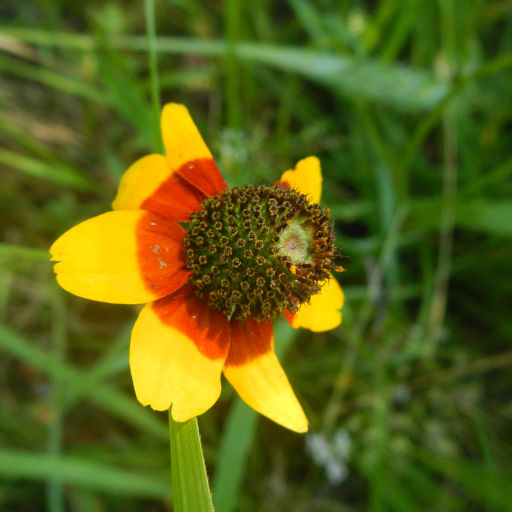
Plant Overview
Often called the Clasping Coneflower, this sunny annual is a staple of North American prairies and wildflower meadows. It is famous for its "hugging" leaves and its ability to turn a roadside into a sea of gold with very little effort. While it looks like a typical Black-eyed Susan from a distance, its unique structure tells a much more intimate story of botanical adaptation.
🔍 How to Identify
- 🍃 Clasping Leaves: The most distinct feature; the base of the heart-shaped, blue-green leaves completely encircles or "clasps" the stem rather than growing from a petiole.
- 🌻 Drooping Petals: The bright yellow ray flowers point sharply downward toward the ground, making the central cone stand out like a golden shuttlecock.
- 🤎 The "Thimble": The center is a prominent, dark brownish-purple cone that elongates as the plant matures, eventually resembling a tall, textured thimble.
🏡 In Your Garden
- 💧 Moisture Lover: While many Rudbeckias are famous for drought tolerance, this species actually thrives in moist, clay-heavy soils. It is the perfect choice for those "low spots" in the yard that stay damp after rain.
- 🦋 Pollinator Magnet: This plant is a high-traffic zone for native bees and butterflies. Because it is an annual, it puts all its energy into massive seed production—if you don't "deadhead" the spent blooms, it will happily replant itself for next summer.
⚠️ Safety & Toxicity
- ✅ Non-Toxic: Rudbeckia amplexicaulis is generally considered safe for humans, dogs, and cats. It is a worry-free choice for a high-activity family garden.
- 🧤 Mild Irritant: Some individuals may experience minor skin redness or "contact dermatitis" from the tiny, bristly hairs on the stems. If you have sensitive skin, it’s best to wear gloves when cutting them for bouquets.
✨ Fun Fact
The species name amplexicaulis is derived from the Latin words amplecti (to embrace) and caulis (stem). It literally translates to "embracing the stem," perfectly describing how the leaves hold onto the plant!

Detailed Care Instructions
To grow Rudbeckia amplexicaulis, also known as the Clasping Coneflower, follow these steps:
- Choose a suitable location: Rudbeckia amplexicaulis prefers full sun to partial shade. Select a spot in your garden that receives at least 6 hours of direct sunlight daily.
- Prepare the soil: The soil should be well-draining and fertile. Amend the soil with compost or well-rotted manure to improve fertility and drainage if needed.
- Planting: Sow the seeds directly into the soil in the spring or early summer after the danger of frost has passed. The seeds can also be started indoors 6-8 weeks before the last frost date and transplanted outdoors once the seedlings are established.
- Spacing: Space the plants 12-18 inches apart to allow enough room for them to grow and spread.
- Watering: Keep the soil consistently moist but avoid overwatering. Water deeply once or twice a week, depending on the weather conditions and soil moisture retention.
- Mulching: Apply a layer of organic mulch around the plants to conserve moisture, suppress weed growth, and regulate soil temperature.
- Fertilizing: Rudbeckia amplexicaulis typically does not require heavy fertilization. However, you can apply a balanced slow-release granular fertilizer once a year in early spring to promote healthy growth.
- Deadheading: Remove faded flowers regularly to encourage continuous blooming throughout the season and prevent the plant from self-seeding excessively.
- Pest and disease control: Clasping Coneflowers are generally resistant to pests and diseases. However, keep an eye out for aphids or powdery mildew. If necessary, treat with organic pesticides or fungicides.
- Division: Every few years, divide the clumps in early spring to maintain vigorous growth and prevent overcrowding. Dig up the clumps, separate them into smaller sections, and replant them.
By following these guidelines, you should be able to successfully grow Rudbeckia amplexicaulis plants in your garden.

Place in a bright room that is sun drenched almost all day. Or directly in a south-facing window.

Rudbeckia amplexicaulis is a perennial plant that requires appropriate watering to grow healthily. It is important to water this plant deeply and regularly during its active growth periods, which usually occur in spring and summer. It is best to water the plant deeply at least once a week, allowing the water to penetrate the soil to a depth of at least six inches.
The soil should be kept moist but not waterlogged as this can lead to root rot. It is also advisable to water Rudbeckia amplexicaulis in the morning or evening when the sun is low as this reduces water loss through evaporation. Avoid watering the plant during the heat of the day or in direct sunlight, as this can cause scorching.
Another useful water management technique for Rudbeckia amplexicaulis is to provide a layer of organic mulch on top of the soil around the plant. This will help to conserve moisture in the soil and minimize the need for frequent watering.
It is also worth considering the climate and weather conditions in your area when deciding on a watering schedule for this plant. In areas with hot, dry summers, the plant may require more frequent watering, while in cooler, more humid climates, less watering may be necessary.
Overall, proper watering is essential to the health and vitality of Rudbeckia amplexicaulis. By providing regular and appropriate watering, you can help ensure that this attractive perennial plant thrives in your garden.
To properly fertilize this plant, begin by selecting a balanced fertilizer that contains equal amounts of nitrogen, phosphorus, and potassium. The ideal time to fertilize is during the plant's active growing season, typically in the spring and summer. Use a granular or soluble fertilizer and apply it evenly around the base of the plant, being careful not to get any fertilizer on the leaves or stems. Be sure to follow the instructions on the fertilizer label for the correct amount and frequency of application. Finally, water the plant thoroughly after fertilizing to help incorporate the nutrients into the soil and promote healthy growth.
Rudbeckia Amplexicaulis is a type of plant that requires well-draining soil to thrive. The ideal soil for this plant should be loamy and rich in organic matter. A pH level between 5.5 and 7.0 is also preferred. It is important to avoid heavy clay soils that retain water, as this can lead to root rot and other issues. Adding a layer of mulch around the base of the plant can help to retain moisture in the soil while also reducing weed growth. It is important to keep the soil consistently moist, especially during hot, dry weather. Overall, the key to growing healthy Rudbeckia Amplexicaulis is to provide it with nutrient-rich soil that is well-draining and moist.
The propagation of this particular plant can be done through a process called division. Division involves selecting a mature plant with a healthy and sizable root system and carefully separating its roots into sections. This can be done by digging up the entire plant and using a sharp, sterilized knife to cut through the root system. Each section should have a portion of the root system and some top growth.
The divided sections can then be transplanted into their desired location, which should be well-draining soil and a sunny spot for optimal growth. It is important to keep the newly transplanted sections moist and well-watered during the establishment period.
Alternatively, this plant can also be propagated through seeds. The seeds should be collected from mature, healthy plants and sowed in a seed-starting mix indoors or directly into the ground in the spring. The seeds should be covered lightly with soil and kept moist until they germinate.
Both division and seed propagation can produce healthy and robust new plants for your garden or landscape.








