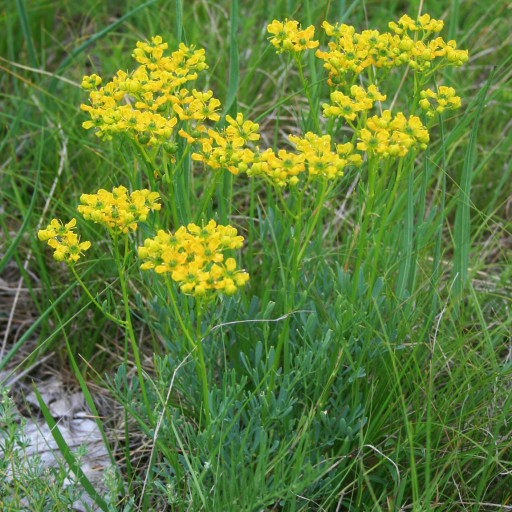
Plant Overview
Known as the "Herb-of-Grace," Common Rue is a Mediterranean native with a storied history in folklore, literature, and ancient medicine. Often mentioned by Shakespeare as a symbol of regret and repentance, this woody perennial is cherished for its unique metallic-blue foliage and its ability to thrive where other plants wither. While it was once a staple in kitchen gardens, it is now more commonly grown for its ornamental beauty and its role in supporting specific butterfly species.
🔍 How to Identify
- 🌿 Distinctive Foliage: The leaves are a striking glaucous blue-green, featuring a deeply lobed, lacy appearance often described as "spoon-shaped" or "paddle-like."
- 🌼 Fringed Flowers: In mid-summer, it produces clusters of small, bright yellow flowers. Each bloom typically has four or five petals with noticeably fringed or "toothed" edges.
- 👃 Strong Aroma: When bruised or brushed against, the plant releases a sharp, bitter, and somewhat medicinal scent that is unmistakable.
🏡 In Your Garden
- 🦋 Butterfly Sanctuary: Rue is a critical host plant for the Giant Swallowtail butterfly. Don't be alarmed if you see striped caterpillars munching on the leaves—they are simply preparing for their transformation!
- ☀️ Sun Lover: This plant thrives in poor, well-drained soil and full sun. It is exceptionally drought-tolerant once established because its woody base and waxy leaves are designed to lock in moisture during hot summers.
- 🛡️ Natural Deterrent: Due to its pungent oils, Rue is often used as a companion plant to deter pests like Japanese beetles. Some gardeners even use it as a border to discourage neighborhood cats or deer from entering specific areas.
⚠️ Safety & Toxicity
- 🚫 Phytophotodermatitis: This is the most important safety rule for Rue. The plant's sap contains furanocoumarins, which make human skin extremely sensitive to UV light. Touching the plant on a sunny day can cause severe, painful blistering and rashes.
- 🧤 Handling: Always wear long sleeves and gloves when pruning or moving this plant to avoid skin contact.
- 🐾 Pets & Kids: Rue is toxic if ingested in significant amounts and is generally avoided by animals due to its bitter taste. However, it should be kept away from curious pets and children's play areas.
✨ Fun Fact
In the Middle Ages, Rue was one of the primary ingredients in "Four Thieves Vinegar," a concoction that legendary graverobbers supposedly used to protect themselves from the Black Plague while they worked!

Detailed Care Instructions
Rue requires very little maintenance as long as it has a sunny spot with well-draining soil.
How long does it take to grow rue?
Rue has a moderate growth rate and will germinate in one to four weeks.
Does rue come back every year?
Rue is a perennial, coming back every year, but it doesn't tend to be long-lived. However, it will self-seed to produce new plants in the garden.
| Color | Yellow |
| Soil Ph | Slightly Acidic To Alkaline; Ph 6.5 To 8.5 |
| Humidity | Normal |
| Lighting | Full Sun |
| Toxicity | Poisonous |
| Soil Type | Average To Poor |
| Bloom Time | Summer |
| Difficulty | Medium |
| Plant Type | Perennial Herb |
| Mature Size | 18 To 24 Inches |
| Native Area | Southern Europe |
| Temperature | 15°C - 21°C |
| Sun Exposure | Full Sun |
| Hardiness Zones | Usda Growing Zones 6 To 11 |
To grow Ruta Graveolens, also commonly known as rue, follow these steps:
- Purchase rue seeds or young plants from a reputable nursery or source. Rue is a perennial herb that can be grown from either seeds or plants.
- Choose a suitable location: Rue prefers full sun to partial shade and well-draining soil. Ideally, the soil should be moderately fertile and slightly alkaline. Prepare the planting area by loosening the soil using a garden fork or spade.
- Sow the seeds: Plant rue seeds directly in the ground, around ½ inch deep and 12-18 inches apart. Water gently after planting and keep the soil consistently moist.
- Seed propagation indoors: If you prefer to start the seeds indoors, sow them in individual pots or trays filled with seed-starting mix. Cover the seeds lightly with soil and keep them in a warm and sunny location. Transplant the seedlings outdoors after the last frost date.
- Watering and care: Rue requires regular watering, especially during dry spells. However, ensure the soil is well-drained to avoid waterlogging. Apply a layer of mulch to help retain moisture and suppress weeds.
- Fertilization: Rue generally does not require much fertilizer. If you feel the plant needs a boost, you can apply a balanced fertilizer once or twice during the growing season.
- Pruning: Prune rue plants in early spring to remove any dead or damaged parts and encourage bushier growth. Regularly pinching off the tips of the plant can also help promote dense foliage.
- Pests and diseases: Rue is generally a tough plant, but it may occasionally face issues with aphids or mites. Monitor the plant regularly and manage any pests by using appropriate insecticidal soap or organic methods. Keep an eye out for diseases such as powdery mildew and treat them promptly.
- Harvesting: You can begin harvesting the leaves of rue once the plants become established, usually after 2-3 months. Use sharp scissors or pruners to cut the leaves, and be cautious as the plant can cause skin irritation in some individuals.
Remember to research specific growing techniques for your particular location and climate, as conditions may vary.

Place in a bright room that is sun drenched almost all day. Or directly in a south-facing window.

To properly water this plant, it is important to take into consideration its specific watering needs. First, make sure that the soil is well-draining, as this plant does not thrive in waterlogged conditions. When watering, avoid getting water on the leaves, as this can cause damage or disease. Instead, water directly at the base of the plant, taking care to avoid over-watering. Allow the top inch of soil to dry out before watering again, and be sure to adjust watering frequency according to the plant's needs based on environmental factors such as temperature and humidity.
To fertilize this plant, use a balanced fertilizer with equal amounts of nitrogen, phosphorous, and potassium. Apply the fertilizer in the spring when new growth appears and again in the summer. Avoid over-fertilizing as this can lead to weak growth and decreased resistance to pests and diseases. Water the plant well after fertilizing to ensure that the nutrients reach the roots.
The soil that is best suited for the Ruta Graveolens plant is one that is well-draining, has good aeration, and is moderately fertilized. It should be rich in organic matter and contain a mixture of sand, loam, and clay. The pH level of the soil should be slightly acidic to neutral, with a range of 6.0 to 7.5. The soil should also be kept moist but not waterlogged, as overwatering can lead to root rot and other fungal diseases. If planting in a container, using a potting mix that provides ample drainage and aeration is recommended. Overall, the soil should provide a balanced environment for the plant to grow and flourish.
Ruta Graveolens is propagated through the process of cutting. This involves carefully selecting a healthy stem from the parent plant and cutting it using sharp, sterilized scissors. Ideally, the cutting should be around 10cm in length and have a minimum of two nodes. Once the cutting has been taken, it should be immediately placed in water to prevent air bubbles from forming in the stem.
After a couple of hours, the cutting can be planted in a pot with a well-draining soil mix. The cutting should be placed in the soil up to the lowest node and then kept moist but not waterlogged. The newly planted cutting should be placed in a shaded area away from direct sunlight, but with enough light to aid the growth process.
After approximately two weeks, the cutting should start to develop roots. When the roots are visible, it is a sign that the cutting has taken root and can start to be treated as a mature plant. Depending on the temperature and humidity, it may take up to a month for the cutting to fully root, and it should be kept in these conditions until this point.
Once the new plant has reached a good size, it can be replanted in a larger pot or in a garden bed if desired. As it grows, it will require regular watering and should be fed with a good quality fertilizer every couple of weeks to encourage optimal growth. With proper care, the new plant should thrive and produce the same fragrant leaves as the parent plant.








