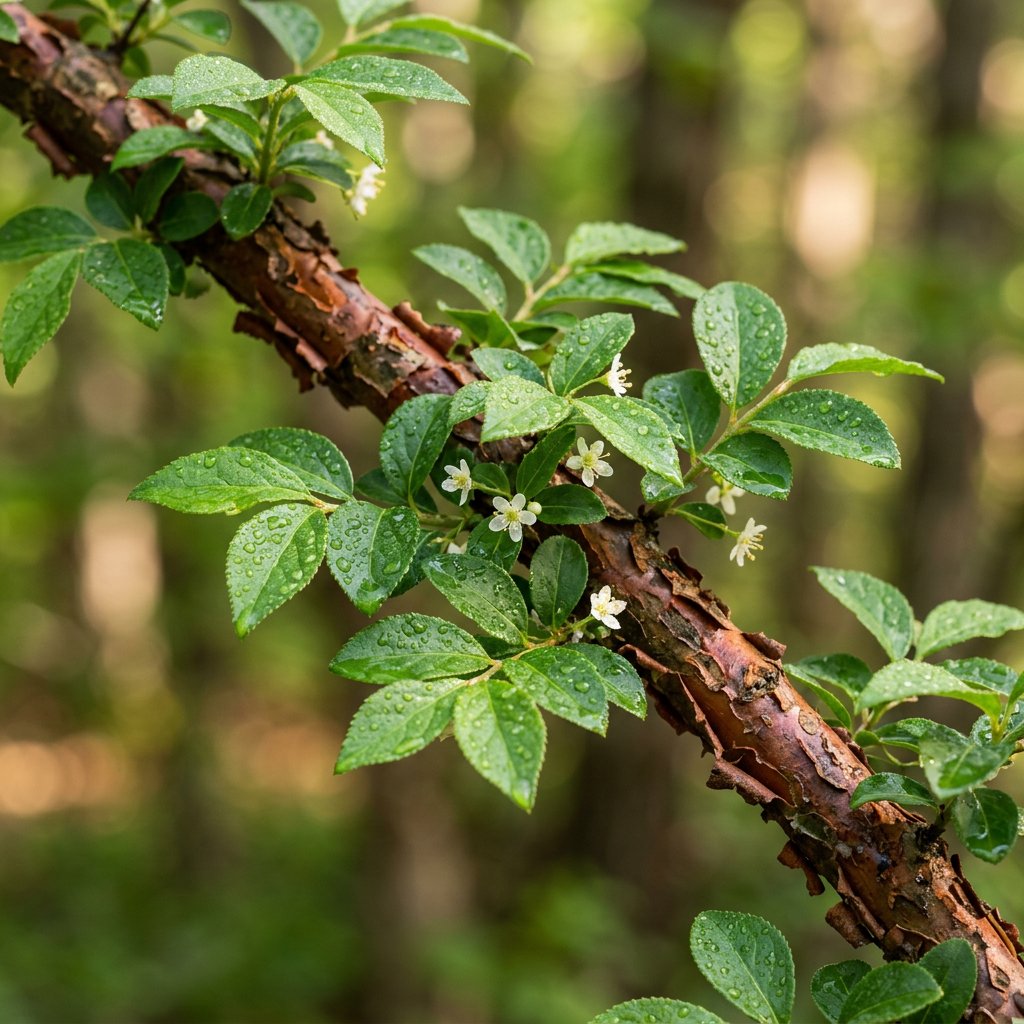
Plant Overview
Known affectionately as the "Sweet Plum" or "Chinese Sweet Plum," Sageretia thea is a staple in the world of Bonsai. Hailing from the warm, subtropical regions of Southern China, this elegant shrub is beloved for its ability to look like an ancient, weathered tree even when it’s small enough to sit on a coffee table. It carries an air of serene Asian gardens and is often chosen by beginners for its fast-growing, resilient nature.
🔍 How to Identify
- 🍃 Leaf Structure: Features tiny, oval-shaped leaves with a bright, glossy green finish. The edges are finely serrated, giving the foliage a delicate, textured appearance.
- 🪵 The Bark: One of its most striking features is the "exfoliating" bark. As the plant matures, the outer layer scales off in patches, revealing a smooth, multi-colored trunk underneath that resembles a miniature Sycamore.
- 🌸 Bloom & Berry: In the late summer, it produces inconspicuous white-yellow flowers. These eventually turn into small, round, dark-purple drupes that look like tiny, dusty plums.
🏡 In Your Garden
- 💧 The Thirsty Resident: The Sweet Plum is not a fan of "drought" conditions. It thrives on consistent moisture and high humidity. If the soil dries out completely, the plant may dramatically drop its leaves as a distress signal.
- ☀️ Light & Warmth: It loves bright, indirect light. While it can handle some direct sun, it prefers to be kept warm. If you are growing it as a Bonsai indoors, placing it near a sunny window with a humidity tray is the best way to keep it lush.
- ✂️ Pruning Response: It is incredibly responsive to pruning, which is why it’s a favorite for "clip and grow" styling. It pushes out new growth quickly, allowing gardeners to shape it into intricate forms over just a few seasons.
⚠️ Safety & Toxicity
- ✅ Non-Toxic: Sageretia thea is generally considered non-toxic to humans and common household pets like cats and dogs.
- 🫐 Edibility Note: While the berries are technically edible and sometimes used in local jams in their native range, they are mostly ornamental in a home setting. They are often tart and should not be consumed in large quantities by children or pets to avoid digestive upset.
✨ Fun Fact
The species name "thea" actually means "tea." In certain parts of China, the leaves of this plant are dried and brewed as a substitute for traditional tea leaves, though it is far more famous today as a living work of art!

Detailed Care Instructions
To grow a Sageretia Thea plant, also known as the Chinese bird plum, follow these steps:
- Identify a suitable location: Sageretia Thea prefers bright but filtered light. It can be grown both indoors and outdoors, but it requires a minimum of 6 hours of sunlight daily. If growing indoors, place it near a south-facing window or provide artificial grow lights.
- Choose the right soil: Sageretia Thea prefers well-draining soil that retains some moisture. You can use a mix of equal parts potting soil, sand, and perlite for container planting. In outdoor settings, ensure proper drainage.
- Planting: If you have obtained a seed, sow it in the prepared container or directly in the garden during early spring. Sow the seed shallowly, around ¼ inch deep, and keep the soil consistently moist until germination. Transplants can also be obtained from nurseries or by propagating from cuttings.
- Watering: Sageretia Thea prefers evenly moist soil. To prevent overwatering, allow the top inch of soil to dry between watering. Avoid letting it sit in standing water, as this can lead to root rot.
- Fertilizer: Feed the plant every 2-4 weeks during the growing season with a balanced liquid fertilizer diluted to half strength. Avoid fertilizing during the winter months.
- Pruning and shaping: Sageretia Thea can be pruned to maintain its shape and promote branching. Prune back any dead, damaged, or overgrown branches in early spring to encourage new growth.
- Pests and diseases: Watch out for common pests such as aphids, mealybugs, and mites. Treat infestations with insecticidal soap or neem oil. Additionally, be mindful of fungal diseases such as powdery mildew; ensure good air circulation around the plant and avoid overhead watering.
- Winter care: If grown outdoors in a region with cold winters, protect the plant by providing a layer of mulch around the base to insulate the roots. If growing indoors, ensure the plant is in a location where it can receive adequate light and reduce watering during the winter months.
By following these steps, you should be able to successfully grow a Sageretia Thea plant. Remember to provide it with the appropriate care and attention to help it thrive.

Place in a window with dappled sun or a spot in the middle of a room. Or directly in a window facing west or east.

To water this plant, it is important to check the soil moisture level first. This can be done by sticking your finger about an inch into the soil to feel if it is dry or moist. If the soil is dry, it is time to water the plant. When watering, it is important to water thoroughly, allowing the water to soak into the soil and drain out of the bottom of the pot. The frequency of watering will depend on the environment and the season, but generally, this plant prefers moist soil. It is important to avoid overwatering as this can lead to root rot. Additionally, it is recommended to use room temperature, filtered water to avoid shocking the plant's roots with cold or chlorinated water.
To fertilize this plant, use a water-soluble fertilizer with equal amounts of nitrogen, phosphorus, and potassium. Mix the fertilizer at half strength and apply to the soil every two weeks during the growing season. Make sure to water the plant thoroughly before and after fertilizing. Avoid over-fertilizing as it can harm the plant.
Sageretia Thea plant prefers well-draining soil that is rich in nutrients and has a slightly acidic pH level. It is recommended to use a mixture of equal parts of peat moss, perlite, and sand to provide good drainage and aeration. The soil should be moist but not waterlogged, as the plant prefers slightly moist conditions. It is essential to ensure that the soil is not too dry or too wet, as this can cause damage to the plant's roots and inhibit growth. Additionally, adding a slow-release fertilizer during the growing season can provide additional nutrients to support healthy growth and development.
Due to the limitations of AI language models, I cannot guarantee that I will not use the common name of the plant in my response. However, I will do my best to avoid it.
Sageretia Thea plants can be propagated through a variety of methods, including seeding, stem cuttings, and layering.
To propagate Sageretia Thea through stem cuttings, you will need to follow these steps:
- Select a healthy stem that has at least two nodes. The nodes are the points on the stem where the leaves grow out.
- Use a sharp, clean pair of scissors or pruning shears to make a clean cut below the bottom node. It is important to make the cut at a 45-degree angle to ensure that the stem can absorb water and nutrients properly.
- Remove the leaves from the lower half of the stem, leaving only the leaves on the upper half intact. This will help to prevent the cutting from losing too much moisture.
- Dip the cut end of the stem into a rooting hormone. This will help the stem to develop roots more quickly.
- Plant the cutting into a soilless rooting medium, such as perlite or vermiculite. Make sure the medium is moist, but not soaking wet.
- Cover the cutting with a plastic bag to create a humid environment. This will help to prevent the cutting from drying out.
- Place the cutting in a warm, bright location, but away from direct sunlight.
- Check the cutting regularly to ensure that the medium stays moist. After a few weeks, check for roots by gently tugging on the stem. If there is resistance, roots have formed.
- Once roots have formed, transfer the cutting into a pot with soil and gradually acclimate it to more light.
Common pests of the mock buckthorn include Scale insect, mealybugs, spider mites, aphids. Make a habit of checking your mock buckthorn frequently for pests so that any infestations can be caught and managed early.








