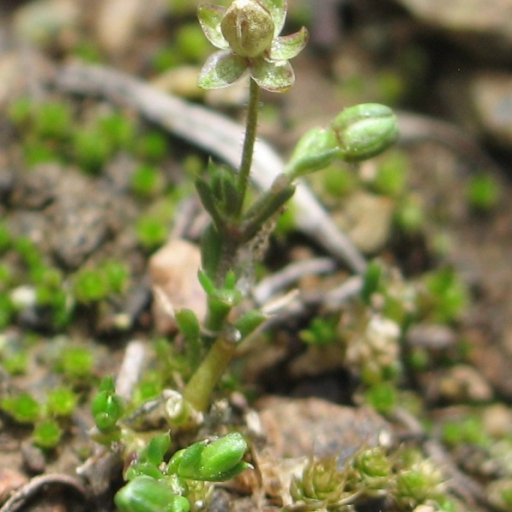
Plant Overview
Often called the Annual Pearlwort, Sagina apetala is the ultimate urban minimalist. It thrives where most plants fail—tucked into the narrow cracks of a sidewalk, surviving in the grit of a gravel path, or clinging to the mortar of an old stone wall. While it looks like a soft cushion of moss at a distance, it is actually a hardy flowering plant that lives a fast-paced life, completing its entire cycle from seed to bloom in a single season.
🔍 How to Identify
- 🌸 The "Apetala" Secret: Its name is a bit of a giveaway—apetala means "without petals." The flowers are tiny, greenish, and usually lack petals entirely, consisting instead of four small sepals that look like a miniature green cup.
- 📏 Low-Profile Growth: It forms small, upright tufts or sprawling mats that rarely grow taller than 2 to 4 inches, making it perfectly adapted to wind and foot traffic.
- 🍃 Needle-like Leaves: The leaves are incredibly thin and linear, often ending in a tiny, sharp-looking (but soft) bristle. They grow in opposite pairs along the stem.
🏡 In Your Garden
- 🧱 The Pavement Specialist: This plant doesn’t need rich potting soil; it loves the alkaline environment and grit found in sidewalk cracks and brickwork. If you find it in your garden, it’s likely telling you that your soil is compacted or that there’s a high mineral content nearby.
- 🌬️ Efficient Colonizer: Because it is an annual, it focuses all its energy on producing seeds. A single plant can scatter hundreds of tiny seeds that hitch a ride on the soles of your shoes or the paws of your pets to find a new home in the next paving gap.
⚠️ Safety & Toxicity
- ✅ Non-Toxic: Sagina apetala is generally considered safe and non-poisonous to humans and domestic animals.
- 🐾 Pet Friendly: It poses no threat to curious dogs or cats who might sniff or brush past it during a walk. However, as with any wild plant, it's best to ensure it hasn't been sprayed with chemical herbicides if it's growing in a public walkway.
✨ Fun Fact
The genus name Sagina is derived from the Latin word for "fattening." Centuries ago, certain plants in this family were believed to be excellent forage for fattening up sheep and other livestock, though this tiny pearlwort is likely too small to provide much of a snack!

Detailed Care Instructions
To grow Sagina apetala, also known as Irish moss or Scotch moss, follow these steps:
- Choose the right location: Sagina apetala prefers full sun to partial shade. It can tolerate some shade but may not thrive in dense shade. Select a spot with well-draining soil.
- Prepare the soil: The soil should be slightly acidic to neutral (pH 6.0-7.5). Amend the soil with organic matter such as compost or well-rotted manure to improve its fertility and drainage.
- Sow seeds or plant seedlings: Sagina apetala can be grown from seeds or purchased as seedlings from a nursery. If using seeds, sow them directly on the prepared soil surface in early spring or late summer. Lightly press the seeds into the soil, but avoid burying them too deep as they require light to germinate. If using seedlings, plant them at the same depth as their nursery containers, leaving space between each plant to allow for spreading.
- Watering: Keep the soil consistently moist during the germination period until the plants are established. After that, water them regularly, especially during hot and dry periods. Avoid overwatering, as Sagina apetala can be sensitive to excessive moisture.
- Mulch: Apply a thin layer of organic mulch around the plants to retain moisture and suppress weed growth. Avoid mulching directly over the plants, as it can suffocate them.
- Fertilization: Sagina apetala generally does not require heavy fertilization. However, you can apply a balanced, slow-release fertilizer in early spring or use liquid fertilizers according to the manufacturer's instructions if the plants appear weak or pale.
- Pruning: Trim the plants regularly to maintain their compact shape and promote denser growth. You can lightly shear or mow them after flowering to keep them tidy and prevent them from becoming too woody.
- Pests and diseases: Sagina apetala is generally resistant to pests and diseases. However, regular inspections are recommended to address any issues promptly.
By following these steps, you can successfully grow Sagina apetala in your garden or container, creating a lush, green ground cover with delicate white flowers.

Place in a bright room that is sun drenched almost all day. Or directly in a south-facing window.

Sagina apetala plant requires regular watering to thrive. It needs to be watered frequently, but make sure not to overwater it as it can lead to root rot. You can check the soil moisture by inserting your finger into the soil. If it feels dry to the touch, then it's time to water the plant.
When watering, make sure to water the soil directly, avoiding the leaves as much as possible as it can lead to several issues such as fungus growth. Use a watering can or a hose with a gentle showerhead to water the plant, allowing the water to seep into the soil slowly.
During hot and dry weather, the plant may require more frequent watering, and during the winter season, you can reduce the watering to once a week. Overall, ensure that the plant is receiving adequate moisture, but avoid allowing the soil to become waterlogged.
For best results, apply a balanced fertilizer that is high in nitrogen and potassium. When using fertilizer, it is important to follow the directions on the packaging and avoid over-fertilizing, as this can harm the plant. Apply the fertilizer in early spring and again in mid-summer, spacing out applications by six to eight weeks. Water the plant thoroughly before and after fertilizing to help the nutrients reach the roots. Remember to always wear gloves and eye protection when handling fertilizers.
Sagina Apetala plant prefers to grow in a well-draining soil, which can retain some moisture but not become waterlogged. The soil should be slightly acidic to neutral and rich in organic matter. A mixture of loam and peat moss makes an ideal soil for this plant. It is important to ensure that the soil is not too compact and is fluffy enough to allow roots to penetrate easily. A top dressing of garden compost or leaf mold can be added to the soil to improve its fertility. In addition, it is recommended to add a slow-release fertilizer to the soil during planting to help provide essential nutrients to the plant over an extended period of time. Finally, it is important to ensure that the soil is well-aerated, and a layer of mulch can be added to the soil surface to improve moisture retention and prevent weed growth.
Sagina apetala plant can be propagated through various methods such as division, cuttings, or seed propagation.
Division: This method involves dividing a mature plant into smaller sections and planting them separately. To propagate Sagina apetala through division, carefully dig up the plant and separate the clumps into smaller sections. Each section should have a few healthy stems and roots. Plant the sections in well-drained soil and water them regularly.
Cuttings: Another method of propagating Sagina apetala involves taking cuttings from healthy plants. Take cuttings from the mother plant, each cutting should be around 4-6 inches long and have a few leaves at the top. Dip the cut ends into rooting hormone and plant them in well-draining soil. Keep the soil moist and place the cuttings in a warm and bright location.
Seed propagation: Sagina apetala can also be propagated by collecting its seeds. Wait for the plant to produce seed heads, let the seeds dry out, and collect them. Sow the seeds in well-draining soil, lightly covering them with soil. Keep the soil moist and place the seeds in a warm and bright location. The seeds will germinate in a few weeks, and once the plants grow strong enough, they can be transplanted to their permanent location.
No matter which propagation method you choose, make sure the plant is well-watered and receives adequate sunlight to help it thrive.








