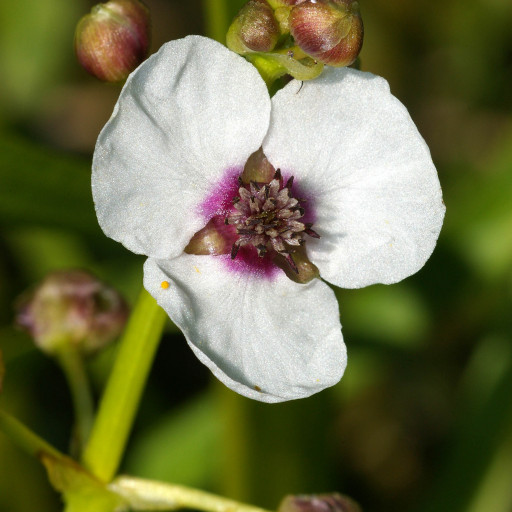
Plant Overview
Commonly known as "Arrowhead" or "Old World Arrowhead," this aquatic beauty is a master of transformation. Its scientific name, Sagittaria, comes from the Latin word for arrow, perfectly describing its striking foliage that looks like it belongs in a quiver. Found across Europe and Asia, it isn’t just a pond ornament—it has been a vital food source for centuries, earning the nickname "Swamp Potato" in many cultures.
🔍 How to Identify
- 🏹 The Foliage: Above the water, the leaves are sharply arrow-shaped with two long, pointed "barbs" at the base. Interestingly, the leaves that grow entirely underwater look completely different—they are long, translucent ribbons.
- 🌸 The Bloom: Delicate white flowers grow in whorls along a tall, central stalk. Each flower has three rounded petals and a distinct dark purple or brownish-red center.
- 🥔 The Roots: Hidden in the mud are long runners that terminate in small, starchy tubers. These tubers are often cream-colored with a purple tint.
🏡 In Your Garden
- 💧 Water Depth: This is a "marginal" plant, meaning it loves the shallow edges of a pond. It performs best when its roots are submerged in about 6 to 12 inches of water, allowing its arrow-like leaves to stand tall above the surface.
- 🏺 Containment is Key: Because it spreads via underground runners, it can quickly take over a small garden pond. To prevent it from crowding out other species, plant it in a submerged mesh basket or a heavy pot to keep its growth contained.
- ☀️ Sun Seeker: To get those iconic purple-centered flowers, ensure it is placed in a spot that receives full sun. In deep shade, the leaves may become thin and the plant will refuse to bloom.
⚠️ Safety & Toxicity
- 🟢 Status: Generally non-toxic and safe for gardens.
- 🍽️ Edibility Note: While the tubers are a delicacy in many Asian cuisines, they should never be eaten raw. Raw tubers contain acrid sap that can be irritating; they must be boiled, roasted, or fried before consumption.
- 🐾 Pet Safety: It is generally considered safe for dogs and cats, though the crunchy leaves might cause mild stomach upset if chewed in large quantities.
✨ Fun Fact
The plant is a "polymorphic" wonder; it can change its leaf shape entirely based on the environment. If the water level rises and submerges the plant, it will stop producing arrow-shaped leaves and grow long, grass-like ribbons to better survive the deeper currents!

Detailed Care Instructions
To grow Sagittaria sagittifolia, also known as arrowhead plant, you can follow these steps:
- Choose a suitable location: Select a spot that receives partial sun to full shade. The soil should be moist and rich in organic matter.
- Prepare the soil: Dig up the planting area and remove any weeds, rocks, or debris. Incorporate compost or well-rotted manure into the soil to improve fertility and drainage.
- Planting: Dig a hole that is slightly larger than the plant's root ball. Place the arrowhead plant in the hole and backfill with soil, ensuring that the top of the root ball is level with the soil surface. Gently firm the soil around the plant.
- Watering: After planting, thoroughly water the plant to settle the soil and ensure good root establishment. Keep the soil consistently moist throughout the growing season. However, avoid overwatering, as it can lead to root rot.
- Mulching: Apply a layer of organic mulch, such as bark chips or straw, around the plant to retain moisture, suppress weeds, and regulate soil temperature.
- Fertilizing: Apply a balanced, slow-release fertilizer in the spring to provide the plant with essential nutrients. Follow the instructions on the fertilizer packaging for the correct dosage.
- Maintenance: Regularly remove any dead or yellowing leaves to promote healthy growth. If the plant becomes overcrowded, divide it in the spring by carefully lifting and separating the clumps, then replanting them.
- Pests and diseases: Keep an eye out for common pests like aphids, slugs, and snails. Treat infestations promptly, using organic methods or suitable insecticides. Sagittaria sagittifolia is generally resistant to diseases if provided with proper care.
By following these guidelines, you can help your Sagittaria sagittifolia plant thrive and grow into a beautiful addition to your garden or water feature.

Place in a bright room that is sun drenched almost all day. Or directly in a south-facing window.

The best way to water this plant is by keeping the soil consistently moist, while also making sure there is good drainage. Avoid overwatering as this can lead to root rot. Check the soil regularly, and water when the top layer feels dry to the touch. Use room temperature or slightly warm water to avoid shocking the plant. Direct the water around the base of the plant, avoiding the leaves if possible. Watering from below by placing the pot in a tray filled with water for a few minutes can also be an effective way to hydrate this plant.
To fertilize this plant, use a balanced fertilizer with a ratio of 10-10-10. Apply the fertilizer every two weeks during the growing season, starting in early spring and stopping in late summer. Be sure to follow the manufacturer's instructions for proper application and dosage. When applying the fertilizer, water the plant thoroughly before and after to help distribute the nutrients evenly and prevent root burn. Avoid over-fertilizing, as it can lead to excessive growth and weaken the plant's overall health.
For optimum growth and health, Sagittaria Sagittifolia requires a specific type of soil. The plant prefers a substrate that is sand-based and rich in nutrients. The pH level of the soil should be neutral, with a range of 6.5 to 7.5. The soil should also be well-draining to prevent waterlogging and root rot. The plant thrives in a moist environment, so it is recommended to keep the soil evenly moist but not waterlogged. Adequate drainage is crucial to keep the plant healthy and to prevent any standing water around the roots. It is recommended to fertilize the plant every two weeks during the active growing season with a balanced fertilizer. Regular pruning and trimming of Sagittaria Sagittifolia are essential as it tends to overgrow if left unattended.
To propagate a certain plant, it is important to carefully observe its growth and physical characteristics. In general, the propagation of this plant can be done through division or seed propagation.
Division involves separating the plant into smaller sections, each containing some roots and foliage. To do this, first dig up the plant carefully to avoid damaging the roots. Then, gently separate the sections by hand or using a clean knife or shears. Each section should have healthy roots and a few leaves. Plant the sections in pots or directly into soil.
Seed propagation involves collecting mature seeds from the plant. The seeds should be planted in moist soil or water. Keep the soil or water consistently moist throughout the germination process. Once the seedlings emerge, they can be transplanted into individual pots or directly into soil.
Regardless of the propagation method used, it is important to keep the new plants well-watered and protected from extreme weather conditions until they become established.








